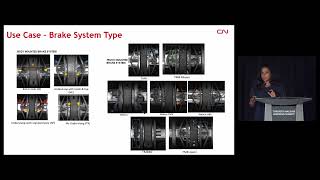
Automated Inspection for Rail Cars Using Computer Vision and Machine Learning
Leverage computer vision and machine learning for automated rail car inspection. Explore challenges in developing robust models, including data selection, image quality, and imbalanced datasets.
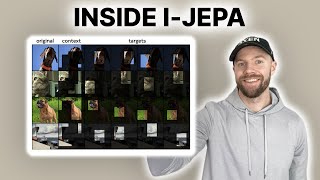
Understanding I-JEPA: A Non-Generative Approach to Self-Supervised Learning from Images
Dive into Meta AI's I-JEPA framework for self-supervised image learning, exploring its architecture, methodology, and advantages over traditional approaches in computer vision and neural networks.
Deep Learning for Self-Driving Cars
Explore deep learning's role in autonomous driving software, addressing challenges and research in reducing traffic fatalities through AI-driven solutions.
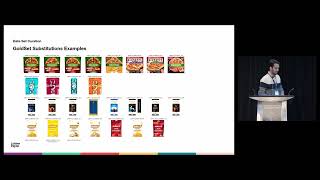
Solving Product Substitutions in Grocery E-Commerce Through Self-Supervised Machine Learning
Explore innovative self-supervised ML techniques for solving product substitution challenges in grocery e-commerce, improving customer experience and business metrics.
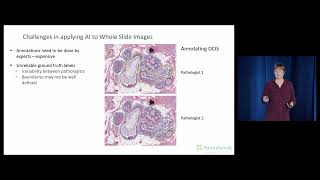
Artificial Intelligence and Digital Pathology: Making the Most of Limited Annotated Data
Explore semi-supervised and self-supervised approaches for efficient use of limited medical imaging datasets in AI, focusing on digital pathology applications.
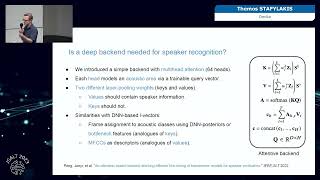
Extracting Speaker and Emotion Information from Self-Supervised Speech Models
Explore techniques for extracting speaker and emotion data from self-supervised speech models, enhancing speech recognition and analysis capabilities.
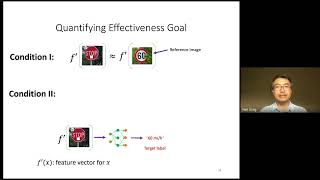
Secure Self-supervised Learning: Challenges and Solutions
Explore secure self-supervised learning techniques, focusing on backdoor attacks, data auditing, and membership inference for pre-trained encoders in machine learning.
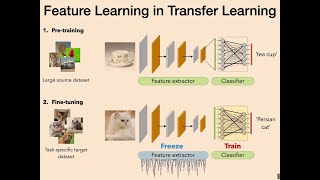
Foundations for Feature Learning via Gradient Descent
Explore the theoretical foundations of feature learning in modern machine learning models, focusing on gradient descent's role in extracting useful features and representations from data.
Introduction to Language Models - LLMs, Prompt Engineering, and Architectures
Explore language models, covering generative AI, LLMs, encoders, prompt engineering, and transformer architecture. Gain insights into embeddings, attention mechanisms, and model limitations.
Neural Network Introspection - Approaches from Machine Learning and Knowledge Representation
Explore AI introspection approaches from ML and KR perspectives, covering ICNs, generative vs. discriminative models, and concept induction for enhanced machine learning understanding.
Empirical Challenges to Theories of Deep Learning
Explore empirical challenges in deep learning theory, examining network representations, non-monotonic training patterns, and complex learning processes through cutting-edge research findings and real-world examples.
Understanding Generalization from Pre-training Loss to Downstream Tasks
Explore the mystery of pre-trained models' effectiveness, examining contrastive loss, embedding spaces, and the roles of inductive bias and optimizers in generalization to downstream tasks.
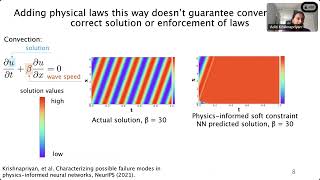
Bridging Numerical Methods and Deep Learning with Physics-Constrained Differentiable Solvers
Explore machine learning strategies for neural PDE solvers, focusing on self-supervised learning and simulation-in-the-loop approaches to enhance spatiotemporal modeling across various systems.
Personalized Speech Enhancement: Data- and Resource-Efficient Machine Learning
Explore data-efficient machine learning techniques for personalized speech enhancement, focusing on modularized models and self-supervised learning to achieve user-specific improvements with minimal data.

Annotation-Efficient Object Detection: Unsupervised Discovery to Active Learning
Explore annotation-efficient object detection techniques, from unsupervised discovery to active learning strategies, enhancing intelligent systems with less manual input.

From CroCo to MASt3R - A Paradigm Change in 3D Computer Vision
Explore groundbreaking advancements in 3D vision through CroCo, DUSt3R, and MASt3R frameworks, revolutionizing multi-view stereo reconstruction and geometric deep learning for enhanced robotic navigation and cultural preservation.
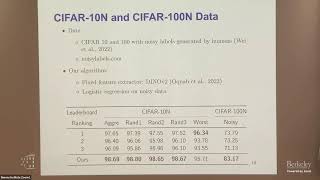
Label Noise and Machine Learning: Why Ignorance is Bliss
Explore theoretical frameworks for handling multi-class label noise in machine learning, focusing on relative signal strength and empirical risk minimization principles.