Unlocking Hearts by Locking Models: Solving Echocardiogram Problems Using a Self-Supervised Approach
Explore self-supervised learning for echocardiogram analysis, overcoming labeling challenges. Discover how ALAN concept enables feature extraction for segmentation and classification tasks across multiple datasets.

Learning Visual Representations with Limited Labels for Semantic Image Understanding
Explore visual representation learning techniques using limited labels, including self-supervised methods, image grouping, model distillation, and adversarial robustness in deep learning.
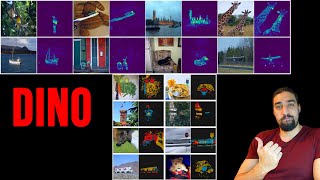
Emerging Properties in Self-Supervised Vision Transformers - Paper Explained
Explore DINO: self-supervised vision transformers with emerging properties like segmentation mask prediction and high-quality features for k-NN classification. In-depth analysis of methodology, results, and visualizations.

A Path Towards Autonomous Machine Intelligence - Paper Explained
Explanation of Yann LeCun's paper on autonomous machine intelligence, combining self-supervised learning, energy-based models, and hierarchical predictive embedding for creating world models and planning.
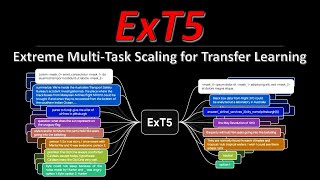
Towards Extreme Multi-Task Scaling for Transfer Learning
Explores ExT5, an advanced NLP model pre-trained on 107 diverse tasks. Analyzes multi-task scaling benefits, task co-training effects, and demonstrates ExT5's superior performance across various NLP benchmarks.

Emerging Properties in Self-Supervised Vision Transformers - Facebook AI Research Explained
Explore Facebook AI's DINO system, combining self-supervised learning with Vision Transformers for impressive image analysis without labels. Learn about its architecture, methodology, and groundbreaking results in computer vision.
Self-Supervised Learning - The Dark Matter of Intelligence
Explore self-supervised learning as a promising approach for AI to develop background knowledge and common sense, with insights from Yann LeCun and Ishan Misra of Facebook AI Research.
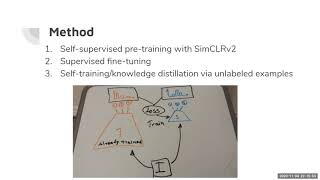
Big Self-Supervised Models are Strong Semi-Supervised Learners
Explore cutting-edge semi-supervised learning techniques using large self-supervised models, examining their potential and impact on machine learning research and applications.
Understanding Deep Neural Networks - CVPR 2020 iMLCV Tutorial
Explore deep neural network interpretability through meaningful perturbations, extremal perturbations, and activation analysis. Learn techniques for understanding and improving model behavior in computer vision tasks.
Self-Supervised Euphemism Detection and Identification for Content Moderation
Explore a novel self-supervised algorithm for detecting and identifying euphemisms in online content, enhancing content moderation capabilities.

A Critical Analysis of Self-Supervision, or What We Can Learn From a Single Image
Explores self-supervision in deep learning, revealing that a single image with data augmentation can effectively train lower network layers, challenging assumptions about large dataset requirements.
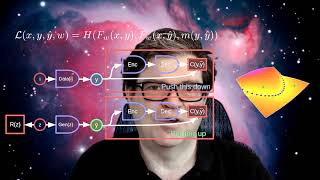
Self-Supervised Learning and Variational Inference
Explore self-supervised learning, variational inference, and advanced deep learning concepts with Yann LeCun. Gain insights into GANs, sparse modeling, and Variational Autoencoders (VAEs) in this comprehensive lecture.

Low Resource Machine Translation
Explore machine translation techniques for low-resource languages, covering evaluation methods, supervised and unsupervised learning approaches, and domain adaptation. Gain insights into Nepali-English translation case study.

Self-Supervised Learning in Computer Vision
Explore advanced self-supervised learning techniques in computer vision, including PIRL, SwAV, AVID+CMA, and Barlow Twins, to enhance your understanding of representation learning and model training.
Supervised and Self-Supervised Transfer Learning With PyTorch Lightning
Explore supervised and self-supervised transfer learning techniques using PyTorch Lightning, comparing their implementation, training, and generalization capabilities in deep learning applications.
Self-Supervised Learning in Computer Vision
Explore self-supervised learning in computer vision, covering pretext tasks, clustering, and contrastive learning. Gain insights into PIRL framework and its evaluation across various applications.

Contrastive Methods and Regularised Latent Variable Models
Explore contrastive methods and regularized latent variable models in energy-based models, covering self-supervised learning, autoencoders, sparse coding, and variational techniques for advanced machine learning applications.
Energy Based Models and Self-Supervised Learning
Explore energy-based models, latent variables, and self-supervised learning. Dive into EBM training, inference, and comparison with probabilistic models. Discover contrastive methods and applications like K-means and BERT.
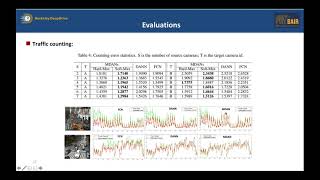
Learning with Limited Labels - ODSC West 2020
Explore advanced techniques for machine learning with limited labeled data, including domain adaptation, few-shot learning, and self-supervised learning to enhance model performance across diverse domains and novel categories.
MAST - A Memory-Augmented Self-Supervised Tracker
Learn about MAST, a novel memory-augmented self-supervised tracker that enhances video tracking and segmentation using attention mechanisms and innovative algorithms.
ALBERT - A Lite BERT for Self-Supervised Learning of Language Representations
Explore ALBERT, a streamlined BERT variant for efficient language representation learning, covering key innovations and performance benchmarks.