
Governing the Digital Transformation - Physics Matters Colloquium
Exploring the impact of digital transformation on society and the need to redefine our conceptual framework to govern it effectively.
Visualization with Python Tutorial
Learn Python visualization techniques for geophysical fluid dynamics, covering data representation and analysis tools essential for atmospheric and oceanic research.
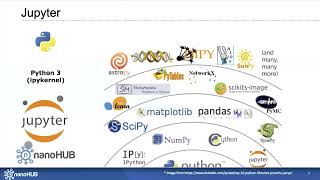
A Guided Tour of Interactive Jupyter Notebooks Powered by nanoHUB
Explore interactive Jupyter Notebooks on nanoHUB. Learn fundamentals, develop code, analyze data, create visualizations, and build GUIs using Jupyter widgets and nanohub-uidl library.
On Mathematical Modeling in Image Reconstruction and Beyond
Explores connections between wavelet frame-based and PDE-based approaches in image reconstruction, linking to deep learning and computational imaging advancements.
Pendulum Simulation: In Search of Chaos - Part 6
Explore chaos in double pendulum systems through simulation, analyzing different initial conditions and observing complex behavior patterns.
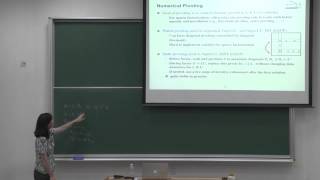
Factorization-based Sparse Solvers and Preconditioners - Lecture 3
Explore factorization-based sparse solvers and preconditioners, covering topics like minimum degree ordering, numerical pivoting, and sparse Gaussian elimination techniques.
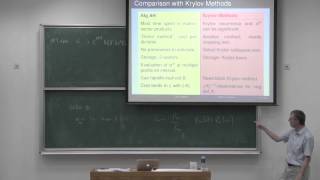
Functions of Matrices - Lecture 5
Explore matrix functions with Nick Higham, covering algorithms, analysis, nonnormality bounds, and practical coding experiments for advanced mathematical understanding.
The Role of Mathematics in Solving the World's Main Challenges
Explore how mathematics and computation contribute to understanding climate, energy, the cosmos, and life itself through TED-style talks by renowned computational scientists.

Solving the Hardest Problems in Mathematics - Interview with Daniel Spielman
Mathematician Tom Crawford interviews Daniel Spielman about his career, the Nevanlinna Prize, and contributions to mathematical aspects of information sciences, offering insights into solving complex problems.
Poseidon: Efficient Foundation Models for PDEs - Tutorial 1
Explore efficient foundation models for PDEs with Poseidon, focusing on innovative techniques and applications in computational science.
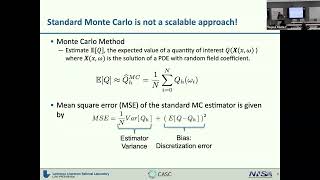
Uncertainty Quantification, Software Ecosystems, and Infrastructure Resilience - Technical Talk
Explore uncertainty quantification, exascale software ecosystems, and infrastructure resilience in this technical talk by Sarah Osborn at WiDS Livermore 2024.

Investigating Crimes Using Julia
Explore forensic science using Julia, applying math and science concepts to solve crime puzzles. Learn to utilize Julia packages for data analysis, visualization, and complex problem-solving in criminal investigations.
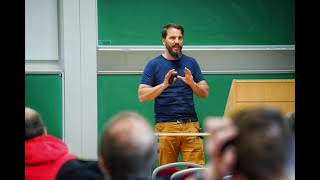
From Quantum Entanglement to Future Data-Driven Engineering - Rothschild Lecture
Explore high-dimensional Bayesian statistics in engineering, focusing on efficient data-physical model integration and uncertainty quantification. Learn about multilevel MCMC and measure-transport approaches.
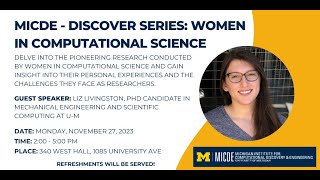
Data to Differential Equations: Discovering Mathematical Models for Biological Systems
Explore data-driven techniques for discovering governing equations in complex biological systems, focusing on PDEs and innovative mathematical methods for modeling phenomena like arterial flow and tissue fracture.
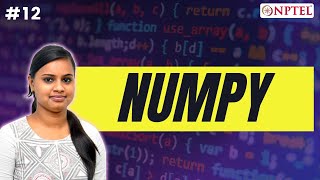
NumPy: Introduction, Installation, Attributes, and Arithmetic Operations
Master NumPy fundamentals: installation, attributes, and arithmetic operations for efficient numerical computing in Python.
Differential Equation with Boundary Conditions Using Finite Difference in Python
Solve differential equations with boundary conditions using Python's NumPy and finite difference method. Master numerical techniques for complex mathematical problems.
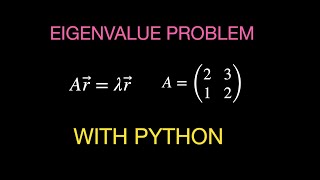
Solving the 2x2 Eigenvalue Problem - Also with Python
Explore eigenvalues and eigenvectors for a 2x2 matrix, with practical Python implementation for solving complex linear algebra problems.

ME3255 - Euler Integration and Solving Numerical Problems
Explore Euler integration and numerical problem-solving techniques for engineering applications. Enhance computational skills and mathematical understanding.

Linear Algebra in NumPy and SciPy - ME3255
Learn essential linear algebra operations using NumPy and SciPy libraries in Python for efficient numerical computations and data analysis.

Convergence of Integration Methods and Root Finding with SymPy - ME3255
Explore integration methods and root finding using Sympy, focusing on convergence analysis for enhanced numerical problem-solving skills.
PDEs and Stencils - SPARSE 2024
Explore PDEs and stencils in computational science, focusing on efficient numerical methods for solving partial differential equations.