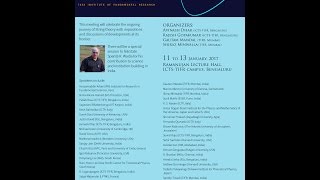
Physics at Different Length Scales by R Shankar
Explore physics across scales, from string theory to quantum matter, black holes, and climate, with insights on theoretical developments and real-world applications.
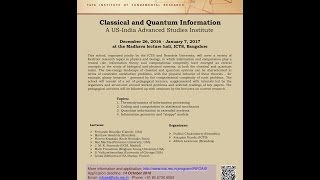
Entanglement Entropy, Quantum Field Theory, and Holography by Matthew Headrick
Explore entanglement entropy in quantum systems, focusing on its applications in field theory and holography. Learn about classical and quantum correlations, mutual information, and entropy in spin systems.
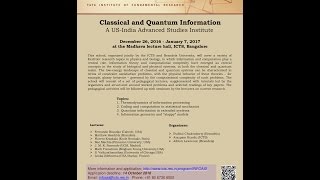
Why Do Simple Models Work? Partial Answers from Information Geometry - Lecture 1
Explores information geometry to understand why simple models effectively describe complex systems, focusing on statistical mechanics, renormalization, and model reduction in physics and biology.
The Universe: Big and Small by Ashoke Sen
Explore the universe from elementary particles to cosmic inflation, delving into standard model physics, cosmology, and string theory with renowned physicist Ashoke Sen.
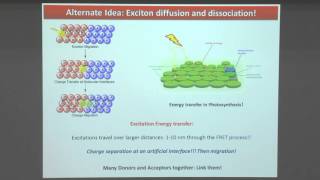
Charge Transfer Rates in Soluble P3HT-PCBM Nano-Aggregates
Explore charge transfer rates in P3HT:PCBM nanoaggregates and their impact on solar cell morphology. Gain insights into molecular materials for efficient charge generation and novel spectroscopic techniques.
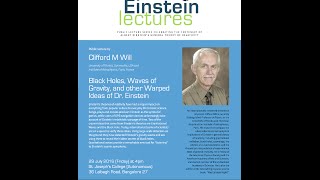
Black Holes, Waves of Gravity, and Other Warped Ideas of Dr. Einstein
Explore Einstein's revolutionary theories, including black holes and gravitational waves, and their impact on science and culture. Learn about recent breakthroughs in detecting cosmic phenomena using advanced technology.
Andreev Reflection Near the Dirac Point at Graphene – NbSe2 Junction by Anindya Das
Explores Andreev reflection in graphene-NbSe2 junctions, discussing experimental challenges, data analysis, and implications for quantum Hall effect and superconductivity in these novel heterostructures.
Introduction to Hydrodynamic Stability - Part 1
Explore hydrodynamic stability concepts, from sand ripples to fluid instabilities. Learn about linear stability analysis, stratification effects, and various instability types in this comprehensive lecture.
Introduction to Gene Genealogies and Coalescent Processes by John Wakeley
Explore gene genealogies and coalescent processes in population genetics, covering inference of human population history from genome sequences and SNP-difference data analysis.
Understanding Tandem Running Recruitment in Indian Ants
Explores tandem running in Indian ants during colony relocation, examining recruitment strategies, decision-making flexibility, and movement dynamics to understand collective behavior in social insects.
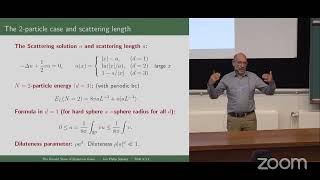
Jan Philip Solovej: The Ground State of Quantum Gases
Explore quantum gases' ground state, thermodynamic limits, and Bogolubov approximation in this mathematical physics lecture, bridging theory and experimental verification.
Fractal Uncertainty Principle and Quantum Chaos
Explore quantum chaos and fractal uncertainty principle in wave equations, with applications to eigenfunctions, Schrödinger equation, and hyperbolic surfaces. Gain insights beyond classical/quantum correspondence.
Active Forces and Flows that Pattern Organisms by Stephan Grill
Explore how active forces and flows in biological systems drive morphogenesis, from molecular interactions to organism-wide patterning, with a focus on actomyosin dynamics and symmetry breaking.
More Perfect Than We Imagined: A Physicist's View of Life - Lecture 1
Explore how biological systems operate near physical limits, from atomic-scale hearing to bacterial decision-making, revealing life's surprising simplicity and perfection through a physicist's perspective.
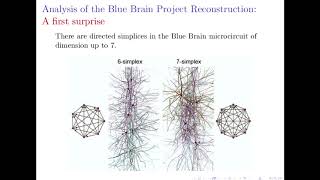
Ran Levi - Bedlewo: Topological Analysis of Neural Networks
Explore topological analysis of neural networks using algebraic topology techniques on biologically accurate digital reconstructions, revealing structural and functional insights into brain connectivity.
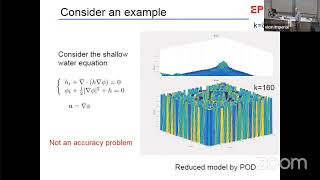
Structure-Preserving Model Order Reduction of Hamiltonian Systems
Explore structure-preserving model order reduction for Hamiltonian systems, focusing on symplectic geometry and reduced basis algorithms. Learn about extensions to nonlinear problems and applications in plasma physics.
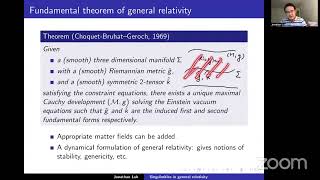
Jonathan Luk- Singularities in General Relativity
Explore singularities in general relativity, from fundamental concepts to advanced topics like Schwarzschild and Kerr spacetimes, cosmic censorship, and gravitational collapse.
Elchanan Mossel: Combinatorial Statistics and the Sciences
Explore combinatorial statistics, broadcasting on trees, and their applications in biology and network analysis, with insights into phylogenetic inference and community detection.
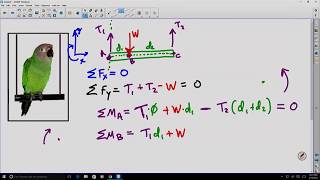
Static Equilibrium - Moments in 2D Force Analysis
Learn to analyze non-concurrent forces in 2D static equilibrium using moment equations. Dr. Love explains the concept and provides a practical example for engineering applications.

Lac Operon Gene Regulation Activity - Visualizing Cis and Trans Elements
Visualize gene regulation of the lac operon through an interactive activity, exploring cis- and trans-acting elements in single copy and partial diploid scenarios.
Sylvie Méléard- Multiscale Eco-Evolutionary Models- From Individuals to Populations
Exploring eco-evolutionary models from individual to population scales, focusing on small population effects, mutation dynamics, and long-term behaviors using stochastic processes and mathematical approximations.