Arctic Curves for Ice Models
Explore arctic curves in statistical mechanics, focusing on the six-vertex model with ice point and domain-wall boundary data. Learn about the geometric tangent method for locating arctic boundaries.
Computational Contributions to Understanding Impaired Motivation and Effort in Psychosis
Exploring computational approaches to understand impaired motivation and effort in psychosis, focusing on reinforcement learning and decision-making to aid treatment development.
Topology and the Electromagnetic Responses of Quantum Materials
Explore electromagnetic responses in quantum materials, focusing on topological insulators, Weyl semimetals, and quantized effects. Gain insights into Berry phases, anomalous Hall effect, and circular photogalvanic effect.
Majorana Particle in Condensed Matter Systems by Sankar Das Sarma
Explore Majorana 'particles' in condensed matter systems, covering qubit states, statistics, superconductors, quantum wires, and recent developments in this cutting-edge field of theoretical physics.
Population Genetics and Evolution - I- The Mechanisms of Evolution
Explore population genetics and evolution mechanisms through key concepts like exponential growth, Galton-Watson processes, selection, and fitness measurement in long-term experiments with E. coli and RNA viruses.
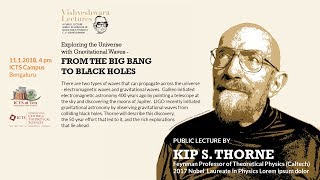
Exploring the Universe with Gravitational Waves - From the Big Bang to Black Holes
Nobel laureate Kip Thorne explores gravitational waves, from their detection by LIGO to their potential for unveiling cosmic mysteries like black holes and the birth of the universe.

Dynamics of 2+1-dimensional Quantum Field Theory - Lecture 2
Explore advanced concepts in 2+1D quantum field theory, focusing on symmetries, topology, and duality. Gain insights into recent developments and their applications across physics disciplines.
The Life History of a Raindrop by Rama Govindarajan
Explore the fascinating journey of raindrops, from formation to interaction with turbulence in clouds. Discover fluid dynamics, monsoon patterns, and the intricate processes behind precipitation.
Entanglement in Theories of Gravity by Suvrat Raju
Exploración de la entropía de entrelazamiento en teorías de gravedad, examinando su definición, paradojas y nuevas perspectivas en el contexto de la teoría cuántica de campos y la gravedad.
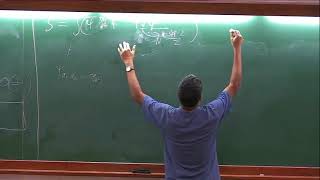
Notes on Melonic SO-N Tensor Models by Shiraz Minwalla
Exploration of Melonic SO(N)^q Tensor models, focusing on SYK theory dynamics, UV Lagrangian, and phase transitions. Discusses large N limit, spectrum analysis, and effective potential minimization in string theory context.
Large Deviations of Markov Processes - Part 1
Explore large deviation theory in statistical physics, covering Markov processes, dynamical observables, and advanced mathematical concepts. Gain insights into recent developments and applications in nonequilibrium systems.
Topology in Biology by Julia Yeomans
Explore active matter systems, focusing on topology in biology, active turbulence, and cell division. Learn about liquid crystal hydrodynamics, topological defects, and confinement effects in active systems.
Quantum Many-Body Physics with Multimode Cavity QED by Jonathan Keeling
Explore quantum many-body physics in multimode cavity QED, covering topics like the Dicke model, superradiance, dipole approximation, and phase transitions in open quantum systems.
Gravitational Waves from Neutron Stars - Lecture 1
Explore gravitational waves from neutron stars, covering detection methods, signal analysis, radiation mechanisms, and fluid dynamics in astrophysical contexts.
Black Holes - Lecture 4
Explore black hole physics, from stability of stars to Einstein's field equations, Schwarzschild geometry, orbits, gravitational capture, and particle motion near event horizons.
Tides in Binary Star Systems - Lecture 1
Explore gravitational waves, tides in binary star systems, and multipole moments in this advanced lecture on theoretical astrophysics and gravitational-wave astronomy.
Pulsars: Properties, Radiation, and Discovery - Lecture 8
Explore pulsars, neutron stars, and their remarkable properties in this comprehensive lecture. Learn about their discovery, radiation mechanisms, and role in astrophysics.
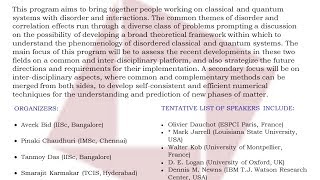
Spontaneous Disorder Near the Mott Transition on Frustrated Lattices
Explore spontaneous disorder in frustrated lattices near Mott transitions. Examine pyrochlore models, effective theories, and experimental realizations in molybdates. Analyze phase diagrams, magnetization, and transport properties.

The Visions of Shamans and Saints - Dynamic Instabilities in Neuroscience by Bard Ermentrout
Explore neural patterns, from motor activity to brain imaging, and their connections to paleolithic art and hallucinations. Discover mechanisms behind spatial and temporal patterns in neuroscience.
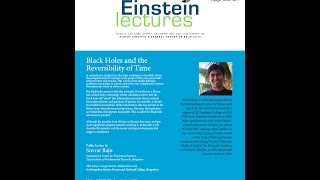
Black Holes and the Reversibility of Time by Suvrat Raju
Explore the black hole information paradox and recent developments in resolving it, examining the conflict between time reversibility in physics and the apparent loss of information in black holes.

Banquet Speeches and Reminiscences at SpentaFest
Celebratory speeches and reminiscences honoring Spenta's contributions to theoretical physics, highlighting his impact on Asian Winter Schools, regional meetings, and mentorship of young researchers.