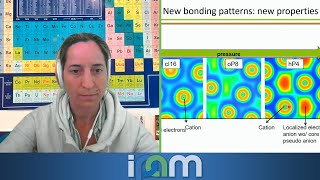
Math-Chimie: Developing Approaches for Predicting New Superconductors
Explore innovative approaches for predicting superconductors, combining mathematics and chemistry to analyze electron density, localization, and high-pressure materials for groundbreaking discoveries in quantum mechanics.
Convergence of the Planewave Approximations for Quantum Incommensurate Systems
Explore quantum incommensurate systems through rigorous analysis of Schrödinger operators' spectrum distribution, focusing on density of states characterization and planewave approximation methods with novel energy cutoffs.
Generating Reference Data and Controlling Accuracy in DFT and Hybrid DFT Simulations
Explore advanced techniques in DFT simulations, including all-electron approaches, pseudopotential validation, and hybrid DFT acceleration methods for improved accuracy and efficiency in quantum mechanics calculations.

Fast Algorithms for FCI Excited States - IPAM at UCLA
Fast algorithms for electronic structure excited-state calculations in configuration interaction framework, focusing on global convergence, linear convergence rates, and acceleration techniques for improved efficiency.
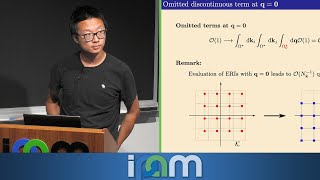
Finite-Size Error and Its Correction in Energy Calculations for Periodic Systems
Explore finite-size errors in periodic systems, focusing on Hartree-Fock and MP2 theories. Learn about convergence rates, Madelung-constant correction, and the staggered mesh method for improved calculations.
Large Scale Hybrid DFT Functionals - Fast Algorithms and Finite-Size Effects - IPAM at UCLA
Explore accelerating DFT calculations with hybrid functionals and finite-size effects in Hartree-Fock calculations for periodic systems in this advanced mathematics lecture.
Low Rank Approximation in Electron Excitation Calculations - IPAM at UCLA
Explore low rank approximation techniques for efficient electron excitation calculations, focusing on the Interpolative Separable Density Fitting method and its applications in quantum mechanics.
Localization Methods - Perspectives on Initialization and Optimization - IPAM at UCLA
Explore Wannier localization in quantum mechanics, its mathematical formulation, challenges, and new approaches for efficient orbital localization in condensed matter systems.
Quantum Dynamics from Classical Trajectories - IPAM at UCLA
Explore semiclassical approximations in quantum mechanics, focusing on a novel approach for complex chemical systems and addressing challenges in path space sampling and prefactor evaluation.

Methods and Software for Electron-Phonon Physics - IPAM at UCLA
Explore electron-phonon physics with advanced methods and software. Learn about spectral density functions, Green's functions, and polarons in materials, with real-world examples and computational challenges.
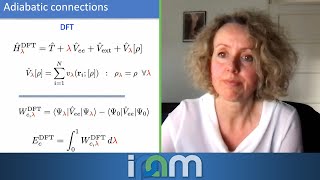
Large-Coupling Strength Expansion in DFT and Hartree-Fock Adiabatic Connections
Explore large-coupling strength expansions in DFT and Hartree-Fock adiabatic connections, examining their applications in quantum chemistry and electronic structure theory.

Systematically Improvable Models from Alchemical Perturbations - IPAM UCLA
Explore systematic improvements in quantum models using alchemical perturbations, connecting chemical spaces and simplifying material design through novel approaches and fundamental constraints.
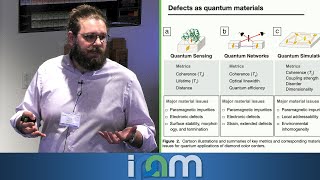
Quantum Embedding Methods for Correlated Excited States of Point Defects
Explore quantum embedding methods for correlated excited states of point defects, focusing on case studies and challenges in computational approaches for defect systems in quantum technologies.
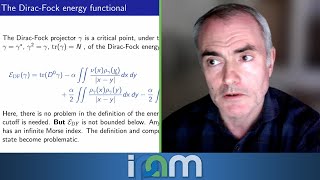
The Ground State of the Dirac-Fock Energy for Molecules and Crystals - IPAM at UCLA
Explore ground state definition for Dirac-Fock energy in molecules and crystals, including existence results and computational algorithms. Insights for theoretical and numerical investigations.
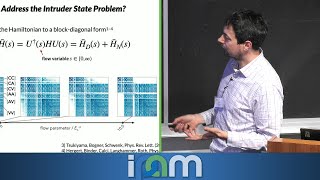
Many-Electron Effective Hamiltonians from Similarity Renormalization Group
Explore many-electron effective Hamiltonians using similarity renormalization group, focusing on bond-breaking reactions, spin states, and excited states of molecules with near-degenerate electronic structures.
Quantum Mechanical Calculations of Electron Interactions in Condensed Matter
Explore precise quantum mechanical calculations for electron interactions in condensed matter, covering theory, challenges, and recent advancements in computational methods.
Recent Results in Density Functional Theory - IPAM at UCLA
Explore recent advancements in Density Functional Theory, including the Lieb-Oxford bound and Local Density Approximation, presented by Mathieu Lewin at IPAM's workshop on Model Reduction in Quantum Mechanics.
Connectome-Based Modeling of Real World Clinical Outcomes in Addictions
Exploring connectome-based modeling to predict addiction outcomes, focusing on cocaine and opioid abstinence, network stability, and brain states. Discusses potential clinical applications and theoretical models.
Modified Traces on Quantum SL(2) and Logarithmic Invariants
Explore quantum sl(2), modified traces, and logarithmic invariants in this advanced topology lecture, covering key concepts and their applications in quantum mathematics.
Splitting Numbers and Signatures
Explore number theory and topology with a focus on splitting numbers, linking number bounds, and signature results in this advanced mathematical lecture.

From Connected and Autonomous Vehicles Control to Vehicular Traffic Control
Explore innovative traffic control strategies, from individual vehicle management to large-scale systems, addressing technological advancements and methodological challenges in road traffic management.