Ab Initio Quantum Chemistry Approaches to Nonequilibrium Interactions in Molecules
Explore ab initio quantum chemistry approaches for nonequilibrium interactions in molecules and materials, covering correlated photon-molecule interactions, molecular strong coupling, and polariton dynamics.
Mesoscale Models and Many-Body Systems - IPAM at UCLA
Explores mesoscale structures in many-body systems, explaining the autonomy of continuum equations and their connection to lower-scale physics, with implications for deep neural networks.
Plasticity Without Genetic Change - Bioelectric Embryos & Synthetic Proto-Organisms
Explore bioelectric embryos and synthetic organisms, delving into morphogenetic control, AI-driven tissue reconfiguration, and collective behaviors challenging traditional biological distinctions.
Rapid and Robust Parameter Estimation for Gravitational Wave Observations
Explore rapid parameter estimation techniques for gravitational wave observations, focusing on machine learning approaches like DINGO that use normalizing flows to efficiently analyze data from future detectors.
Low-Latency Noise Mitigation Techniques in Gravitational-Wave Detector Data Using Auxiliary Sensor Information
Explore low-latency noise mitigation techniques in gravitational-wave detectors, focusing on automated methods to enhance sensitivity and enable rapid multi-messenger follow-up of astrophysical events.
Machine Learning and Gravitational Wave Detectors
Explore machine learning applications in gravitational wave detector science, focusing on noise subtraction and advanced control systems to enhance sensitivity and robustness in astrophysical research.
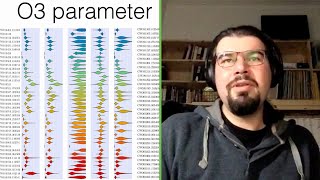
Computational Challenges in Gravitational Wave Parameter Estimation - IPAM at UCLA
Explore computational challenges in gravitational wave parameter estimation, including novel techniques and future requirements for analyzing compact binary signals in astrophysics.
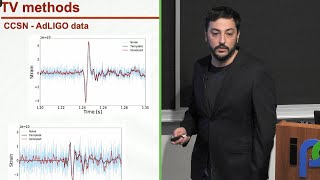
Variational Models and Algorithms for GW Denoising and Reconstruction
Explore variational models and algorithms for gravitational wave denoising and reconstruction, including applications to simulated and real detector data, signal classification, and glitch detection.
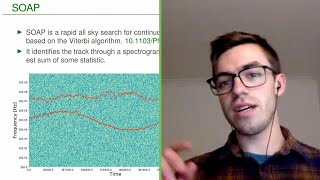
Rapidly Searching for Continuous Gravitational Waves
Explore challenges and solutions in detecting continuous gravitational waves from neutron stars, focusing on SOAP's rapid search method using neural networks for signal identification and parameter estimation.

Machine Learning in Low-Latency Electromagnetic Counterpart Inference
Explore machine learning applications in electromagnetic counterpart inference from gravitational waves, focusing on low-latency data products for efficient follow-up of gravitational wave candidates.
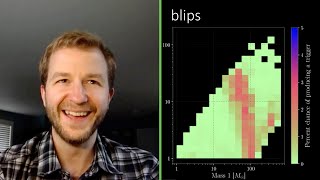
Nobody Likes a Glitch - IPAM at UCLA
Explore transient noise artifacts in gravitational wave astronomy, their impact on signal detection, and innovative approaches for understanding and mitigating these glitches in data analysis.
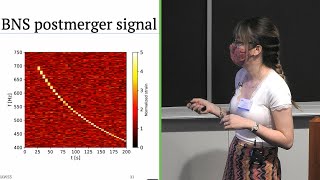
Power Spectral Density Uncertainty and Gravitational-Wave Parameter Estimation
Explore power spectral density uncertainty in gravitational-wave parameter estimation, its impact on Bayesian analysis, and methods to incorporate this uncertainty for more accurate results in compact binary coalescence detection.
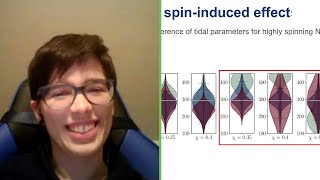
Waveform Systematics in the Gravitational-Wave Inference of Tidal Parameters
Exploración de sistemáticas en formas de onda para inferir parámetros de marea y ecuación de estado en señales de ondas gravitacionales de sistemas binarios de estrellas de neutrones.
Physically Inspired Machine Learning for Excited States - IPAM at UCLA
Explore machine learning applications in photochemistry, focusing on excited state predictions and light-matter interactions. Discover innovative techniques for overcoming data limitations and enabling accurate photodynamics simulations.
High Accuracy Wavefunctions Using Deep-Learning-Based Variational Monte Carlo
Explore deep learning-based variational Monte Carlo for high-accuracy wavefunctions in computational chemistry, featuring novel architecture and improved methods for ground state energy calculations.
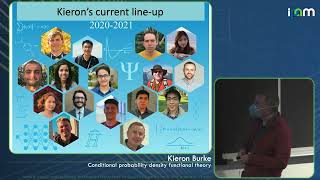
Conditional Probability Density Functional Theory - IPAM at UCLA
Explore conditional probability density functional theory for electronic structure calculations, addressing challenges in DFT and offering insights into ground-state correlations and warm dense matter simulations.
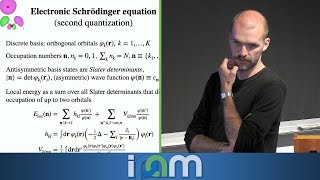
Neural-Network Wave Functions for Quantum Chemistry - IPAM at UCLA
Explore neural-network wave functions in quantum chemistry, covering variational quantum Monte Carlo, antisymmetric ansatzes, and applications to electronic and exciton-phonon Hamiltonians for improved accuracy in molecular modeling.
Stochastic Density Functional Theory - IPAM at UCLA
Explore stochastic density functional theory for efficient ground-state calculations in extended materials, including noise reduction techniques and applications in warm dense matter at elevated temperatures.
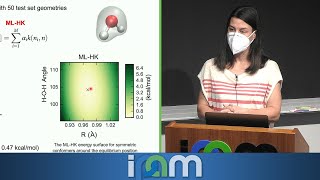
Molecular Electron Densities via Machine Learning - IPAM at UCLA
Explore machine learning techniques for predicting molecular electron densities and energies, with applications in quantum mechanics and molecular dynamics simulations.
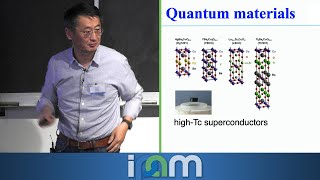
Auxiliary-Field Methods for Quantum Materials - IPAM at UCLA
Overview of auxiliary-field quantum Monte Carlo methods for simulating quantum materials, discussing recent advances in ab initio calculations, including correlated sampling and structural optimization.
Error Bounds for Properties in Planewave Electronic Structure Calculations
Explore error bounds in planewave electronic structure calculations, focusing on ground state density matrix and interatomic forces estimation. Learn efficient approximation methods and see numerical results for materials systems.