
ITensorNetworks.jl - Introduction to Tensor Network Algorithms in Julia
Explore tensor network algorithms and their implementation in Julia using ITensorNetworks.jl for efficient quantum many-body simulations.
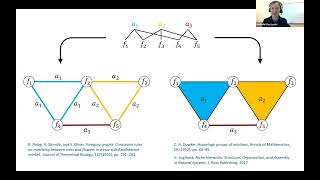
Persistent Homology of Plant-Pollinator Interactions - The Importance of Flowering Plant Surveys
Explore persistent homology in plant-pollinator interactions, analyzing topological features and the impact of flowering plant surveys on understanding community structures.
Functional and Structural Connectome of Reinforcement Learning
Explore functional and structural connectomes of reinforcement learning, focusing on neural substrates, computational models, and applications in depression research.
The Promise and Challenge of Harnessing Collateral Information from Medical Images Using AI
Explore AI's potential in extracting collateral information from medical images, discussing promises and challenges in this field.
Mapping Brain Dynamics and Trajectories with Geometric and Topological Machine Learning
Explore geometric and topological machine learning techniques for mapping brain dynamics and trajectories, enhancing understanding of neural processes.

Validation of AI Techniques in MRI for Clinical Studies
Explore AI validation techniques for MRI in clinical studies, focusing on enhancing accuracy and reliability in medical imaging analysis.

Noise Limits in Atomic Qubit Control for Quantum Computing
Explore the impact of laser noise on trapped ion qubit control and learn about new techniques to improve quantum computing performance to fundamental limits.
New Platforms for Two-Dimensional Electron Gases in Quantum Computing - Quantum Today
Explore new platforms for two-dimensional electron gases in quantum computing, focusing on Indium Antimonide's potential for topological quantum computing applications.
Open Quantum Computing - One Atom at a Time
Explore ion-trap quantum computing: build qubits from atoms, simulate complex systems, and discover open-access hardware advancing research in this cutting-edge field.
Quantum Simulation of Lattice Gauge Theories with Qudit Systems
Explore quantum simulation of lattice gauge theories using qudit systems, focusing on advanced techniques and applications in quantum computing.

Simple Factorization and Other Properties of D-Dimensional Unitaries
Explore d-dimensional unitaries, their factorization properties, and average characteristics in quantum computing. Gain insights into constructing and analyzing higher-dimensional quantum transformations.
Kittens, Cats, Combs and Compasses - Superposing Coherent States
Explore superpositions of coherent states in quantum computing, communication, and sensing. Discover nuclear cat states on nuclear qudits.
Quantum Computation and Simulation with Qudits
Explore multilevel quantum systems using trapped Ca40 ions for enhanced quantum computation and efficient simulation of high-dimensional problems like spin systems and lattice gauge theories.
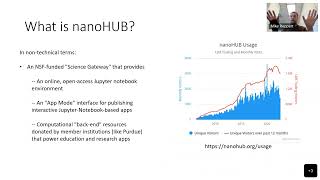
Hands-on Teaching with Jupyter Notebooks on nanoHUB
Explore hands-on teaching using Jupyter Notebooks on nanoHUB for chemistry courses. Learn to create interactive simulations, visualizations, and programming projects for enhanced student engagement and learning.
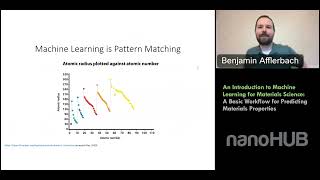
Introduction to a Basic Machine Learning Workflow for Predicting Materials Properties
Learn a basic machine learning workflow for predicting material properties, covering data cleaning, feature engineering, model training, and optimization using decision trees to forecast material bandgaps from compositions.
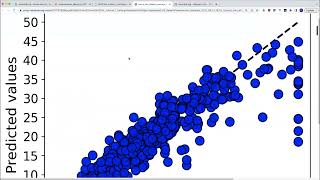
The Materials Simulation Toolkit for Machine Learning (MAST-ML): Automating Development and Evaluation of Machine Learning Models for Materials Property Prediction
Automate machine learning model development for materials property prediction using MAST-ML. Learn data import, feature engineering, model evaluation, and uncertainty quantification through hands-on activities.
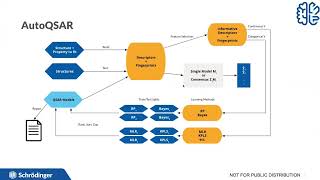
Machine Learning Models for Ionic Conductivity with Schrödinger's AutoQSAR - Hands-On Workshop
Explore machine learning for ionic conductivity prediction using Schrödinger's AutoQSAR tool. Gain hands-on experience with MS Maestro interface to create and implement models for materials science applications.
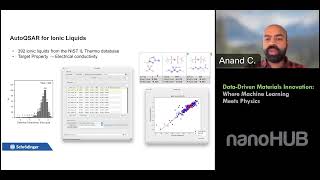
Data-Driven Materials Innovation: Where Machine Learning Meets Physics
Explore how machine learning and physics-based methods synergize to revolutionize materials science, addressing challenges in data-driven design across various technology fields with Schrödinger's innovative tools.
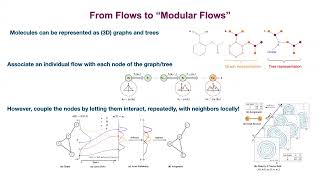
New Frontiers for AI-assisted Design and Discovery in Molecular Generation
Explore AI-assisted design for generating molecules with desired properties. Learn about overcoming challenges in combinatorial search, modeling interactions, and segregating representations for improved drug and material discovery.
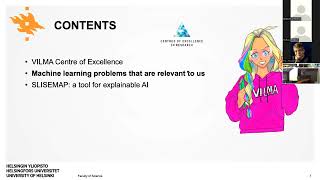
Explainable and Robust AI for VILMA Virtual Laboratory
Explore explainable AI and uncertainty quantification in atmospheric research. Learn about SLISEMAP, a supervised manifold visualization method for local explanations and dimensionality reduction.
New Frontiers for AI-assisted Design and Discovery in Molecular Generation
Explore AI-assisted design and discovery for generating molecules with desirable properties. Learn about overcoming challenges in combinatorial space, modeling interactions, and segregating representations for improved drug and material development.