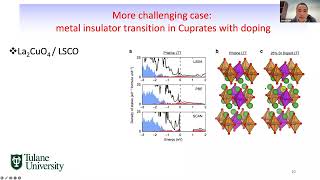
SCAN Functional and DFT Errors for Open-Shell d- and f-Electron Systems
Explore DFT challenges in correlated materials, focusing on SCAN functional's improvements for open-shell d- and f-electron systems. Analyze error sources and symmetry breaking effects.
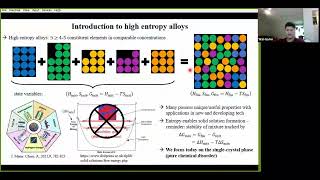
On the Mechanism of Charge Transfer and Electrostatic Field Fluctuations in Disordered Metals
Explore disorder-driven charge distribution fluctuations in metals, examining electrostatic screening, impurity scattering, and linear charge transfer trends in multicomponent alloys.
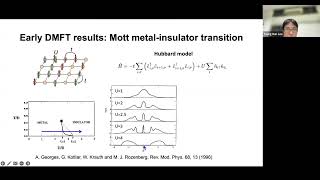
An Efficient and Accurate Approach to Strongly Correlated Materials
Explore an enhanced method for simulating strongly correlated materials using ghost-rotationally-invariant slave-boson (g-RISB) approach, improving accuracy in describing material properties with realistic parameters.
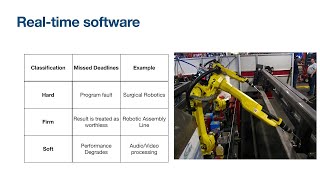
Robotics at Compile Time: Optimizing Robotics Algorithms With C++'s Compile-Time Features - Lecture
Optimize robotics algorithms using C++ compile-time features. Learn to leverage template metaprogramming, constexpr, and concepts for enhanced performance and safety in real-time robotic applications.
Pavex - Reimagining API Development in Rust
Explore Pavex, a new Rust web framework designed to streamline API development. Learn about its innovative approach, key features, and potential impact on Rust's role in backend development.
Odd Challenges of Using Deep Learning in Designing a Feedback Delay Network Reverb
Explore challenges in optimizing audio effects using deep learning, focusing on Feedback Delay Network reverb design. Gain insights into DSP, machine learning, and innovative approaches to audio processing.
Free and Open Source Software: Software Design for the Environment
Explore the environmental impact of software design and how Free & Open Source Software can contribute to sustainable ICT practices and reduce global CO2 emissions.
AI-Powered Solution for Agrochemical Management in Farming - Arm Tech Talk
Explore how an 18-year-old innovator uses AI on Arm to create a blockchain-based solution for secure agrochemical storage and transportation, addressing global farming challenges.
Hardware and its Concurrency Habits - Kernel Recipes 2023
Explore hardware structure, physics limitations, and synchronization mechanisms in modern computer systems for improved concurrent software design.
Powering Gigawatt Data Centers: Comparing Wind, Solar, and Gas Options
Explore powering gigawatt data centers using wind, solar, and gas. Analyze demand curves, cost models, and hybrid solutions to optimize energy efficiency and sustainability in large-scale computing facilities.
Probabilistic Inference of the Steady-State Distribution of an Age-Size Structured Population
Explore probabilistic techniques for inferring steady-state distributions of age-size structured populations using single-cell data and stochastic modeling.
Wandering Through Sequence Space
Explore protein sequence space and its implications for evolution, structure, and function with insights from statistical physics and machine learning.
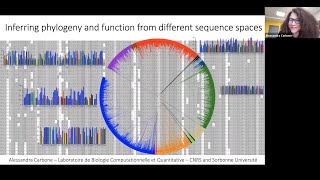
Inferring Phylogeny and Function from Different Sequence Spaces
Explore phylogeny and function inference using diverse sequence spaces, led by Alessandra Carbone from CNRS and Sorbonne Université.
Interpreting Deep Neural Networks Towards Trustworthiness
Explore methods for interpreting neural networks, including contextual decomposition and adaptive wavelet distillation, to enhance model trustworthiness and performance.
Perception of Visual Art and Topological Data Analysis
Explore topological data analysis applications in visual art perception, comparing eye movements for abstract paintings vs. AI-generated images using algebraic topology methods.
Thirty-Six Entangled Officers of Euler: Quantum Solution to a Classical Problem
Explore quantum combinatorial designs and their application in solving Euler's 36 officers problem, revealing insights into quantum information processing and error detection.
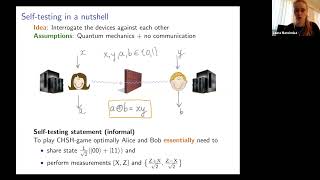
Certification of Quantum Devices via Operator-Algebraic Techniques
Explore quantum device certification through operator-algebraic techniques, focusing on self-testing and its connection to algebraic relation stability.
Philosophy and Neuroscience in the Study of Conscious Perception
Explore the intersection of philosophy and neuroscience in understanding conscious perception with insights from Aaron Schurger's conference talk.
Neuroscience and Philosophy in the Scientific Study of Free Will
Explore neuroscience and philosophy's intersection in free will research, examining scientific approaches and philosophical implications.
Quantum Steampunk - Quantum Information Meets Thermodynamics
Explore quantum information's intersection with thermodynamics, blending modern physics with Victorian-era aesthetics in this innovative theoretical framework.
Solving Complex Quantum Chemistry Problems with Amazon Braket
Explore quantum chemistry problem-solving using Amazon Braket with insights from an applied scientist at QHack 2023.