Fusing Biophysics and Machine Learning for Computational Oncology
Innovative approach combining biophysics and machine learning to enhance understanding of cancer dynamics, utilizing clinical data to extract disease patterns and improve oncology research.

On Random Grid Neural Processes for Solving Forward and Inverse Problems
Explore innovative deep learning models for parametric PDEs using random grids and variational neural processes, addressing challenges in physics-informed frameworks and data integration.
Calibration of Spatial Forecasts from Citizen Science Urban Air Pollution Data
Innovative machine learning approach for forecasting urban air pollution using citizen science data, offering improved accuracy and calibration for spatial predictions up to 5 days ahead.
Generating Approximate Ground States of Molecules Using Quantum Machine Learning
Explore quantum machine learning for generating molecular ground states, focusing on potential energy surfaces and efficient state preparation using variational quantum circuits and neural networks.
Overview of Learning Structured Quantum States - IPAM at UCLA
Explore efficient methods for learning structured quantum states, focusing on models and classes that require fewer copies for estimation, with insights on Boolean functions and alternative learning approaches.
Revolutionizing Healthcare: Generative AI and Prompt Engineering in Emergency Medicine
Explore the transformative impact of generative AI on emergency medicine, covering personalized care, medical diagnostics, and ethical considerations in healthcare innovation.
Machine Learning Tutorial Exercise
Hands-on tutorial exploring machine learning applications in geophysical fluid dynamics, covering data analysis, modeling, and prediction techniques for climate and ocean systems.
Basic Aspects of Convolutional Neural Networks - Tutorial
Explore fundamental concepts of convolutional neural networks in this tutorial, covering key principles and applications in deep learning for image processing and pattern recognition.
The Right Token for Next-Token Visual Prediction
Explore next-token visual prediction techniques, examining AI approaches to understanding and generating visual content through lower-level intelligence perspectives.

The Physics of Associative Memory - Exploring Hopfield Networks
Explore Hopfield networks, a foundational model of associative memory in neuroscience and machine learning. Learn about network architecture, inference, learning, and limitations.
Randomized Algorithms for Rounding and Rank Compression in the Tensor Train Format
Explore randomized algorithms for efficient tensor-train rounding, enhancing performance in quantum systems and condensed matter physics applications with significant computational speedups.
Deconstructing an Abstraction to Reconstruct a Database Outage
Explore a complex Postgres cluster outage, learn to reproduce failures locally, and gain insights into debugging complex systems and understanding database internals.
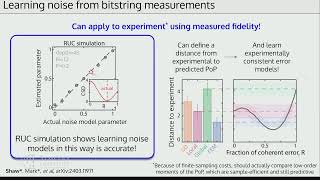
Using Chaos to Characterize a Programmable Analog Quantum Simulator
Explore chaos in analog quantum simulators, uncovering random behavior, estimating fidelity, and learning noise models for large-scale entangled states using Rydberg atom arrays.
Why You Should Believe in Quantum Computing
Explore quantum computing basics, advantages, and potential applications in cryptography and sensors. Gain insights into this revolutionary technology's impact on society and economy.
How AI Is Unlocking the Secrets of Nature and the Universe
Demis Hassabis explores AI's potential to accelerate scientific discovery, from predicting protein shapes to unraveling mysteries of the mind and universe, showcasing its transformative impact on human knowledge.
Evidence for the Utility of Quantum Computing Before Fault Tolerance
Explore noise mitigation in quantum computing, demonstrating reliable results from a 127-qubit processor and discussing the potential of pre-fault-tolerant quantum devices.
Fundamental Limits to Quantum Computation
Explores quantum computing's potential and limitations, discussing learnability, error mitigation, and non-unital noise impacts on near-term devices and fault-tolerant systems.
Hardware-Efficient Quantum Computing Using Qudits
Explore hardware-efficient quantum simulations using qudits, enabling complex gauge field computations and opening doors for near-term quantum devices.
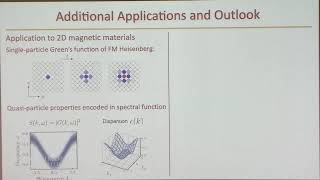
Analog Quantum Machine Learning for Near-Term Hardware
Explore analog quantum machine learning's potential on current hardware for cognitive tasks, energy calculations, and quantum metrology enhancements using programmable quantum simulators.
Probing the Limits of Classical Computing with Arbitrarily Connected Quantum Circuits
Explore the computational gap between classical and quantum computers through random circuit sampling in highly connected geometries, focusing on limitations and potential improvements.
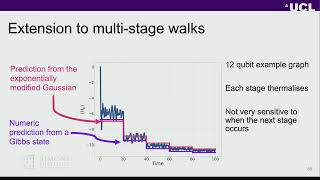
Continuous-Time Quantum Walks for MAX-CUT Optimization
Explore quantum walks for MAX-CUT optimization, linking Hamiltonians to thermalization. Discover novel insights into unitary dynamics for combinatorial problems using multi-stage walks and Floquet systems.