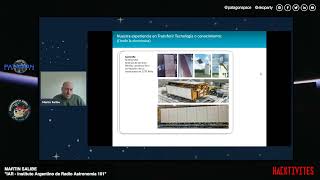
Instituto Argentino de Radio Astronomia 101 - Patagon Aerospace
Exploración del Instituto Argentino de Radio Astronomía: proyectos, desarrollos, facilidades y transferencia tecnológica. Presentado por Martin Salibe, responsable de vinculación tecnológica del IAR y técnico del Conicet.

Radio Astronomy for Programmers
Explore radio astronomy from a programmer's perspective, covering key concepts, data formats, and practical applications in space observation and satellite tracking.

Radio Astronomy with Python
Explore radio astronomy using Python, focusing on redshift studies, galaxy distribution analysis, and machine learning techniques for processing large astronomical datasets.

How Radio Telescopes Show Us Unseen Galaxies
Astronomer Natasha Hurley-Walker explores how radio telescopes reveal unseen galaxies, probing the universe's mysteries through light spectrums invisible to the human eye.
Probing Reionization of the Universe Using Signal from Hydrogen
Explore the fascinating process of cosmic reionization and how scientists study the early universe through hydrogen signals in this engaging astronomy presentation.
Beyond the Visible Universe - Discovering Wonders in Radio and X-rays
Explore the mysteries of space through radio and X-ray astronomy, uncovering celestial phenomena beyond human vision and discovering how scientists observe the invisible cosmos.

1.2 Tb/s Packet Processing of Radio Telescope Data on GPU
Discover how to process massive radio telescope data streams at 1.2 Tb/s using NVIDIA Grace Hopper GPUs, optimizing packet handling and reducing energy consumption through innovative system architecture.

Searching for Extraterrestrial Intelligence Using Google Cloud
Explore how Google Cloud aids in the search for extraterrestrial intelligence through radiofrequency data analysis and technosignature detection, featuring insights from SETI Forward Award winner Raffy Traas.
Introduction to Radio Astronomy
Explore the fundamentals of radio astronomy, including electromagnetic spectrum and its significance in astronomical research. Learn course structure and logistics.
Earth Detecting Earth: Human Baselines for Technosignatures - AbGradCon 2023
Explore Earth's technosignatures and their potential for exoplanet detection. Gain insights into radio transmissions, laser leakage, and exoplanetary pollutants in astrobiology research.
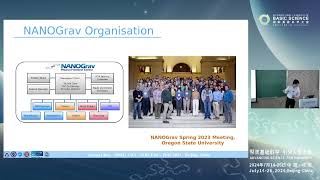
The NANOGrav 15-Year Data Set: Gravitational Wave Results
Explore nanohertz gravitational wave detection using pulsar timing arrays, focusing on NANOGrav's 15-year dataset and its implications for astrophysics and theories of gravity.
Efforts at RRI Towards Hunting Elusive Signatures from the First Stars
Explore groundbreaking research on detecting signals from the universe's first stars, examining innovative detection methods and scientific discoveries at the Raman Research Institute.
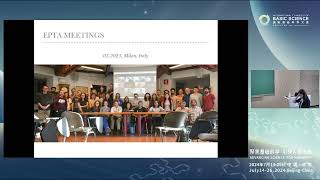
The Second Data Release from the European Pulsar Timing Array - Search for Gravitational Wave Signals
Explore the latest findings from the European Pulsar Timing Array's second data release and its implications for gravitational wave detection.
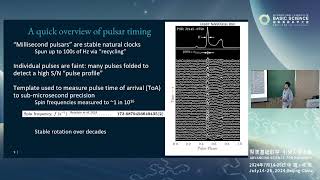
The Parkes Pulsar Timing Array Third Data Release: Overview and Search for an Isotropic Gravitational-wave Background
Explore the Parkes Pulsar Timing Array's latest data release, focusing on gravitational wave detection techniques and results from isotropic stochastic background searches.
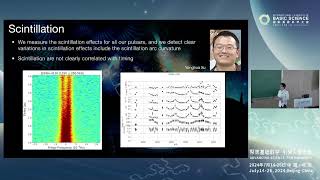
Searching for Gravitational Wave Background with Chinese Pulsar Timing Array Data Release I
Explore gravitational wave detection using Chinese Pulsar Timing Array data. Learn about millisecond pulsar observations, data analysis techniques, and key findings in the search for nanohertz gravitational wave backgrounds.
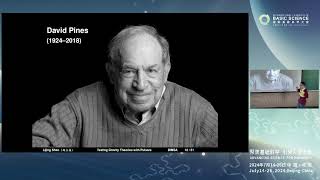
Testing Gravity Theories with Radio Pulsar Timing
Explore radio pulsar timing techniques and their application in testing alternative gravity theories using binary pulsars.
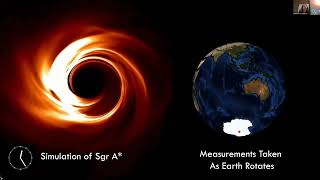
Moving Beyond the First Portrait of Our Milky Way's Black Hole by Leveraging Underlying Structure
Explore computational imaging techniques used to capture black hole images and leverage data structure to extract evolving details of the Milky Way's supermassive black hole.
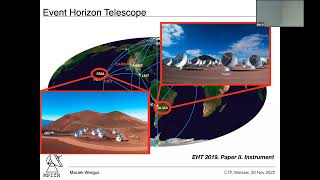
First Image of the Black Hole Shadow in the Galactic Center - Sagittarius A*
Explore groundbreaking images of Sagittarius A*, the Milky Way's central supermassive black hole, captured by the Event Horizon Telescope. Delve into data analysis, theoretical interpretations, and implications for black hole physics.
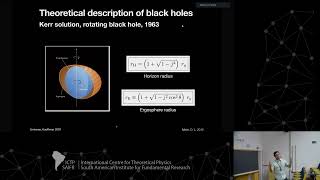
Supermassive Black Holes - Class 2
Explore supermassive black holes in this advanced astrophysics lecture, part of the Latin-American School on CTA Science series.
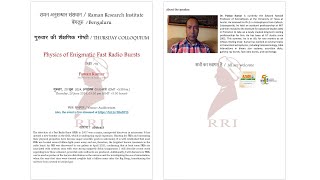
Physics of Enigmatic Fast Radio Bursts
Delve into the mysterious world of Fast Radio Bursts through an in-depth exploration of their physical properties, characteristics, and current theoretical understanding.
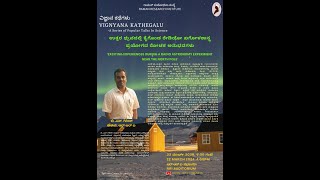
Exciting Experiences During a Radio Astronomy Experiment Near the North Pole
Discover fascinating stories and scientific insights from a radio astronomy expedition to the Arctic, exploring unique challenges and breakthrough moments in astronomical research.