Machine Learning for Quantum Applications - Part 1
Explore machine learning applications in quantum physics, focusing on cutting-edge techniques and their impact on quantum systems research.
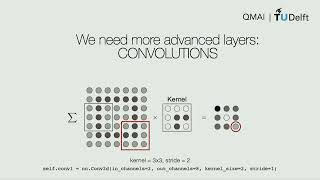
Machine Learning for Quantum Applications - Lecture 2
Explore advanced machine learning techniques for quantum systems, focusing on applications in condensed matter and statistical physics.
Simplifying the Simulation of Local Hamiltonian Dynamics
Explore advanced techniques for simplifying simulations of local Hamiltonian dynamics in quantum systems, enhancing understanding of complex quantum behaviors.
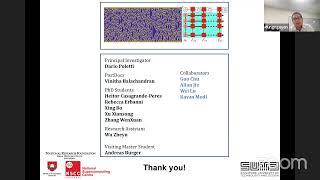
Amorphous Quantum Magnets in a Two-Dimensional Rydberg Atom Array
Explore amorphous quantum magnets using 2D Rydberg atom arrays, delving into cutting-edge research in condensed matter and statistical physics.

Classical Machine Learning for Quantum Simulations: Detection of Phases, Order Parameters, and Hamiltonians
Explore classical machine learning techniques for quantum simulations, focusing on phase detection, order parameters, and Hamiltonian analysis.

Optimal Control and Implementation of Quantum Algorithms
Explore optimal control techniques for implementing quantum algorithms, enhancing efficiency and performance in quantum computing systems.
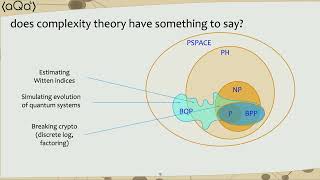
Provable Quantum Learning Advantages for Physics Data
Explore quantum learning advantages for physics data, uncovering provable benefits and applications in scientific research and analysis.
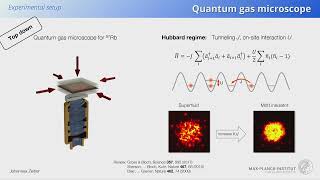
Quantum Gas Microscopy of Hubbard Systems Out of Equilibrium
Explore quantum gas microscopy techniques for studying Hubbard systems in non-equilibrium states, focusing on cutting-edge research in condensed matter physics.
Tensor Networks for Classical and Quantum Machine Learning Tasks
Explore tensor networks for machine learning in quantum systems. Learn to implement sequence prediction using matrix product operators for classical and quantum problems.
Exploring Long Range Dipolar Interactions: From Collective Dipolar Spin Dynamics to Light-Mediated Interactions
Explore long-range dipolar interactions in quantum systems for sensing, simulation, and discovery. Examine collective spin dynamics, layer exchange, light-mediated interactions, and Pauli-blocking.
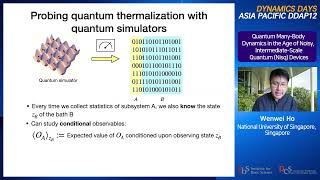
Quantum Many-Body Dynamics in the Age of NISQ Devices
Explore quantum many-body dynamics using NISQ devices, focusing on novel thermalization phenomena and their applications in quantum information science.
Can Quantum Machines Execute Complex Adaptive Strategies More Efficiently?
Explore quantum-enhanced agents' potential to execute complex adaptive strategies with reduced computational costs and improved efficiency in real-time decision-making scenarios.
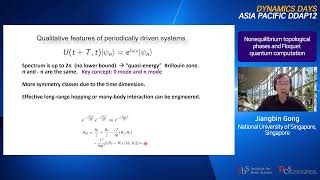
Nonequilibrium Topological Phases and Floquet Quantum Computation
Explore nonequilibrium topological phases and Floquet quantum computation, covering recent research on single-particle and many-body systems, chiral edge channels, and applications in quantum computing.
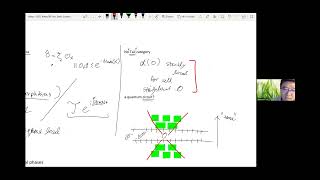
Topological Phases of Discrete Unitary Dynamics
Explore topological phases in discrete unitary dynamics, focusing on classification in the Clifford category across spatial dimensions and connections to anomalous boundary topological order.
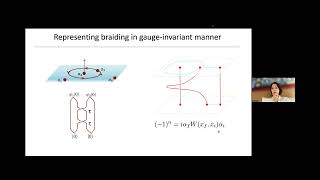
Non-Abelian Braiding with Plaquette Surface Code on Noisy Intermediate Scale Quantum Devices
Explore non-Abelian braiding in plaquette surface code on NISQ devices, uncovering quantum computing advancements and topological quantum information processing.
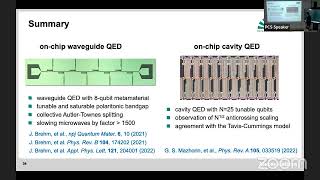
Slowing Down Microwave Photons with Superconducting Qubits
Explore superconducting qubit arrays for controlling microwave photons, demonstrating slow light and potential quantum memory applications in the microwave domain.
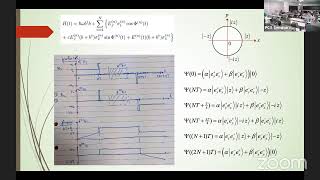
Nanomechanical Control of Superconducting Charge-Qubit Networks
Explore nanomechanical manipulation of superconducting charge-qubit networks using nanoelectromechanical setups and time-protocols for quantum information transduction and entanglement.
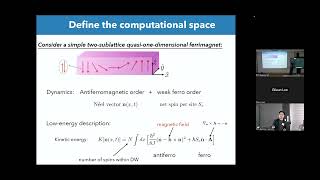
Shuttling Domain Wall Qubit on the Magnetic Racetrack
Explore a scalable quantum computing implementation using mobile domain walls on magnetic racetracks, with long-lived qubits and noise-resistant operations.
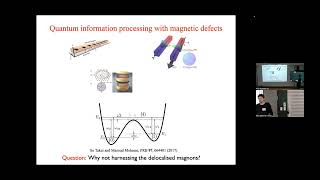
Cavity Magnonics with Domain Walls in Insulating Ferromagnetic Wires
Explore cavity magnonics with domain walls in ferromagnetic wires, uncovering quantum states, entanglement, and detection methods for potential computing applications.
Reliable AI: From Applied Harmonic Analysis to Quantum Computing
Explore reliable AI through generalization in graph neural networks and explainability using applied harmonic analysis. Delve into limitations of digital hardware and connections to quantum computing.
Thirty-Six Entangled Officers of Euler: Quantum Solution to a Classical Problem
Explore quantum combinatorial designs and their application in solving Euler's 36 officers problem, revealing insights into quantum information processing and error detection.