Topology and Physics - Clay Cordova with Edward Witten
Explore the intersection of topology and physics with Clay Cordova and Edward Witten, covering quantum mechanics, fermions, and topological quantum computing in this engaging discussion.
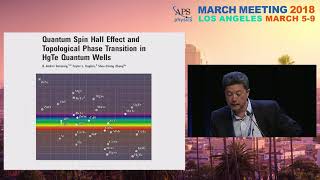
Discovery of the Chiral Majorana Fermion and Its Application to Topological Quantum Computing
Exploration of chiral Majorana fermions: theoretical prediction, experimental realization, and potential applications in topological quantum computing.
Theory of the Non-Abelian Quantum Hall States - Lecture 3
Explore non-Abelian quantum Hall states in this advanced physics lecture, delving into complex theories and their implications for quantum information processing and condensed matter physics.
Theory of the Non-Abelian Quantum Hall States - Lecture 2
Explore non-Abelian quantum Hall states in this advanced physics lecture, delving into complex theories and their implications for quantum information processing and condensed matter physics.
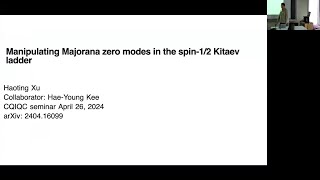
Manipulating Majorana Zero Modes in the Spin-1/2 Kitaev Ladder
Explore manipulation of Majorana zero modes in spin-1/2 Kitaev ladder systems, examining quantum information applications and theoretical physics concepts.

A New Kind of Quantum Computer - The Map of Topological Quantum Computing
Explore Microsoft's innovative topological quantum computing approach, featuring Majorana quasiparticles and exotic superconductivity. Learn about noise reduction, chip fabrication, and the potential for groundbreaking advancements in quantum technology.
Fractional Quantum Hall Effect in Multicomponent Systems: Old and New
Explore the intricacies of fractional quantum Hall effect in multicomponent systems, covering both established and emerging concepts in quantum physics.
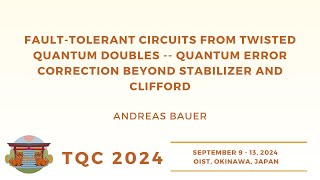
Fault-Tolerant Circuits from Twisted Quantum Doubles - Quantum Error Correction Beyond Stabilizer and Clifford
Explore advanced quantum error correction through fault-tolerant circuits and twisted quantum doubles, focusing on geometric locality and abelian non-chiral topological phases implementation.
Topological Defects in Toric Code and Sequential Quantum Circuit - IPAM at UCLA
Explore topological defects in toric code and sequential quantum circuits, focusing on the Cheshire string and its implications for understanding higher-dimensional topological orders and quantum error correction.
Topological Quantum Computation with Majorana Zero-Energy Modes - IPAM at UCLA
Explore topological quantum computing using Majorana zero-energy modes. Learn about recent advancements in engineering topological superconductors and their potential for scalable, error-resistant quantum computation.
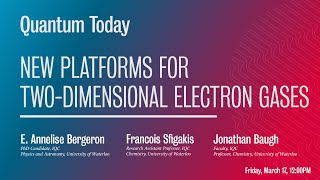
New Platforms for Two-Dimensional Electron Gases in Quantum Computing - Quantum Today
Explore new platforms for two-dimensional electron gases in quantum computing, focusing on Indium Antimonide's potential for topological quantum computing applications.
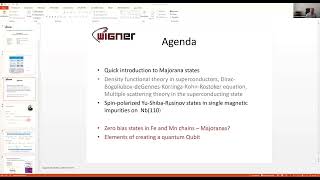
Electronic Structure in the Superconducting State from First Principles
Explore first-principles theory of inhomogeneous superconductivity, focusing on magnetic atom chains on superconductor surfaces and the identification of Majorana Zero Modes in topological systems.