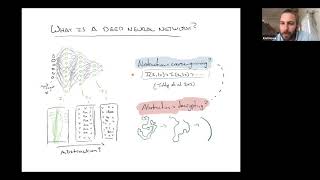
Swimming Without a Lifeguard in the Ocean of Ideas - Abstraction and Unsupervised Deep Learning
Explore unsupervised deep learning techniques for discovering hierarchical latent feature spaces, improving interpretability and performance in downstream tasks, and bridging neural and symbolic learning systems.
Introducing DMRjulia v1.0 - Tensor Network Computations in Julia
Explore DMRjulia v1.0, a tensor network library for quantum systems modeling. Learn design principles, hardware optimization, and cutting-edge research applications in this comprehensive introduction.
Probabilistic Inference Using Contraction of Tensor Networks
Explore probabilistic inference using tensor networks with TensorInference.jl. Learn exact methods for complex models, optimizing contraction sequences, and leveraging GPU technology for enhanced performance.
Quantum Circuits, Cellular Automata and Tensor Networks - Ignacio Cirac
Explore quantum circuits, cellular automata, and tensor networks, focusing on their representations, entanglement properties, and generalizations to quantum channels and measurement-assisted dynamics.
Matrix Product Operator Algebras in Topological Order
Explore matrix product operator algebras and their connection to topological order in 2D systems, focusing on MPO symmetries and their interpretation as weak Hopf algebra representations.
Lower and Upper Bounds on the VC-Dimension of Tensor Network Models
Explorez les limites de la dimension VC des modèles de réseaux de tenseurs. Apprenez les bornes supérieures et inférieures pour divers modèles de décomposition tensorielle et leurs implications pour l'apprentissage automatique.
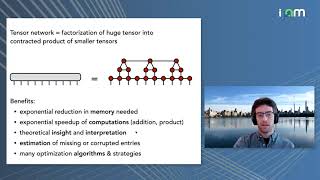
Tensor Networks for Machine Learning and Applications
Explore tensor networks in machine learning, their benefits, and applications. Learn about model functions, optimization algorithms, and potential insights for matching architectures to data types.
Conservative Adaptive Rank Integrators for Nonlinear Kinetic Models
Explore low-rank time integrators for PDEs, including explicit and implicit schemes, with applications to Vlasov, heat, Fokker-Planck, and advection-diffusion equations.
High-Dimensional PDEs, Tensor Networks, and Convex Optimization
Explore innovative computational methods for high-dimensional PDEs using tensor networks and convex relaxations, addressing the curse of dimensionality with low-order statistics approximations.
Operator Algebras, Bi-Unitary Connections and Tensor Networks - Lecture 4
Explore tensor categories as quantum symmetries, using Jones subfactor theory and bi-unitary connections to study 2D topological order and tensor networks.
Operator Algebras, Bi-Unitary Connections and Tensor Networks - Lecture 2
Explore tensor categories as quantum symmetries, using Jones subfactor theory and bi-unitary connections to study 2D topological order and tensor networks.
Operator Algebras, Bi-Unitary Connections and Tensor Networks - Lecture 1
Explore tensor categories as quantum symmetries, using Jones subfactor theory and bi-unitary connections to study 2D topological order and tensor networks.
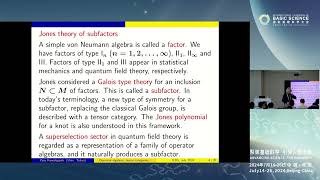
Operator Algebras, Tensor Categories and Tensor Networks in Topological Order
Explore tensor networks in topological order using operator algebra techniques. Discover quantum symmetries and their mathematical representation through tensor categories.
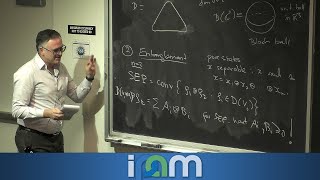
Monogamy of Highly Symmetric States in Quantum Entanglement
Explore entanglement limits in highly symmetric quantum states on complete graphs, using semidefinite programming and representation theory to solve long-standing problems.
Defective Tensor Network Varieties
Explore defective tensor networks and their anomalies in algebraic varieties, focusing on graph structure, dimensions, and unexpected deviations from parameter-based expectations.
Tailoring Coupled Cluster Theory with Matrix Product States
Explore the fusion of coupled cluster theory and DMRG for tackling strongly correlated systems in computational chemistry, with insights on mathematical and computational advancements.
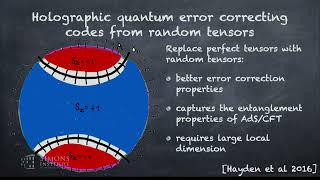
Tensor Network Toy Models of Holographic Dualities - Locality and Causality
Explore holographic quantum error correcting codes as models for AdS/CFT correspondence, examining local Hamiltonian mappings and causal properties in bulk-boundary dualities.
A Skein Theoretic Approach to CFT Correlators - Part 3
Explore advanced skein theoretic techniques for analyzing conformal field theory correlators in this in-depth mathematical physics lecture.
A Skein Theoretic Approach to CFT Correlators - Part 2
Explore skein theoretic approaches to CFT correlators in this advanced physics lecture, delving into mathematical techniques for analyzing quantum field theories.
Introduction to Quantum Information Aspects of AdS/CFT - Lecture 2
Explores quantum information in AdS/CFT correspondence, focusing on spacetime emergence, quantum gravity, and information theory applications in black hole physics and quantum field theories.
Introduction to Quantum Information Aspects of AdS/CFT - Lecture 3
Explores quantum information in AdS/CFT correspondence, focusing on spacetime emergence, quantum gravity, and information theory applications in physics and many-body systems.