Algebraic Graph Theory and Quantum Computing - Lecture 29
Explore the intersection of algebraic graph theory and quantum computing, delving into advanced mathematical concepts and their applications in quantum information science.
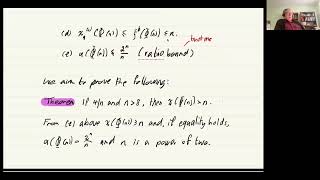
Algebraic Graph Theory and Quantum Computing - Lecture 24
Explore the intersection of algebraic graph theory and quantum computing, uncovering mathematical connections and potential applications in quantum information science.
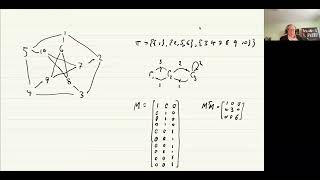
Algebraic Graph Theory and Quantum Computing - Lecture 21
Explore connections between algebraic graph theory and quantum computing, examining mathematical concepts and their applications in quantum information science.
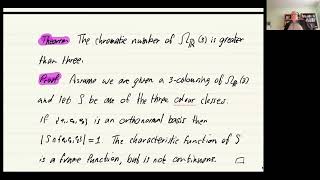
Algebraic Graph Theory and Quantum Computing - Lecture 26
Explore the intersection of algebraic graph theory and quantum computing, delving into advanced mathematical concepts and their applications in quantum information science.
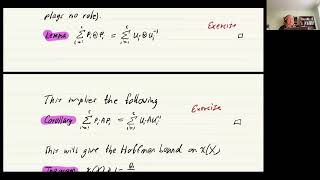
Algebraic Graph Theory and Quantum Computing - Lecture 25
Explore the intersection of algebraic graph theory and quantum computing, delving into advanced mathematical concepts and their applications in quantum information science.
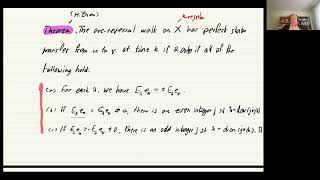
Algebraic Graph Theory and Quantum Computing - Lecture 20
Explore the intersection of algebraic graph theory and quantum computing, uncovering mathematical connections and potential applications in quantum information science.
Algebraic Graph Theory and Quantum Computing - Lecture 10
Explore the intersection of algebraic graph theory and quantum computing, delving into advanced mathematical concepts and their applications in quantum information science.
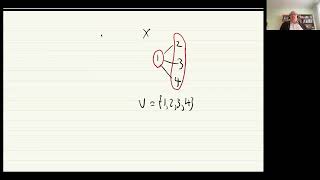
Algebraic Graph Theory and Quantum Computing - Lecture 6
Explore connections between algebraic graph theory and quantum computing, delving into mathematical concepts that bridge these fields and their practical applications.
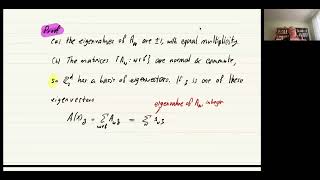
Algebraic Graph Theory and Quantum Computing - Lecture 12
Explore connections between algebraic graph theory and quantum computing, delving into mathematical concepts that bridge these fields and their practical applications.
Conservative Adaptive Rank Integrators for Nonlinear Kinetic Models
Explore low-rank time integrators for PDEs, including explicit and implicit schemes, with applications to Vlasov, heat, Fokker-Planck, and advection-diffusion equations.
High-Dimensional PDEs, Tensor Networks, and Convex Optimization
Explore innovative computational methods for high-dimensional PDEs using tensor networks and convex relaxations, addressing the curse of dimensionality with low-order statistics approximations.

Collaborating with Mathematicians on Major Societal Challenges - Session B02
Explore interdisciplinary collaborations between mathematicians and physicists addressing societal challenges, from quantum computing to climate science, through talks by leading researchers.
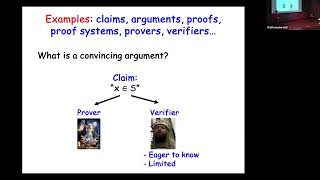
The Value of Errors in Proofs
Explore the significance of errors in mathematical proofs with Avi Wigderson, delving into their role in advancing quantum information and physics research.
Integrability of Open^2 Quantum Circuits
Explore integrability of open^2 quantum circuits with Chiara Paletta, delving into advanced concepts in gauge and string theory.
Numerical Methods and Quantum Many-Body Dynamics I - July 4
Explore numerical methods and quantum many-body dynamics with Frank Pollmann. Gain insights into advanced physics concepts and computational techniques for studying complex quantum systems.
Mathematics of Post-quantum Cryptography in the AI Era
Explore post-quantum cryptography's mathematical foundations and its intersection with AI, focusing on cutting-edge developments and future implications for cybersecurity.
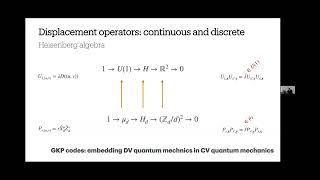
GKP Codes: A Rosetta Stone for Quantum Error Correction
Explore GKP Codes for fault-tolerant quantum computation, examining logical Clifford gates, complex elliptic curves, and geometric understanding of fault-tolerance. Discover connections between physics and modern mathematics.
Schoenberg Correspondence and Semigroup of k-(super)positive Operators
Explore Schoenberg correspondence and semigroups of k-(super)positive operators, extending LKGS theorem to characterize generators of various positive maps in quantum information theory.
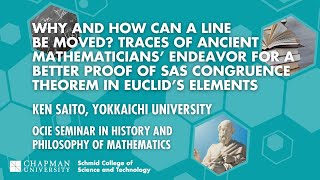
Why and How Can a Line be Moved? - Examining Euclid's Elements
Explore ancient mathematicians' efforts to improve proofs of the side-angle-side congruence theorem in Euclid's Elements, examining linguistic peculiarities and textual variations in related propositions.
Matrix Spaces and Graphs: Connections and Applications
Explore connections between matrix spaces and graphs, uncovering surprising equivalences and their applications in theoretical computer science, quantum information theory, and algebra.
Polynomial-Time Power-Sum Decomposition of Polynomials - Efficient Algorithms and Applications
Explore efficient algorithms for power-sum decomposition of polynomials, improving on prior work for tensor decomposition and Gaussian mixture identifiability. Gain insights into numerical linear algebra and noise-resilient techniques.