Tensors, State-Sum Topological Field Theories and the Evaluation of Extruded Graphs
Explore three-dimensional topological field theories, tensor network models, and graph evaluations in relation to state-sum constructions and surface defects.
Condensation and Stability of Topological Order in Tensor Networks
Explore quantum topological order stability in tensor networks, focusing on connections to condensation of topological excitations and implications for 3D discrete gauge theories.
Thermalization of Quantum Memories - A Tensor Networks Approach
Explore thermalization of quantum memories using tensor networks, focusing on 2D Kitaev's quantum double models and their Gibbs state representation as PEPS.
An Effective Field Theory for Holographic Random Matchgate Tensor Networks
Explore effective field theory for random matchgate tensor networks, analyzing phase transitions and topological connections in 2D systems with open physical boundaries.
Tensor Network Methods and Large Deviations in Stochastic Dynamics
Explore tensor network methods for studying fluctuations in stochastic systems, covering long-time statistics, rare event sampling, finite-time extensions, and symmetry protected topological phases in dynamical LDs.
Photonic Quantum Computing: A Bright Future for Many Applications
Explore photonic quantum computing architectures, applications, and future challenges. Discover quantum machine learning, reinforcement learning, and secure computing in quantum networks.
Entanglement Transitions in Tree Tensor Networks
Explore entanglement transitions in tree tensor networks, delving into mathematical structures and novel algorithms in quantum information theory.
New Ideas on Tensor Networks for Entanglement in Quantum Many-Body Systems
Explore new applications of tensor networks in quantum systems, including random networks, material properties, and learning tasks. Gain insights into capturing entanglement and analyzing complex quantum phenomena.
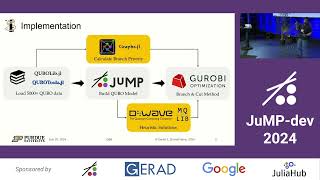
Hybrid Quantum Branch-and-Bound Method for Quadratic Unconstrained Binary Optimization
Explore a hybrid quantum branch-and-bound method for solving QUBO problems, combining quantum hardware strengths with global search capabilities. Implementation details and performance evaluation included.
The Future of Computing - What to Expect in the Next Decade
Explore emerging technologies shaping computing's future, from AI-driven innovations to quantum and neuromorphic computing, and their potential impact on businesses and space manufacturing.
Classical and Quantum Subjectivity in Uncertainty and Belief Systems
Explore uncertainty in subjective logic, from Markov networks to quantum quasiprobabilities, gaining insights on computational irreducibility and belief spaces.
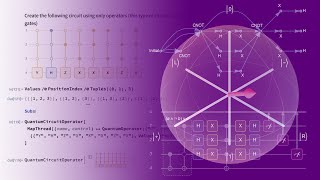
Quantum Circuits: Introduction to Wolfram Quantum Computation Framework
Explore quantum computing with Wolfram's framework, covering states, transformations, algorithms, and circuits using symbolic expressions and Wolfram Language.
Review of Quantum Framework Functionalities - Wolfram Quantum Computation Framework
Explore Wolfram's Quantum Computation Framework, covering quantum states, transformations, algorithms, and hardware implementation using Wolfram Language.
Quantum Operators, Time Evolution and Quantum Measurement
Explore quantum operators, time evolution, and measurement using Wolfram's Quantum Computation Framework. Learn to model and simulate quantum processes symbolically.
Exploring Random Quantum Circuits: A New Implementation Method
Discover a novel method for constructing random quantum circuits, comparing its properties to traditional approaches and exploring its potential for quantum hardware implementation.
Toward Fault-Tolerant Quantum Computing
Explore fault-tolerant quantum computing, strategies to reduce quantum noise, and the Q-CTRL-Wolfram partnership with experts from both organizations.
Quantum Programming: Classiq and Wolfram - Building Higher Level Functionality for Quantum Algorithms
Explore higher-level quantum algorithm functionality with Classiq developers, focusing on application areas and Qmod abstraction for problem-solving in quantum programming.
Writing Quantum Algorithms for QuEra Devices with Wolfram Mathematica
Explore quantum algorithm development for QuEra devices using Wolfram Mathematica, leveraging the world's largest neutral-atom computer for research and education.
Supporting End-Users in Realizing Quantum Computing Applications
Explore tools and methods for automating quantum computing tasks, shielding end-users from complex concepts and supporting application development across diverse domains.
Dataflow-Based Optimization for QIR Programs
Explore QDFO, a dataflow-based optimization approach for Microsoft QIR, improving code efficiency and readability through preprocessing and redundancy reduction in quantum computing programs.
Verifying Quantum Circuits in GAP
Explore quantum circuit verification using GAP, focusing on equivalence checking, ancilla management, and rotational gate validation in the Quantum GAP library.