The Quest for a Valuable Quantum Algorithm
Explore the search for impactful quantum algorithms, their potential applications, and the challenges in developing them for practical use in various fields of science and technology.
Teaching Quantum Computers to Simulate Particle Physics
Explore quantum computing's potential in simulating particle physics, focusing on innovative approaches and cutting-edge research in this rapidly evolving field.
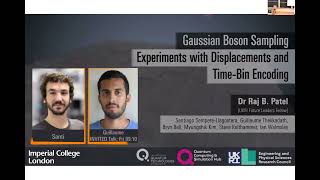
Gaussian Boson Sampling Experiments with Displacements and Time-Bin Encoding
Explore cutting-edge quantum information experiments using Gaussian Boson Sampling, focusing on displacements and time-bin encoding techniques in this advanced physics lecture.
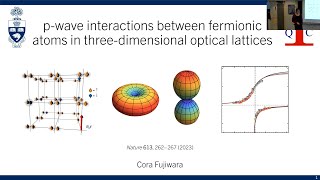
Strongly Interacting P-Wave Fermionic Atoms in Three-Dimensional Optical Lattices
Explore p-wave fermionic atoms in 3D optical lattices, focusing on strong interactions and their implications for quantum information and condensed matter physics.
A Polynomial-Time Classical Algorithm for Noisy Random Circuit Sampling
Explores polynomial-time classical algorithm for noisy random circuit sampling, challenging quantum supremacy claims. Discusses computational complexity, experimental implications, and recent progress in quantum computing.
Learning to Predict Arbitrary Quantum Processes
Explore quantum learning theory and its surprising ability to predict local properties of arbitrary quantum circuits, contrasting with classical limitations and highlighting potential for efficient quantum dynamics prediction.
New Approaches in Simulation of Transition Paths - IPAM at UCLA
Explores tensor methods for simulating chemical transition processes, focusing on compressing high-dimensional PDE functions and introducing a novel tensor-network generative modeling approach without optimization.
Weakening Assumptions in Quantum Cryptography IV.a Part 1 of 2 - IPAM at UCLA
Explore quantum information's role in relaxing cryptographic assumptions, focusing on secure multiparty computation and oblivious transfer. Learn about advancements from Crepeau and Kilian to recent developments.
Information-Theoretic Quantum Cryptography Part 2 of 2 - IPAM at UCLA
Explore advanced quantum cryptography topics, including secure delegated computation, quantum key distribution, and certified deletion, with a focus on security against unbounded adversaries.
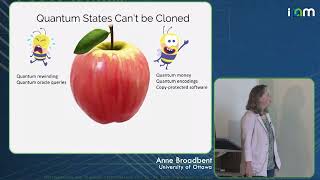
Information-Theoretic Quantum Cryptography Part 1 of 2 - IPAM at UCLA
Explore information-theoretic quantum cryptography, covering topics like quantum money, secure computation, and key distribution. Gain insights into the interplay between quantum information and cryptography.
Introduction to Quantum Computing - Part 3 - IPAM at UCLA
Explore density matrices, mixed states, and quantum channels in cryptography. Learn about POVM measurement and distance measures for quantum states and operators.
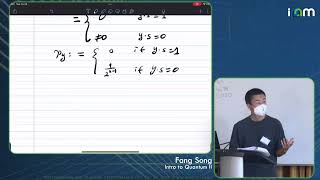
Introduction to Quantum Computing Part 2 of 3 - IPAM at UCLA
Explore quantum algorithms like period finding and Grover's search, including Simon's algorithm, phase estimation, and Shor's factoring algorithm. Examine their impact on cryptography and cryptosystem vulnerabilities.
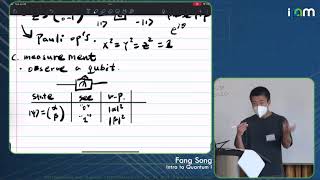
Introduction to Quantum Computing - Part 1 of 3
Explore quantum computing basics: qubits, unitary operations, superposition, entanglement, and no-cloning. Discover quantum circuits, information processing protocols, and elementary algorithms like Deutsch-Josza.
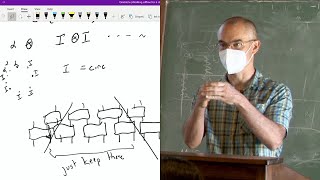
Introduction to Quantum Cellular Automata
Explore quantum cellular automata: fundamental concepts, applications, and connections to topological phases of matter in this comprehensive lecture by Microsoft Research expert.
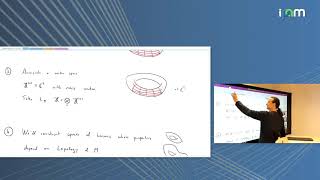
Stabilizer Formalism & Quantum Error Correction Through the Lens of Tensors - Part 1
Explore stabilizer formalism and quantum error correction using tensor methods. Learn about many-body systems, error correction challenges, and connections to finite symplectic geometries.
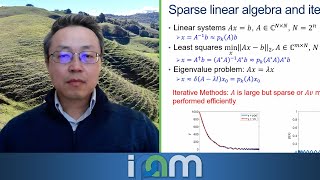
Practical Quantum Circuits for Block Encodings of Sparse Matrices
Explore efficient quantum circuits for block encodings of sparse matrices, focusing on strategies for well-structured matrices and quantum walks on graphs. Gain insights into quantum linear algebra algorithms.
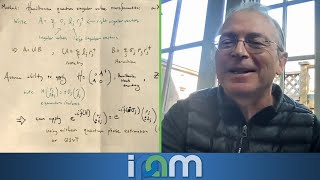
Seth Lloyd - Quantum Polar Decomposition - IPAM at UCLA
Explore quantum polar decomposition algorithm, its applications in unitary operations, Hermitian matrix measurements, and potential uses in quantum numerical linear algebra.
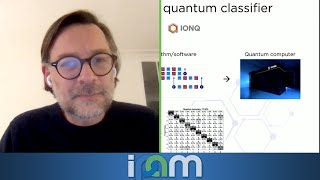
New Results in Quantum Linear Algebra - IPAM at UCLA
Explore cutting-edge advancements in quantum linear algebra, including optimized circuit constructions and their applications in numerical computations and algorithms.
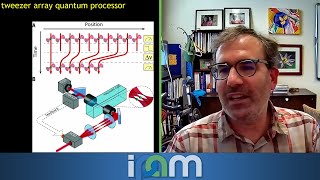
Approaches to Quantum Information Processing With Cold Atoms
Explore quantum simulation and computation approaches using cold atoms for understanding nature and advancing computational capabilities.
Quantum Pseudorandomness in Algorithmica, and Its Implications to Cryptography and Complexity
Explore quantum pseudorandomness, its separation from one-way functions, and implications for cryptography and complexity theory. Discover potential for quantum cryptography without relying on traditional assumptions.
Commitments to Quantum States
Exploring quantum state commitments, their definition as erasure of sender's message, and applications in cryptography, including succinct arguments for NP and potentially QMA.