Generalizations of Matrix Multiplication for Solving the Light Bulb Problem
Explore a novel approach to solving the Light Bulb Problem using tensor-based algorithms, potentially outperforming traditional matrix multiplication methods for faster data analysis and pattern recognition.
Random Tensor Networks with Nontrivial Links
Explorez les réseaux de tenseurs aléatoires avec états de liens non triviaux, leurs propriétés d'intrication et applications en théorie de l'information quantique et gravité quantique holographique.
Optimization at the Boundary of the Tensor Network Variety
Explore tensor network states, their boundary variety, and optimization techniques for finding ground states of local Hamiltonians in quantum many-body systems.
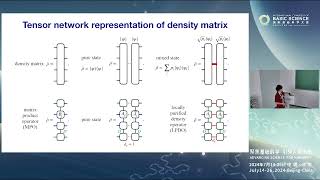
Locally Purified Density Operators for Noisy Quantum Circuits
Explore efficient representation of mixed states in noisy quantum circuits using locally purified density operators, addressing challenges and insights in open quantum systems simulation.
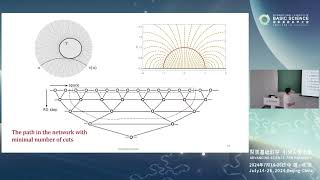
Partial Entanglement Network and Geometry Reconstruction in AdS/CFT
Explore partial entanglement entropy geometrization in AdS/CFT, examining PEE threads, network formation, and bulk geometry reconstruction using novel approaches.
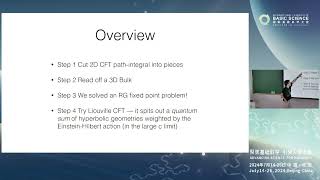
Building Space-time with BCFT Legos - ICBS 2024
Explore quantum gravity duals of CFTs through conformal bootstrap, topological symmetries, and tensor networks. Discover how 2D Liouville theory illustrates building quantum gravitational path integrals using BCFT correlations.
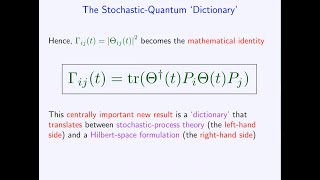
A New Formulation of Quantum Theory
Explore a novel correspondence between stochastic processes and quantum theory, offering new insights into quantum mechanics and potential applications for quantum computing.
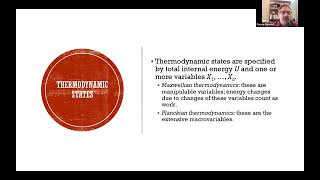
A Tale of Two Sciences: Contrasting Views on Thermodynamics
Explore the distinction between two approaches to thermodynamics: the Maxwellian view as a resource theory and the Planckian view as a theory of macroscopic matter properties. Examine their implications for statistical mechanics.
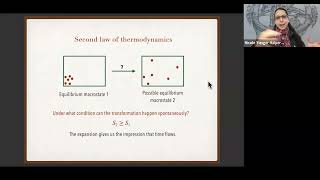
Updates to the Second Law from Quantum Thermodynamics
Explore quantum thermodynamics' impact on the second law of thermodynamics, examining its evolution and implications for small systems and quantum phenomena.
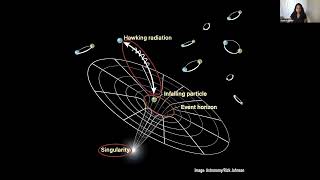
Not the Measurement Problem's Problem: Black Hole Information and Schrödinger's Cat
Explore the relationship between black hole information loss and quantum measurement, challenging unitarity's dominance and proposing interpretation-neutral solutions to these fundamental physics puzzles.
Basics of Quantum Computing - Lecture 21
Explore quantum computing fundamentals, including qubits, superposition, and entanglement. Gain insights into quantum algorithms and their potential impact on machine learning.
Basics of Quantum Computing - Lecture 21
Explore quantum computing fundamentals, including qubits, superposition, entanglement, and quantum algorithms, to understand its potential impact on machine learning and computation.
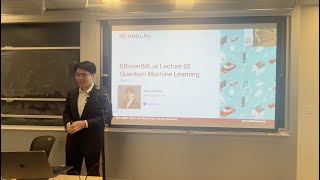
Quantum Machine Learning - Lecture 22
Explore quantum machine learning concepts and applications in this advanced MIT lecture, covering cutting-edge developments in the field.
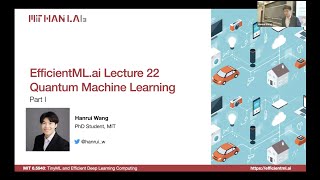
Quantum Machine Learning - Lecture 22
Explore quantum machine learning concepts and applications in this advanced lecture from MIT's EfficientML.ai series, covering cutting-edge developments in the field.
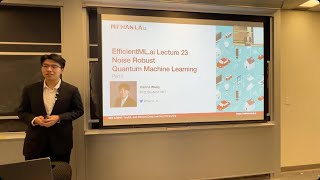
Noise Robust Quantum Machine Learning - Lecture 23
Explore noise-robust quantum machine learning techniques, focusing on mitigating errors in quantum systems for improved ML performance.
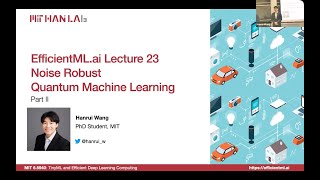
Noise Robust Quantum Machine Learning - Lecture 23
Explore noise-robust quantum machine learning techniques, focusing on overcoming challenges in quantum systems for improved ML performance and reliability.
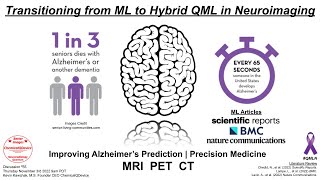
Transitioning from ML to Hybrid QML in Neuroimaging - Episode 55
Explore the transition from machine learning to hybrid quantum-classical approaches in neuroimaging, focusing on Alzheimer's detection and neurodegenerative syndrome classification.
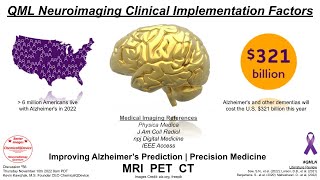
QML Neuroimaging Clinical Implementation Factors for Alzheimer's Disease
Explore QML neuroimaging implementation factors for Alzheimer's disease, covering regulatory frameworks, AI challenges, and quantum machine learning applications in biomedicine.
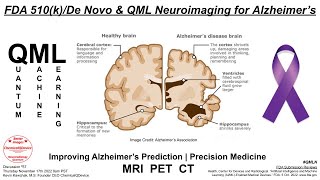
FDA 510(k)/De Novo and QML Neuroimaging for Alzheimer's - Discussion 57
Explore FDA approval processes for Quantum Machine Learning in neuroimaging, focusing on 510(k) and De Novo classifications for AI/ML software as medical devices in Alzheimer's research.
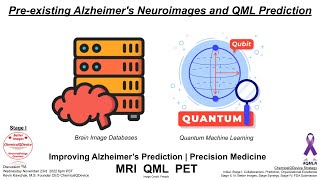
Pre-existing Alzheimer's Neuroimages and Quantum Machine Learning Prediction
Explore quantum machine learning applications for Alzheimer's prediction using pre-existing neuroimages. Discover recent FDA approvals, regulatory standards, and key research supporting this innovative approach.
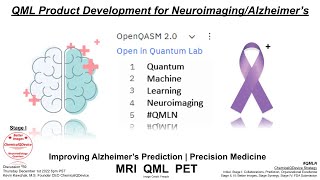
QML Product Development for Neuroimaging and Alzheimer's
Explore quantum machine learning for neuroimaging in Alzheimer's research. Learn product development strategies, QML techniques, and healthcare innovation principles to advance neuroimaging solutions.