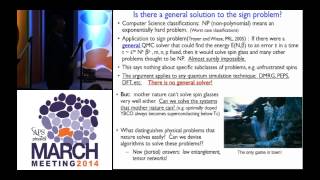
Numerical Studies of Strongly Correlated Systems - Beating the Exponential Growth in Computation Time
Explore numerical approaches to tackle strongly correlated systems, focusing on entanglement entropy, matrix product states, and recent advancements in 2D systems and the TJ model.
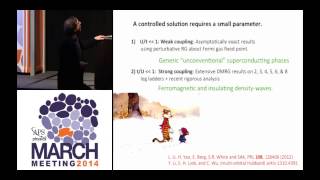
Theoretical Approaches to Correlated Electron Problems
Explore advanced theoretical approaches to correlated electron systems, focusing on recent developments and challenges in understanding complex quantum phenomena in condensed matter physics.
Tailoring Coupled Cluster Theory with Matrix Product States
Explore the fusion of coupled cluster theory and DMRG for tackling strongly correlated systems in computational chemistry, with insights on mathematical and computational advancements.
ML-Accelerated DFT Sampling of Catalytic Processes at Heterogeneous Interfaces - Al Fortunelli
Explores machine learning-accelerated density functional theory for sampling catalytic processes at heterogeneous interfaces, advancing computational methods in materials science and chemistry.
Classical Quantum Chemistry and QIS Applications - Part I
Explore quantum chemistry fundamentals and their applications in quantum information science with Prof. Anna Krylov in this comprehensive lecture from IPAM's Winter School.
Molecular Spin Qubits - Part 2
Explore advanced concepts in molecular spin qubits, focusing on their applications in quantum information science for chemistry, presented by expert Nicholas Chilton.
Classical Quantum Chemistry and QIS Applications - Part 2
Explore advanced quantum chemistry concepts and their applications in quantum information science, focusing on cutting-edge research and theoretical frameworks.
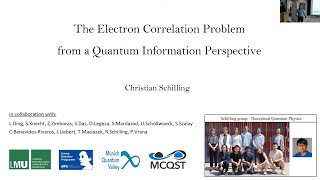
The Electron Correlation Problem from a Quantum Information Perspective
Explore quantum information's role in understanding electron correlation, featuring insights from Christian Schilling on this complex physics problem.
Some Open Mathematical Problems Concerning Charged Quantum Particles
Explore open mathematical challenges related to charged quantum particles, delving into complex theoretical concepts and unsolved problems in quantum physics.
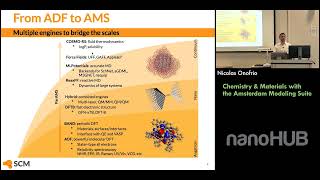
Chemistry and Materials with the Amsterdam Modeling Suite
Explore atomistic simulations using Amsterdam Modeling Suite. Learn about AMS driver, DFT engines, force fields, and PARAMS for novel molecular interactions. Gain insights through demos and practical applications.
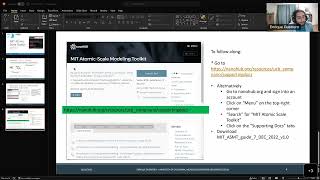
Teaching and Learning with the MIT Atomic Scale Modeling Toolkit - Classical and Quantum Atomic Modeling
Explore classical and quantum atomic modeling using MIT's toolkit. Perform molecular dynamics, Monte Carlo simulations, and quantum chemistry computations. Learn practical applications for various physics and chemistry courses.
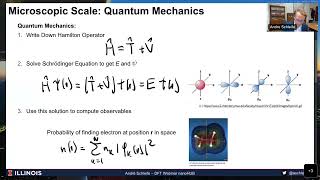
Density Functional Theory: Introduction and Applications
Explore Density Functional Theory fundamentals and applications using Quantum Espresso on nanoHUB. Learn to compute electronic structures, densities of state, total energies, and bulk modulus for materials.
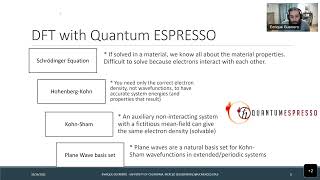
Interactive Modeling of Materials with DFT Using Quantum ESPRESSO - MIT Atomic Scale Toolkit
Explore interactive modeling of materials using density functional theory with Quantum ESPRESSO in the MIT Atomic-Scale Modeling Toolkit. Learn to compute and analyze various material properties through hands-on examples.
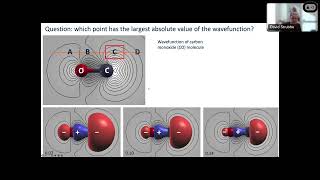
DFT with SIESTA, Data Visualization, and Sophomore-level CURE Using MIT Atomic-Scale Modeling Toolkit
Explore density functional theory, data visualization, and undergraduate research experiences using the MIT Atomic-Scale Modeling Toolkit for modern physics and condensed matter studies.
Simulation of Chemical Reactions on a Quantum Computer
Explore quantum computing algorithms for calculating scattering matrix elements in chemical reactions, focusing on the Møller operator formulation and its application to hydrogen exchange.
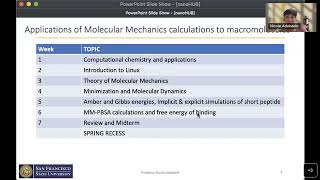
Teaching Electronic Structure Methods in Chemistry Using Simulation Tools in nanoHUB
Explore electronic structure methods in chemistry using nanoHUB simulation tools. Learn to teach computational chemistry concepts and gain hands-on practice with Hartree-Fock and basis sets using ORCA.
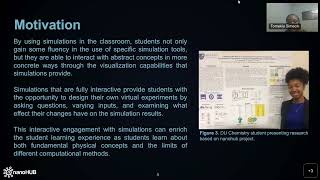
Introduction to Computational Chemistry Using the NUITNS Simulation Toolkit in nanoHUB
Explore computational chemistry using NUITNS toolkit on nanoHUB. Learn to integrate simulations in undergraduate chemistry courses and analyze nanodiamonds through hands-on demonstrations and practical applications.
Quantum Chemistry with a Quantum Computer
Explore quantum chemistry simulations using quantum computers, focusing on strongly correlated systems, digital-analog toolboxes, and extracting spectral properties for practical applications.
The Equation of State Between Nuclear Structure and Astrophysics - Lecture 4
Explore nuclear physics concepts, focusing on the equation of state and its connections to nuclear structure and astrophysics in this advanced lecture.
The Equation of State Between Nuclear Structure and Nuclear Astrophysics and Beyond - Lecture 1
Explore the interplay between nuclear structure and astrophysics, focusing on the equation of state and its implications for understanding cosmic phenomena.
Getting from DaFT to DeFT: An Introduction to Using DFT for 2D Materials
Comprehensive introduction to Density Functional Theory for 2D materials, covering fundamental concepts, applications, and practical implementation techniques.