
Density Functional Theory - IPAM at UCLA
Comprehensive exploration of density functional theory, covering advanced concepts and applications in materials science, presented by Prof. Vikram Gavini at IPAM's exascale mathematics workshop.
Density Functional Theory - IPAM at UCLA
Comprehensive introduction to density functional theory, exploring its principles and applications in materials science and computational physics.

Symbolic Regression for Discovery of a DFT Functional - IPAM at UCLA
Explore symbolic regression for DFT functional discovery, combining AutoML ideas to improve existing models in computational chemistry and materials science.
Machine Learning to Improve the Exchange and Correlation Functional in DFT
Explore machine learning approaches to improve exchange and correlation functionals in density functional theory, discussing physically informed methods and their advantages in quantum mechanics.
Fast, Accurate and Large-Scale Ab-Initio Calculations for Materials Modeling
Explore advanced computational methods for large-scale density functional theory calculations, their applications in materials modeling, and the performance of the DFT-FE open-source code.
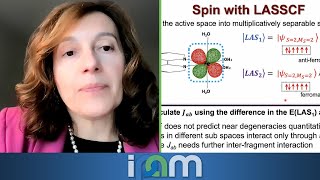
Localized-Wave-Function Methods in Quantum Chemistry and Their Extension to Quantum Computers
Explore localized wave-function methods in quantum chemistry, their applications to large systems, and potential extensions to quantum computing algorithms for improved efficiency and accuracy.
Many-Body Perturbation Theory and Wavefunction Methods: A Physics Perspective
Explore many-body perturbation theory and wavefunction methods from a physics perspective, covering applications, multiscale modeling, and advanced quantum mechanics concepts.
Elements of Electronic Structure Calculations - HF and DFT - IPAM at UCLA
Explore fundamental concepts of electronic structure calculations, including Hartree-Fock and Density Functional Theory, with insights on modern methodologies and applications in quantum mechanics.
Ab Initio Quantum Chemistry Approaches to Nonequilibrium Interactions in Molecules
Explore ab initio quantum chemistry approaches for nonequilibrium interactions in molecules and materials, covering correlated photon-molecule interactions, molecular strong coupling, and polariton dynamics.

Physically Inspired Machine Learning for Excited States - IPAM at UCLA
Explore machine learning applications in photochemistry, focusing on excited state predictions and light-matter interactions. Discover innovative techniques for overcoming data limitations and enabling accurate photodynamics simulations.

Conditional Probability Density Functional Theory - IPAM at UCLA
Explore conditional probability density functional theory for electronic structure calculations, addressing challenges in DFT and offering insights into ground-state correlations and warm dense matter simulations.
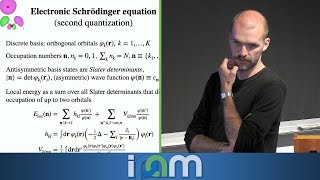
Neural-Network Wave Functions for Quantum Chemistry - IPAM at UCLA
Explore neural-network wave functions in quantum chemistry, covering variational quantum Monte Carlo, antisymmetric ansatzes, and applications to electronic and exciton-phonon Hamiltonians for improved accuracy in molecular modeling.

Stochastic Density Functional Theory - IPAM at UCLA
Explore stochastic density functional theory for efficient ground-state calculations in extended materials, including noise reduction techniques and applications in warm dense matter at elevated temperatures.
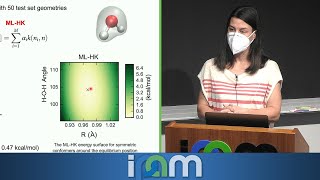
Molecular Electron Densities via Machine Learning - IPAM at UCLA
Explore machine learning techniques for predicting molecular electron densities and energies, with applications in quantum mechanics and molecular dynamics simulations.
Error Bounds for Properties in Planewave Electronic Structure Calculations
Explore error bounds in planewave electronic structure calculations, focusing on ground state density matrix and interatomic forces estimation. Learn efficient approximation methods and see numerical results for materials systems.
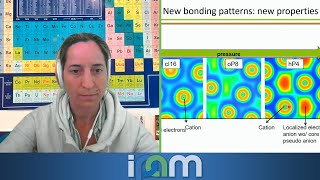
Math-Chimie: Developing Approaches for Predicting New Superconductors
Explore innovative approaches for predicting superconductors, combining mathematics and chemistry to analyze electron density, localization, and high-pressure materials for groundbreaking discoveries in quantum mechanics.
Generating Reference Data and Controlling Accuracy in DFT and Hybrid DFT Simulations
Explore advanced techniques in DFT simulations, including all-electron approaches, pseudopotential validation, and hybrid DFT acceleration methods for improved accuracy and efficiency in quantum mechanics calculations.
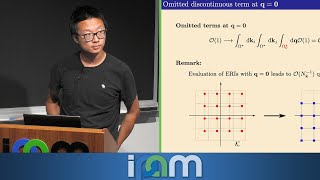
Finite-Size Error and Its Correction in Energy Calculations for Periodic Systems
Explore finite-size errors in periodic systems, focusing on Hartree-Fock and MP2 theories. Learn about convergence rates, Madelung-constant correction, and the staggered mesh method for improved calculations.
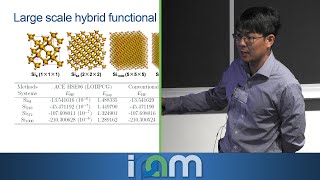
Large Scale Hybrid DFT Functionals - Fast Algorithms and Finite-Size Effects - IPAM at UCLA
Explore accelerating DFT calculations with hybrid functionals and finite-size effects in Hartree-Fock calculations for periodic systems in this advanced mathematics lecture.
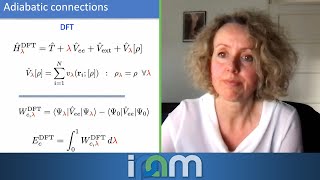
Large-Coupling Strength Expansion in DFT and Hartree-Fock Adiabatic Connections
Explore large-coupling strength expansions in DFT and Hartree-Fock adiabatic connections, examining their applications in quantum chemistry and electronic structure theory.
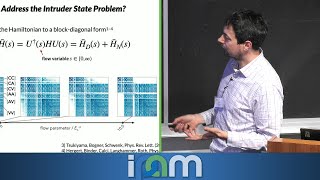
Many-Electron Effective Hamiltonians from Similarity Renormalization Group
Explore many-electron effective Hamiltonians using similarity renormalization group, focusing on bond-breaking reactions, spin states, and excited states of molecules with near-degenerate electronic structures.