Automating Distributed Heterogeneous Computing for Domain Experts
Explore new approaches for enabling domain experts to program future HPC systems efficiently, focusing on compiler and runtime techniques for distributed heterogeneous computing.
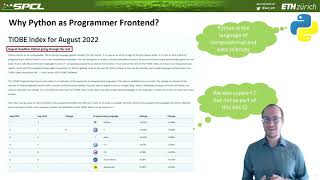
Portable High-Performance Python on CPUs, GPUs, and FPGAs
Optimize Python for high performance on CPUs, GPUs, and FPGAs. Learn HPC-oriented extensions, automatic optimizations, and portable performance techniques across architectures.
Productive Performance Engineering for Weather and Climate Modeling with Python
Optimize weather and climate models using Python-embedded DSL and data-centric techniques. Improve productivity and performance through abstraction, semi-automated workflows, and transfer tuning for efficient scaling on supercomputers.
AI-Driven Performance Metaprogramming - Embedding Spaces for Program Analysis and Optimization
Explore AI-driven performance metaprogramming using embedding spaces for programs. Learn to assess, analyze, and improve program performance through advanced AI methods.

ME3255 - Rocket Science Solutions with Python
Explore rocket science solutions using Python, covering advanced concepts and practical applications in aerospace engineering.
C/C++ Compiler Options Best Practices - February 15, 2023
Explore best practices for C/C++ compiler options to enhance code security and performance. Learn optimization techniques and defensive programming strategies.
C/C++ Compiler Options Best Practices - March 29, 2023
Discover best practices for C/C++ compiler options to enhance code security and performance. Learn optimization techniques and defensive programming strategies.

My Plan B: Exploring Alternative Strategies in Computer Science Research
Explore innovative approaches to software testing and verification with Professor Alastair Donaldson in his Imperial Inaugural lecture.

Learn Redux Toolkit in One Video
Master Redux Toolkit with step-by-step guidance. Explore state management, actions, reducers, and middleware. Enhance React applications with efficient data flow and centralized state handling.

Java Me Smarter: Unleashing AI Power with Quarkus
Explore Quarkus for building AI-powered Java microservices. Learn to integrate AI capabilities, from machine learning to chatbots, and discover the future of Java development with AI.

Complete Roadmap for Backend Software Engineers
Master backend software engineering with a comprehensive roadmap covering essential topics from operating systems to containerization.

Practical OOP - Encapsulation in C#
Master encapsulation in C# through hands-on practice, enhancing your object-oriented programming skills and building robust, maintainable code structures.

ASP.NET Core Authentication and Authorization - Key Concepts
Explore key concepts of ASP.NET Core authentication and authorization, including schemes, Identity, data protection, and policies. Gain practical insights for secure web development.
Tackling Property Data with Readable Code - NDC Oslo 2024
Explore domain modeling with F# for property data, using Event Sourcing and pattern matching to achieve readable, maintainable code in complex real-world applications.
Creating Solutions Together - A Low-Code and Data-Driven Approach to User-Centric Innovation
Explore a low-code, data-driven approach to user-centric innovation in Oslo Municipality using Microsoft Fabric for future-focused solution development.
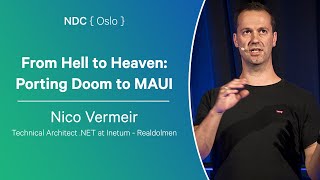
From Hell to Heaven: Porting Doom to MAUI - NDC Oslo 2024
Explore the journey of porting Doom to MAUI, uncovering challenges, workarounds, and insights into cross-platform development using Microsoft's framework.

Building Consensus for C++ Naming Conventions at Bloomberg
Explore Bloomberg's process for building consensus on C++ naming conventions across a massive codebase, learning from their challenges and successes to apply in your own organization.

Dude, Where's My Code? - Improving Julia's Debugging and Code Update Capabilities
Exploring Julia's usability challenges in debugging and live updates, with focus on improving code provenance tracking and enhancing macro expansion for better developer experience.
Gatlab - Combining Computer Algebra and Standard ML Modules
Explore GATlab, combining computer algebra with Standard ML modules. Learn to create and manipulate algebraic theories, interpret syntax trees, and work with generalized algebraic theories for advanced mathematical structures.
A Cloud-Native Parallel Data Processing Application in Julia
Explore cloud-native parallel data processing in Julia, covering design, debugging, and profiling techniques for high-performance applications. Learn AWS integration, containerization, and performance optimization strategies.
Extrae.jl: Advanced Profiling of Julia Code in HPC Clusters
Explore advanced profiling of Julia code in HPC clusters using Extrae.jl. Learn to annotate regions, sample hardware counters, and optimize performance for scientific applications on various architectures.