Introduction to Entity Component System (ECS) in Game Programming - Lecture 5
Explore Entity Component System (ECS) architecture for game programming, covering design principles, implementation details, and practical coding examples using C++ and SFML.

What Do You Mean by Cache Friendly - Optimizing Data Structures for CPU Performance
Explore cache-friendly data structures and algorithms in C++. Learn techniques to analyze and improve cache efficiency, optimizing performance through memory layout and access patterns.
Recipes for Reducing Allocations by C++ Containers - C++ on Sea 2022
Explore techniques to minimize allocations in C++ containers, including vector reservations, container choices, constructors, scope promotion, view types, and PMR allocators. Gain insights with benchmarks and diagnostics.

How to Rangify Your Code - C++ on Sea 2022
Learn to apply C++20 ranges to real-world code examples, using standard library and range-v3 library. Explore techniques for refactoring existing algorithms and thinking in terms of ranges.
Contractual Disappointment in C++ - Ensuring Robust Software Development
Explore effective strategies for robust C++ software development, focusing on contracts and interfaces to enhance usability, efficiency, and reliability in program operation.
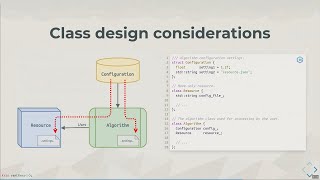
Special Member Functions in C++ - Lecture
Explore special member functions in C++, including constructors, destructors, and copy/move operations. Learn definition rules, implementation idioms, and common scenarios for effective C++ programming.
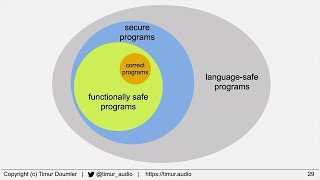
C++ and Safety - Exploring Memory Safety and Language Evolution
Explore C++ safety issues, their consequences, and potential solutions. Examine memory safety, language evolution, and comparisons with other programming languages. Discuss tools and proposals for improving C++ safety.
New Algorithms in C++23 - Lecture 1
Explore new C++23 Ranges library algorithms and their types, from C++98 to C++23. Gain insights into advanced programming techniques and language features for efficient coding.
A Safer Iteration Model for C++ - Flux Library Introduction
Explore a safer iteration model for C++, introducing Flux library. Learn about reducing undefined behavior, performance implications, and quality-of-life improvements in C++20 Ranges.
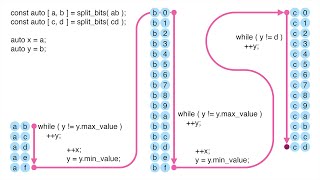
Why C++ Loops End - Midnote
Explore reasons for loop termination in C++ and learn to formally express them in code. Gain insights into stability, substitutability, and repeatability principles for robust loop design.
Polymorphism, Cohesion, and Coupling in C++ - Lecture
Explore low coupling and high cohesion through polymorphism in C++. Learn to implement a performance-efficient framework using template metaprogramming for easy composition and feature addition.
Employing Modern C++ for High Performance Delta-Coding Compression
Explore high-performance delta-coding compression using modern C++. Learn reflection-like techniques, delta compression principles, and micro-benchmarking for low-latency code optimization.
The Power of C++ Templates with mp-units: Lessons Learned and New Library Design - 2023
Explore advanced C++ template techniques, focusing on mp-units library design. Learn about dimensional analysis, quantity manipulation, and novel C++20/23 features for improved interfaces.
AI-Assisted Software Engineering - Endnote
Explore AI-assisted software engineering tools revolutionizing code writing and problem-solving for C++ developers. Learn about AI-powered code generation and root-cause analysis techniques.
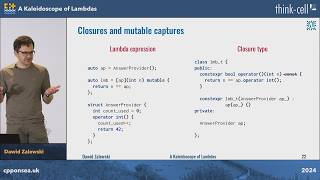
A Kaleidoscope of C++ Lambdas
Explore C++ lambda expressions' syntax, features, and applications. Learn to simplify code, implement functional programming techniques, and leverage lambda-specific idioms for more expressive and efficient C++ development.
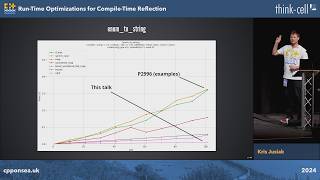
C++ Run-Time Optimizations for Compile-Time Reflection - Lecture 1
Explore static reflection in C++26, focusing on code injection, stateful meta-programming, and runtime performance optimizations. Dive into enum_to_string and string_to_enum case studies.
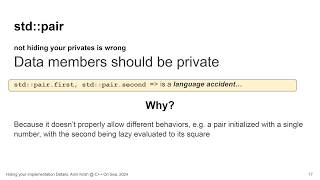
Hiding Your Implementation Details in C++ - Challenges and Best Practices
Explore challenges and best practices for hiding implementation details in C++. Learn to write more elegant, robust, and maintainable code by mastering encapsulation and decoupling techniques.
Understanding The constexpr Two-Step
Explore the "constexpr two-step" method for generating compile-time data of unknown size and efficiently transferring it to runtime, minimizing binary sizes in C++20.
C++ in Constrained Environments
Explore modern C++ techniques for constrained environments, focusing on simplicity, performance, and safety. Learn top-down approaches from the language's creator.

Principia Mathematica - The Foundations of Arithmetic in C++ - Lecture
Explore C++ integral arithmetic operations through formal interface design, mathematical theorems, and procedural proofs. Gain insights into foundations of arithmetic and writing mathematical proofs.

C++20's Coroutines for Beginners - Lecture
Explore C++20 coroutines from basics to advanced concepts. Learn new keywords, customization points, and benefits like lock-free multitasking. Gain practical knowledge for effective implementation.