Design Datalog Templates for Synthesizing Bidirectional Programs from Tabular Examples
Design Datalog templates for synthesizing bidirectional programs from tabular examples, exploring innovative approaches in program synthesis and transformation.
Program Synthesis via Bi-directional Reduced-product Abstract Interpretation - N40AI'24
Explore bi-directional reduced-product abstract interpretation for inductive program synthesis, focusing on example-based techniques and their application to bit-manipulation programs.
SuSLik: Deductive Synthesis of Safe Programs with Pointers - Tutorial 1b
Explore deductive program synthesis for creating provably correct pointer-manipulating programs using SuSLik. Practice specifying programs with formal logic and learn about separation logic.
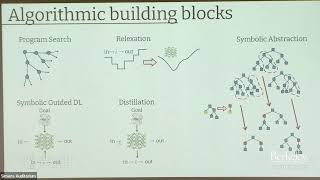
A Tutorial on Neurosymbolic Techniques
Explore neurosymbolic techniques for synthesizing models and systems, blending neural networks with symbolic reasoning to enhance AI capabilities.
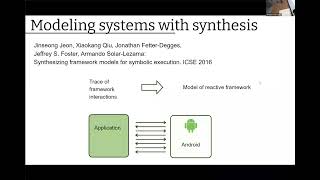
Better Learning Through Programming Languages: Neurosymbolic Synthesis and Learning
Explore program synthesis evolution as a learning tool, from early data-driven models to modern neurosymbolic algorithms.
Deep Learning Advances in Uncertainty and Generative Modeling - Session 1
Explore cutting-edge deep learning research, including Bayesian methods, generative modeling, visual concept programming, conformal regression, and heteroskedastic regression analysis.
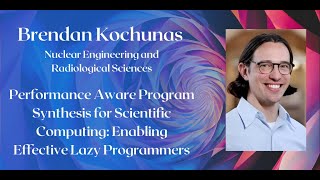
Performance Aware Program Synthesis for Scientific Computing - Enabling Effective Lazy Programmers
Explore performance-aware program synthesis techniques for scientific computing, focusing on efficient code generation and optimization strategies for computational research.
Learning Libraries of Programmatic Policies
Discover how artificial agents can learn and maintain libraries of reusable behaviors for solving sequential decision-making problems through programming and neural network approaches.
Program Synthesis: Applications, Experiences, and Neuro-Symbolic Techniques
Explore program synthesis applications across spreadsheets, development, and education, discovering how user intent combines with neuro-symbolic techniques and LLMs for enhanced automated solutions.
Abstraction and Evolution with Large Language Models
Explore how large language models enhance genetic programming through concept-guided evolution, with applications in symbolic regression and image classification demonstrated through practical examples.