Semi-Automated Direction-Driven Functional Conversion - miniKanren'23
Explore semi-automated direction-driven functional conversion techniques in miniKanren, enhancing program transformation and optimization capabilities.
Semantic Code Refactoring for Abstract Data Types
Explore automated semantic code refactoring for Abstract Data Types using a novel method that generates equivalent implementations based on new data representations and relational invariants.
Fusing Direct Manipulations into Functional Programs
Explore a novel framework for bidirectional live programming that fuses direct manipulations into functional programs, enabling code-insensitive output modifications and automatic source code updates.
A Neural Network Solves and Generates Mathematics Problems by Program Synthesis - Paper Explained
Explore how OpenAI's Codex model solves university-level math problems through program synthesis, covering calculus, differential equations, and linear algebra. Learn about prompt engineering and problem generation techniques.
DreamCoder- Growing Generalizable, Interpretable Knowledge With Wake-Sleep Bayesian Program Learning
Explores DreamCoder's approach to program synthesis, combining neural-guided search with symbolic reasoning to learn generalizable knowledge and solve complex tasks through iterative abstraction and refinement.
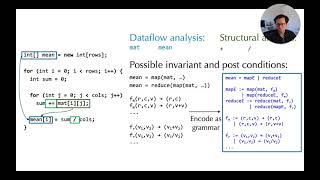
Using Program Synthesis to Build Compilers
Explore program synthesis techniques for building efficient compilers, focusing on syntax-driven compilation, verification, and evaluation methods.
Autoformalization with Large Language Models - IPAM at UCLA
Explore autoformalization using large language models for translating natural language math to formal proofs, advancing formal verification and AI in mathematics.
Interpretable Machine Learning via Program Synthesis - IPAM at UCLA
Explore interpretable machine learning through program synthesis, focusing on control policies and RNA splice prediction. Learn novel approaches for creating custom, problem-specific model families.
Verifying the Verifier - eBPF Range Analysis Verification
Automated tool Agni checks eBPF verifier's range analysis correctness, extracts semantics from kernel source, and synthesizes programs to expose potential bugs in older kernel versions.
Sequence Abstractions for Flexible, Line-Rate Network Monitoring
Introduces FLM, a language for network monitoring that recognizes packet sequences. Compiles to P4 code for switch ASICs, enabling efficient implementation of various monitoring tasks.
Inductive Program Synthesis via Iterative Forward-Backward Abstract Interpretation
Explore a novel approach to inductive program synthesis using iterative forward-backward abstract interpretation, enhancing search space pruning and improving synthesis efficiency.
One Pixel Adversarial Attacks via Sketched Programs
Explore a novel approach for one-pixel adversarial attacks using program synthesis, achieving state-of-the-art success rates with fewer queries and transferable programs for neural network classifiers.
Trace-Guided Inductive Synthesis of Recursive Functional Programs
Explore a novel trace-guided approach for synthesizing recursive functional programs from input-output examples, addressing ambiguity and generalization challenges in program synthesis.
Towards a Language-parametric DSL for Refactoring - Short Paper
Explore a language-parametric DSL approach for refactoring, examining its potential to streamline code improvement across multiple programming languages.
Synthesis 2 - Session Preview
Explore cutting-edge research in program synthesis with Hila Peleg's preview of the Synthesis 2 session at POPL'24, highlighting recent advancements in the field.
Toward Probabilistic Coarse-to-Fine Program Synthesis
Explore probabilistic coarse-to-fine program synthesis, a novel approach using iterative refinement of stochastic programs to efficiently search and generate programs matching specifications.
API-Driven Program Synthesis for Testing Static Typing Implementations
Explore API-driven program synthesis for testing static typing in compilers. Learn about generating type-intensive programs using existing APIs to uncover compiler bugs efficiently.
Efficient Bottom-Up Synthesis for Programs with Local Variables
Explore a novel synthesis algorithm for efficient program search with local variables, featuring lifted interpretation for improved space reduction in web automation tasks.
Machine Learning Meets Program Synthesis - TutorialFest at POPL'24
Explore key principles for leveraging machine learning in program synthesis, examining challenges at the intersection of programming languages, software engineering, and AI.
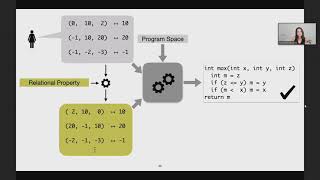
Program Synthesis - A Dream Realized
Explore program synthesis, its challenges, and innovative approaches to improve inductive synthesis engines' generalizability and robustness. Learn about classical and inductive methods, common problems, and semantics-guided solutions.
You Are a Program Synthesizer
Explore program synthesis insights to improve coding skills. Learn about code quality, specification-driven development, and advanced analysis techniques for better programming practices.