In Conversation - Organisms and Size - Why Size Matters by Amitabh Joshi and TNC Vidya
Explore how size impacts organisms' structures, behaviors, and evolution. Learn about gravity's effects, surface tension, and size-related adaptations across species with experts Joshi and Vidya.
Sylvie Méléard- Multiscale Eco-Evolutionary Models- From Individuals to Populations
Exploring eco-evolutionary models from individual to population scales, focusing on small population effects, mutation dynamics, and long-term behaviors using stochastic processes and mathematical approximations.
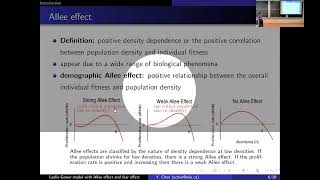
Dynamic Behaviors of a Leslie-Gower Model With Strong Allee Effect and Fear Effect in Prey
Explore dynamic behaviors in a Leslie-Gower model, examining strong Allee effect and fear effect in prey populations. Gain insights into ecological modeling and population dynamics.
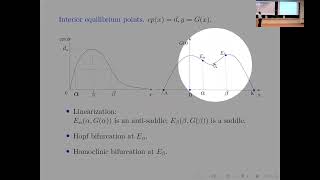
A Predator-Prey System with Generalized Holling Type Functional Responses and Allee Effects in Prey
Explore predator-prey dynamics with generalized Holling responses and Allee effects, examining mathematical models and ecological implications in population interactions.
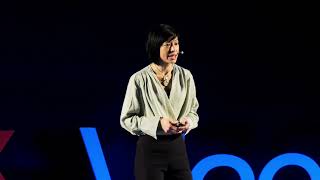
Climate Change Effects on Population Dynamics
Exploring the impact of climate change on fertility, mortality, and migration, and the need for inclusive policies to address these demographic shifts.

Demographic Models of Age-Structured Populations by Sarah Otto
Explore demographic models of age-structured populations, examining how population dynamics and evolutionary processes interact across different life stages and generations.
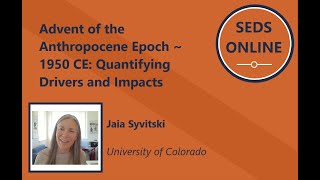
Advent of the Anthropocene Epoch - Quantifying Drivers and Impacts Since 1950 CE
Explores the Anthropocene epoch's onset around 1950, examining human energy consumption, population growth, and their profound impacts on Earth's systems and stratigraphic record.
Maps, Networks and Mechanisms: System Modeling and Analysis of Disease Maps
Explore disease map modeling and analysis techniques for understanding complex biological systems and their applications in cancer research and treatment strategies.
Modulation of Ensemble-level TNFR1 Mediated Apoptosis Response - Lecture 2
Explore ensemble-level TNFR1 mediated apoptosis response modulation, delving into advanced concepts of cancer cell death mechanisms and potential therapeutic implications.
Dynamics of Biological Systems - Lecture 4
Explore biological dynamics using physics tools to model predator-prey oscillations, ecosystem chaos, and microbial swimming. Learn to predict species competition, population changes, and collective behavior in fluids.
Dynamics of Biological Systems - Lecture 1
Explore biological dynamics using physics tools to model complex living systems, from predator-prey oscillations to bacterial motility, in this introductory course for undergraduates.
Dynamics of Biological Systems - Lecture 2
Explore biological dynamics using physics tools to model predator-prey oscillations, ecosystem chaos, and microbial swimming. Learn to predict species competition, population changes, and collective behavior in fluids.
Dynamics of Biological Systems - Lecture 3
Explore biological dynamics using physics tools to model predator-prey oscillations, ecosystem chaos, and microbial swimming. Learn to predict species competition, population changes, and collective behavior in fluids.
The Inevitable Density-Dependent Dispersal of Viral Populations and the Emergence of Pushed Waves - Lecture 1
Explore density-dependent dispersal in viral populations and the emergence of pushed waves, focusing on cutting-edge research in viral dynamics and population spread.
Is Cross-Feeding Evolutionarily Stable?
Explore the evolutionary stability of cross-feeding in microbial communities through an insightful analysis of ecological dynamics and selective pressures.
The Impact of Flow and Flow-Oriented Swimming on the Capacity to Aggregate
Explore how fluid flows and rheotaxis affect group formation in cells and animals, revealing optimal strategies for aggregation in dynamic environments.
Range Dynamics for a Spatially Structured Asexual Population
Explore range dynamics of spatially structured populations, considering spatial propagation and evolutionary dynamics in heterogeneous environments.
Filling the Gap Between Individual-Based Evolutionary Models and Hamilton-Jacobi Equations
Explore Hamilton-Jacobi equations in quantitative genetics, bridging stochastic individual-based models and phenotypic density analysis through asymptotic derivations and population dynamics.
Adaptation in a Heterogeneous Environment - A Host in the Middle
Explore nonlocal reaction-diffusion equations modeling adaptation dynamics in multi-patch environments. Analyze persistence, extinction, and the impact of migration and host addition on fitness.
Density-Dependent Diffusion in Expanding Phage Populations
Explore density-dependent diffusion in expanding phage populations, examining pulled vs. pushed waves and the impact on viral evolution and adaptability.
Evolution of Dispersal in Spatially Heterogeneous Environments - Dockery's Problem
Explore the evolution of dispersal in heterogeneous environments through mathematical models, focusing on recent advancements in diffusion-competition systems and selection-mutation models.