The Complexity of the Local Hamiltonian Problem
Explore the complexity of the Local Hamiltonian Problem, its NP-containment proof, and connections to adiabatic computation and open quantum systems in this advanced physics lecture.
Loss Landscape and Performance in Deep Learning by Stefano Spigler
Explore deep learning's loss landscape, performance, and theoretical insights. Discover connections to statistical physics, jamming, and neural tangent kernels. Gain understanding of learning dynamics and network behavior.
The Sensitivity Conjecture: A Proof from the Book and Connections to Physics
Explore the elegant proof of the Sensitivity Conjecture, its implications for theoretical computer science, and connections to physics concepts like Majorana fermions.
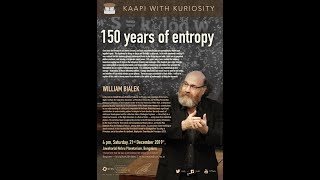
150 Years of Entropy by William Bialek
Explore the concept of entropy across physics, information theory, and technology with Princeton's William Bialek. Discover how this fundamental idea shapes our understanding of the universe and modern innovations.
Quantum Technology - Concepts and Prospects
Explore quantum technologies' breakthroughs, from sensors and communications to computation. Learn about quantum algorithms, simulations, and their practical applications in various fields.
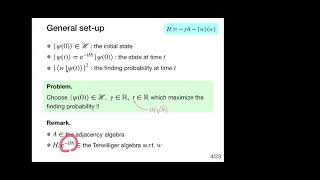
Spatial Search on Johnson Graphs by Continuous-Time Quantum Walk
Explore quantum walks on Johnson graphs for spatial search, covering setup, strategies, and analysis of search algorithms and success probabilities.
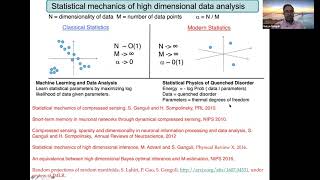
Weaving Together Machine Learning, Theoretical Physics, and Neuroscience
Exploring the intersection of machine learning, physics, and neuroscience through complex systems analysis to develop better algorithms and understand neural systems.
Unified Understanding of E(3)-Equivariant Interatomic Potentials - Theory and Applications
Explore E(3)-equivariant interatomic potentials, covering theory, applications, and advancements in machine learning approaches for quantum mechanics and molecular dynamics simulations.
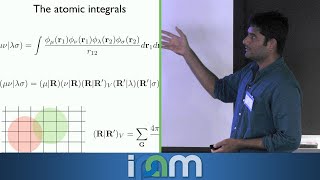
Auxiliary Field Quantum Monte Carlo - AFQMC with Multi Slater Wavefunctions
Explore advanced quantum Monte Carlo techniques, focusing on AFQMC with multi-Slater wavefunctions and efficient exchange matrix evaluation for large-scale quantum systems.
Fermionic Neural-Network Quantum States - IPAM at UCLA
Explore fermionic neural-network quantum states, their efficient representations, and applications in quantum mechanics with Giuseppe Carleo's insightful presentation at IPAM's workshop.
Contracted Quantum Eigensolver for the Quantum Simulation of Many-Electron Systems
Explore a novel quantum algorithm for many-body systems, comparing it to existing methods and demonstrating its advantages in molecular simulations and quantum computing applications.

Quantum Simulation - IPAM at UCLA
Explore quantum simulation's origins, relevance, and key concepts with Nathan Wiebe. Delve into Schrödinger equations, Hamiltonian simulation, and Taylor's theorem in this comprehensive lecture.
End-to-End Learning and Auto-Differentiation - Forces, Uncertainties, Etc.
Explore deep learning and auto-differentiation in molecular simulations, covering surrogate functions, sampling distributions, and time-propagation of differential equations for scientific problem-solving.
Advancing Molecular Simulation with Deep Learning - IPAM at UCLA
Explore cutting-edge applications of deep learning in molecular simulation, covering quantum chemistry, force fields, and Markov State Models for advanced scientific research.
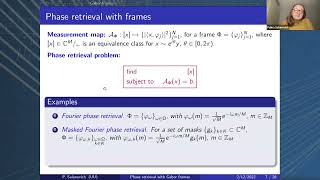
STFT Phase Retrieval - Robustness and Generative Priors - IPAM at UCLA
Explore STFT phase retrieval, focusing on robustness and generative priors. Learn about stable reconstruction techniques, application of generative models, and reducing required measurements in imaging and acoustics applications.
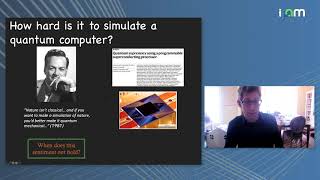
Phase Transitions in the Complexity of Simulating Random Shallow Quantum Circuits
Explores phase transitions in simulating random shallow quantum circuits, discussing computational complexity, tensor network contraction, and mapping 2D circuits to 1D processes with implications for quantum computing.
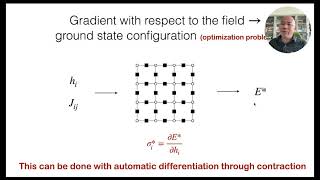
Tropical Tensor Networks
Unified tensor network approach for spin glasses using tropical algebra, enabling ground state energy computation, optimal configuration identification, and solution counting. Combines graphical models and quantum circuit simulation.
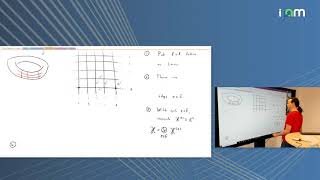
David Gross: Stabilizer Formalism & Quantum Error Correction Through the Lens of Tensors
Explore advanced quantum error correction techniques, focusing on the stabilizer formalism and its applications in quantum fault tolerance, using tensor-based approaches and group theory.
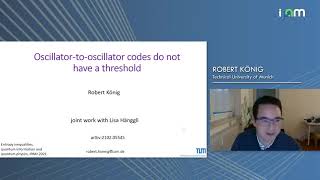
Oscillator-to-Oscillator Codes Do Not Have a Threshold
Explores limitations of oscillator-to-oscillator codes in quantum information, proving they lack a threshold property for error correction when using constant squeezing and maximum likelihood decoding.
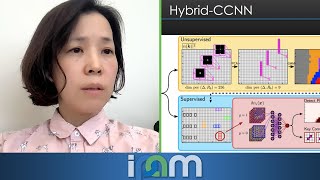
Machine Learning for Quantum Simulation - IPAM at UCLA
Explore machine learning applications in quantum simulation, focusing on neural networks for phase recognition and insights into complex quantum systems.
Tensor Networks -QC-DMRG- in a Complete Active Space Coupled Cluster Method
Explore tensor networks in quantum mechanics, focusing on their application in coupled cluster methods for modeling strongly correlated systems and computing dynamical correlations.