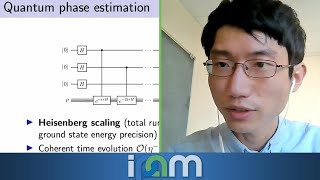
Heisenberg-Limited Ground State Energy Estimation for Early Fault-Tolerant Quantum Computers
Explore Heisenberg-limited ground state energy estimation for early fault-tolerant quantum computers, featuring a simplified circuit and classical post-processing for improved efficiency.
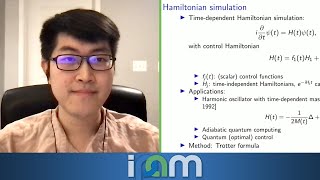
Improved Complexity Estimation for Hamiltonian Simulation with Trotter Formula
Explore improved complexity estimation for Hamiltonian simulation using Trotter formula, focusing on time-dependent effective mass and near adiabatic dynamics scenarios with potential for enhanced efficiency.
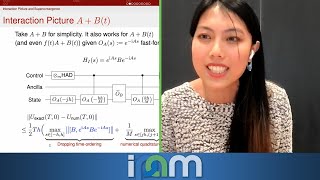
Time-Dependent Hamiltonian Simulation of Highly Oscillatory Dynamics - IPAM at UCLA
Explore highly oscillatory dynamics in quantum systems, focusing on efficient simulation algorithms for time-dependent Hamiltonians with applications in various scientific fields.
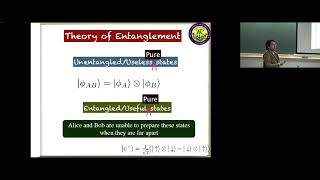
Quantum Phase Transitions Through Quantum Information Window by Aditi De
Explore quantum phase transitions through entanglement, focusing on bipartite and multipartite entanglement as detectors. Discover how entanglement plays a crucial role in detecting dynamical quantum phase transitions.
Deep Learning Applications by Rina Panigrahy
Explore deep learning applications, from basic concepts to advanced techniques. Learn about neural networks, optimization methods, and real-world uses in image and speech recognition.
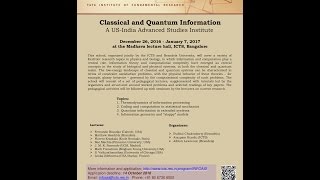
From Information Theory to Learning via Statistical Physics - Introduction
Explore connections between information theory, statistical physics, and learning. Delve into classical statistics, high-dimensional problems, and Bayesian approaches, with applications in signal processing and regression.
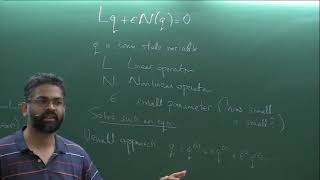
Perturbation Methods for Nonlinear PDEs - Lecture 1
Explore perturbation methods for nonlinear PDEs, focusing on adapting linear equation techniques. Learn unified approaches through examples from cold atoms, water waves, and atmospheric science.
Computational Imaging Systems and Optical Design - Webinar
Explore computational imaging systems, diffractive optics, and neural network-based reconstruction in this advanced signal processing webinar by Prof. Wolfgang Heidrich from KAUST.

Machine Learning Based on Stochastic Magnetic Tunnel Junctions
Explore spintronics-based neuromorphic systems for efficient machine learning, addressing device variability through in situ learning in Boltzmann machines for autonomous AI applications.
Journal Club - Benchmarking a High-Fidelity Mixed-Species Entangling Gate
Explore high-fidelity mixed-species entangling gates in ion traps, discussing benchmarking techniques and future milestones in quantum computing research.
Physical Review Journal Club - Quantum Research with the Authors
Explore efficient quantum simulation for molecular spectroscopy using superconducting bosonic processors, with insights on implementation, photon detection, and algorithmic approaches.
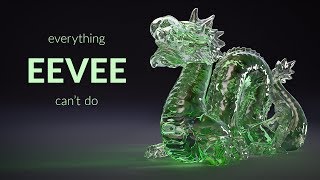
When Not to Use Eevee for Blender Rendering
Explore Eevee's limitations in Blender 2.8, comparing it to Cycles and understanding when to choose each render engine for optimal results in various 3D rendering scenarios.
Intro to Cloth Sims & Softbody Dynamics in Blender 2.93 - 2021
Learn to simulate soft objects in Blender 2.93, including cloth folding, bouncing balls, and draping curtains. Master soft body dynamics and cloth simulations for realistic, deformable objects.
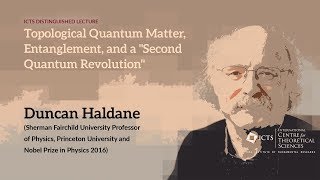
Topological Quantum Matter, Entanglement, and a "Second Quantum Revolution" by Duncan Haldane
Explore topological quantum matter, entanglement, and the "second quantum revolution" with Nobel laureate Duncan Haldane. Discover exotic states, quantum information theory, and potential applications in quantum computing.
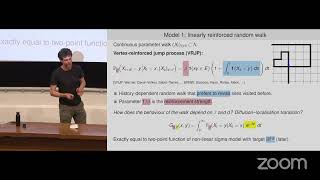
Spin Systems with Hyperbolic Symmetry
Explore spin systems with hyperbolic symmetry, their origins, applications in probabilistic models, recent findings, and open questions in this advanced mathematical discussion.
Rydberg Physics for Quantum Information Processing
Explore Rydberg physics and its applications in quantum information processing, covering key concepts and recent advancements in this cutting-edge field of research.
Quantum Walks on Hierarchical Graphs
Explore quantum walks on hierarchical graphs, examining their properties and applications in quantum information theory and quantum computing.
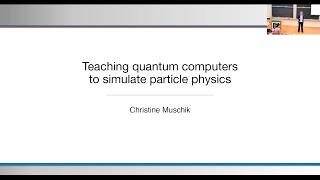
Teaching Quantum Computers to Simulate Particle Physics
Explore quantum computing's potential in simulating particle physics, focusing on innovative approaches and cutting-edge research in this rapidly evolving field.
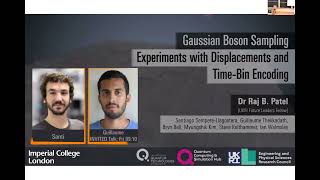
Gaussian Boson Sampling Experiments with Displacements and Time-Bin Encoding
Explore cutting-edge quantum information experiments using Gaussian Boson Sampling, focusing on displacements and time-bin encoding techniques in this advanced physics lecture.
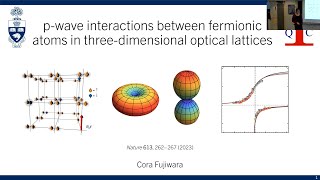
Strongly Interacting P-Wave Fermionic Atoms in Three-Dimensional Optical Lattices
Explore p-wave fermionic atoms in 3D optical lattices, focusing on strong interactions and their implications for quantum information and condensed matter physics.
Learning to Predict Arbitrary Quantum Processes
Explore quantum learning theory and its surprising ability to predict local properties of arbitrary quantum circuits, contrasting with classical limitations and highlighting potential for efficient quantum dynamics prediction.