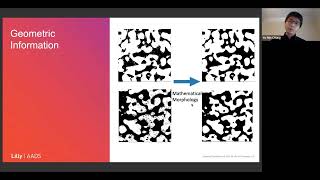
A Multi-Parameter Persistence Framework for Mathematical Morphology
Exploring mathematical morphology through persistent homology, offering new insights for image processing and automated denoising techniques in binary, grayscale, and color images.
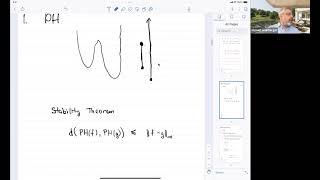
Shmuel Weinberger - PH(X^Y) and the Geometry of Function Spaces
Exploring persistent homology in function spaces through geometric considerations, focusing on examples that illuminate this central topic in algebraic topology.
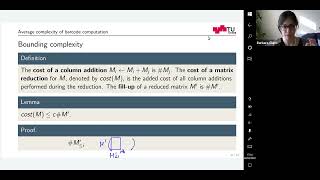
Barbara Giunti - Average Complexity of Barcode Computation for Vietoris-Rips Filtrations
Explore algorithmic complexity of persistent homology in random Vietoris-Rips filtrations, focusing on boundary matrix fill-up and its implications for computational efficiency.
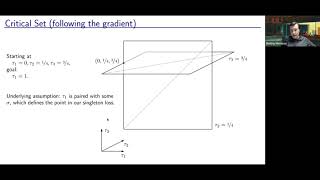
Topological Optimization with Big Steps
Explore persistent homology for optimization, using cycles and chains to prescribe gradients. Learn about a linear-time algorithm for special cases and its practical benefits in reducing optimization steps.

Minimal Cycle Representatives in Persistent Homology Using Linear Programming
Explores optimization techniques for selecting minimal cycle representatives in persistent homology, comparing effectiveness and computational costs of various algorithms using linear programming methods.
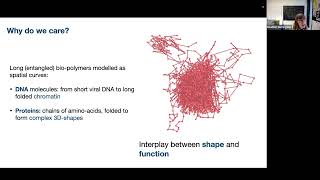
Shape of Data in Biology - Extending the PH Pipeline
Exploring spatial structure in biological data using topological data analysis, with focus on knotted proteins and introducing hyperTDA for interpretable, automated analysis of complex systems.
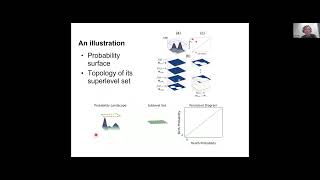
Non-Diffusive Vortexes at Transition State of Activated Process by Persistent Homology
Exploring non-diffusive dynamics in molecular transitions using persistent homology, revealing reactive vortexes and rotational fluxes at transition states of alanine-dipeptide isomerization.
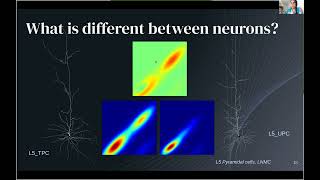
A Topological Understanding of Neuronal Morphologies
Exploring topological data analysis for neuronal morphologies, from single cells to networks. Highlights applications in classification, clustering, and solving inverse problems in neuroscience.
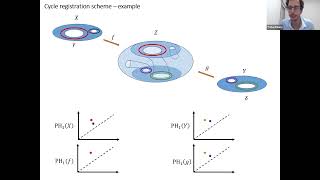
Persistent Cycle Registration and Topological Bootstrap
Novel approach for comparing persistent homology representations, utilizing spatial placement of persistent cycles. Demonstrates application in topological inference to differentiate signal from noise in point cloud data.
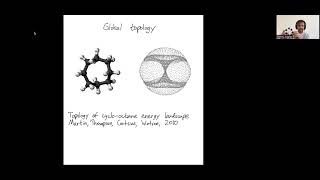
Henry Adams - Topology in Machine Learning
Explore persistent homology in machine learning, covering applications in materials science, computer vision, and agent-based modeling. Learn how topology relates to dataset geometry and explainable AI.
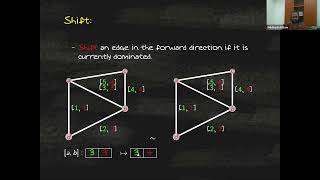
Swap, Shift and Trim to Edge Collapse a Flag Filtration
Exploring efficient algorithms for reducing flag filtrations in persistent homology, with focus on edge collapse techniques and their applications in computational topology.
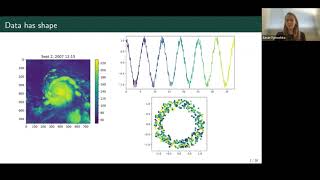
Topological Time Series Analysis for Hurricanes and Dynamical Systems
Explore topological data analysis applications in studying hurricane satellite imagery and dynamical system bifurcations using persistent homology and zigzag persistence techniques.

Ephemeral Persistence Modules and Distance Comparison
Exploring sheaf theoretic methods in persistent homology, comparing approaches using Alexandrov's and gamma-topology, and examining pseudo-distances in persistence module spaces.
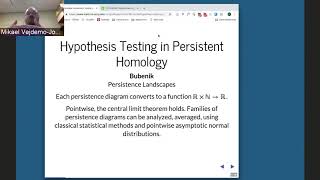
Multiple Hypothesis Testing with Persistent Homology
Exploring methods for multiple hypothesis testing in persistent homology, including family-wise error rates and false discovery rates, with applications to Mapper complex validation.
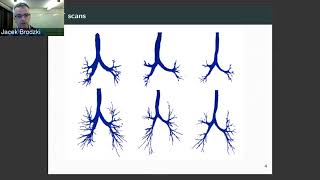
Quantifying Lung Structure in COPD and Solubility of Chemical Compounds
Explore topological data analysis applications in medicine and chemistry, focusing on lung structure in COPD and chemical compound solubility using persistent homology as a key tool.
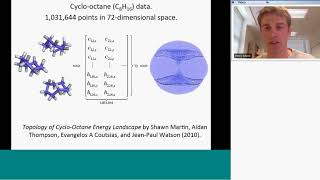
The Vietoris Rips Complex of the Circle
Explore the Vietoris-Rips complex of the circle, its homotopy types at different thresholds, and implications for persistent homology in topological data analysis.
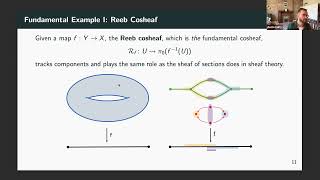
Exemplars of Sheaf Theory in TDA
Exploring sheaf theory applications in topological data analysis through four case studies, covering level set persistence, merge trees, and innovative approaches to persistent homology.
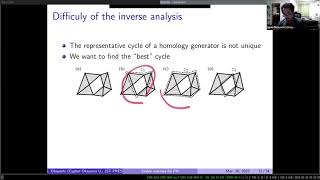
Ippei Obayashi - Stable Volumes for Persistent Homology
Explore stable volumes in persistent homology: a novel method to identify robust topological structures in data, overcoming instability issues and revealing minimal building blocks.
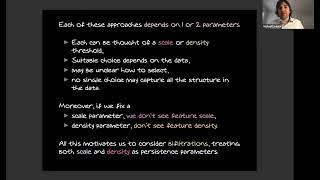
Stability of 2-Parameter Persistent Homology
Explores stability results for 2-parameter persistent homology, covering multicover bifiltration, subdivision bifiltrations, and degree bifiltrations. Discusses computational aspects and implications for practical applications.
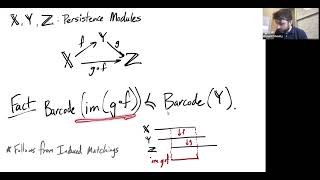
Don Sheehy - Persistent Homology of Lipschitz Extensions
Explore persistent homology of Lipschitz functions, analyzing sublevel set filtrations and barcodes from sample data. Learn about sub-barcodes and their theoretical guarantees in topological data analysis.
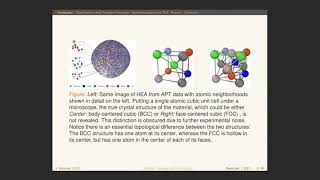
Statistics, Topology and Data Analysis
Explore the synergy between statistics and topological data analysis for solving real-world problems, with a focus on supervised learning and applications in materials science.