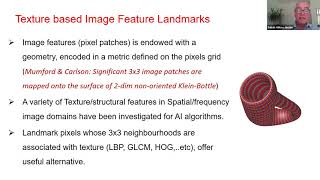
Topological Analysis of Convolutional Neural Network Layers for Image Analysis
Explore the impact of CNN layers on image topological texture features, examining their effectiveness in detecting subtle changes and understanding decision-making processes in image analysis.
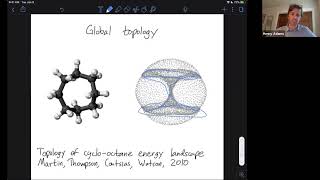
From Persistent Homology to Machine Learning
Overview of persistent homology's applications in machine learning, exploring its use in analyzing global topology and local geometry of datasets, with examples from various fields and discussions on stability and interpretability.
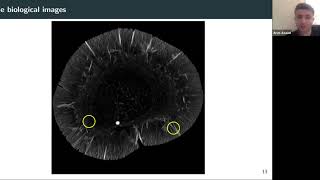
Peter Bubenik - Topological Data Analysis for Biological Images
Explore topological data analysis for biological images, combining persistent homology with machine learning to classify cell structures and analyze various image types.
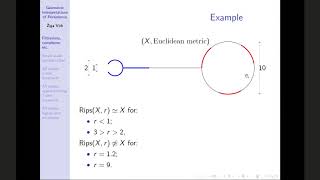
Geometric Interpretation of Persistence
Explore geometric interpretations of persistence in algebraic topology, covering space reconstruction, one-dimensional persistent homology classification, and detection of contractible geodesics using higher-dimensional features.
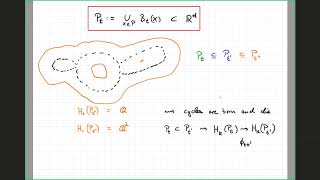
Limit Theorems in Topological Data Analysis
Explore limit theorems in topological data analysis, focusing on barcodes, persistence modules, and random persistence modules. Learn about convergence proofs and expectations for uniform distributions on compact submanifolds.
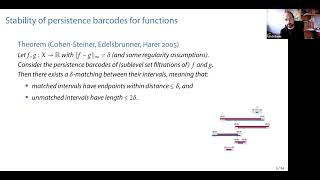
Persistence in Functional Topology
Explore functional topology's evolution, connecting persistent homology to critical point theory and calculus of variations. Gain insights into Morse's theory and its application to minimal surfaces.
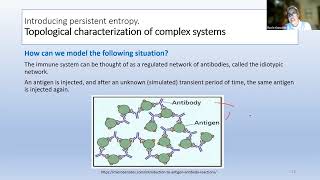
Persistent Entropy, a Tool for Topologically Summarizing Data
Explore persistent entropy as a tool for data summarization, covering its properties, stability, and diverse applications in emotion recognition, cell organization, and literary analysis.
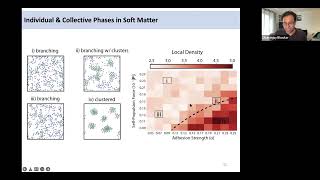
Data-Driven Modeling & TDA of Self-Organized Multicellular Architectures
Explore data-driven modeling and topological data analysis for classifying multicellular structures in cancer and embryonic development, focusing on cell motility and adhesion patterns.
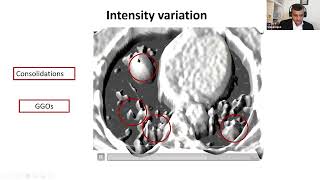
Classification of COVID-19 via Homology of CT-Scans
Explore topological data analysis for COVID-19 detection in CT scans, using persistent homology to quantify shape features and achieve high accuracy in classification.
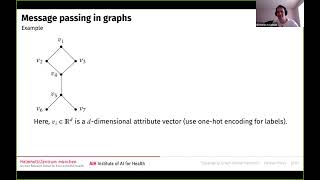
Bastian Rieck - Topological Graph Neural Networks
Explore topological data analysis in graph representation learning, focusing on novel techniques that incorporate topological features to enhance graph neural networks' expressivity and performance.
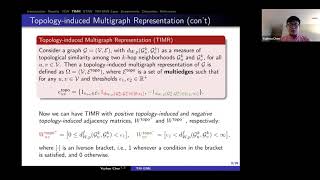
Topological Relational Learning on Graphs
Explore topological relational learning on graphs, enhancing graph neural networks with higher-order information and local structure learning for improved classification and robustness to perturbations.
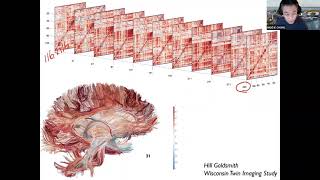
Topological Learning and Its Application to Multimodal Brain Network Integration
Explore topological learning for integrating multimodal brain networks, focusing on a novel framework using persistent homology and Wasserstein distance-based loss for efficient computations in neuroimaging studies.
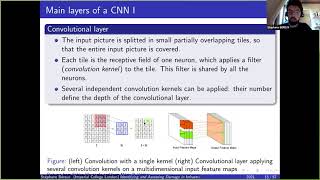
Identifying and Assessing Damage in Infrastructure Using Topological Data Analysis and Machine Learning
Innovative approach using topological data analysis and machine learning for low-cost, imaging-based concrete damage assessment in infrastructure, offering a potential alternative to expensive laboratory diagnostics.
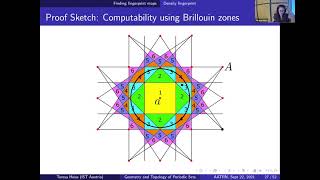
Geometry and Topology of Periodic Point Sets, for Example Crystals
Explore geometric and topological tools for characterizing crystalline materials, including Brillouin zones and persistent homology, and discuss challenges in defining persistent homology for periodic point sets.
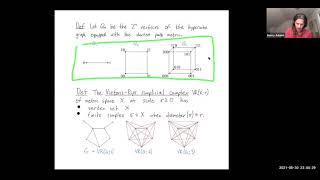
Henry Adams - Vietoris-Rips Complexes of Hypercube Graphs
Explore Vietoris-Rips complexes of hypercube graphs, their homotopy types, and applications in genetic recombination and persistent homology. Discover formulas, open questions, and conjectures in this fascinating area of applied algebraic topology.

Other Persistence Invariants - Homotopy and the Cohomology Ring
Explore persistent homotopy groups and cohomology rings, focusing on fundamental groups, rational homotopy, and cup-length diagrams. Learn about new tools complementing persistent homology in topological data analysis.
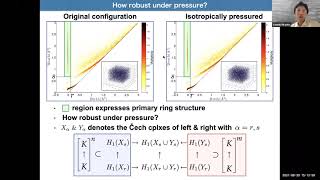
On Characterizing Rare Events in Persistent Homology
Explore rare events in persistent homology, focusing on indecomposables in multi-parameter settings. Learn about large deviation principles and laws of large numbers in topological data analysis.
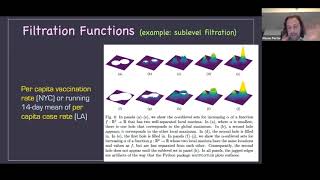
Mason Porter - Topological Data Analysis of Spatial Complex Systems
Explore topological data analysis in spatial systems, from spider webs to COVID-19 spread. Learn filtered simplicial complexes and their applications in various real-world scenarios.

GPU Accelerated Computation of VR Barcodes in Evaluating Deep Learning Models
GPU-accelerated computation of VR barcodes for evaluating deep learning models, focusing on Ripser++ software and its applications in measuring data distribution shifts and analyzing attention graphs in BERT models.
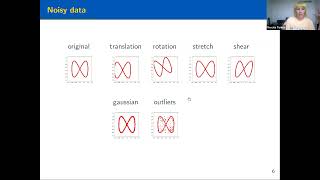
On the Effectiveness of Persistent Homology
Exploring persistent homology's effectiveness in shape analysis tasks, outperforming baselines in detecting holes, curvature, and convexity from point clouds, with robustness to limited resources and data transformations.

Approximation of Compact Metric Spaces by Finite Samples
Explore topological data analysis through finite approximations of compact metric spaces, connecting Shape Theory and Persistence for robust feature extraction from noisy datasets.