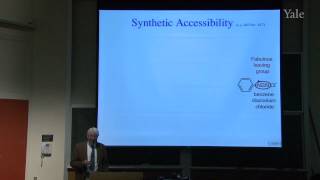
Aromatic Substitution in Synthesis: Friedel-Crafts Reactions and Benzylic Chemistry
Explore Friedel-Crafts reactions, synthetic strategies for substituted benzenes, nucleophilic aromatic substitution, and benzylic reactivity. Gain insights into the historical development of organic chemistry through key discoveries.
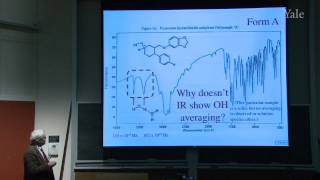
C-13 and 2D NMR - Electrophilic Aromatic Substitution - Lecture 25
Explore advanced NMR techniques and electrophilic aromatic substitution. Learn about proton decoupling, 2D NMR applications, and substituent effects in organic chemistry reactions.
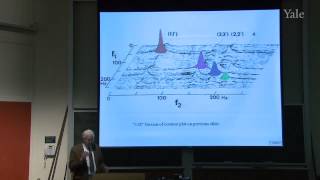
Higher-Order Effects, Dynamics, and the NMR Time Scale - Lecture 24
Explore advanced NMR concepts: higher-order effects, dynamics, and time scales. Learn about hybridization, spin-spin splitting, and spectral prediction for complex molecular structures.
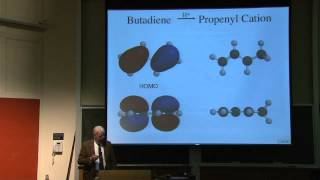
Alkynes and Conjugation in Allylic Systems and Dienes - Lecture 17
Explore alkynes, conjugation in allylic systems, and dienes. Learn about isomerization, stability, and reactivity of these organic compounds through various chemical reactions and principles.
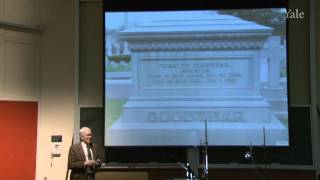
Isoprenoids, Rubber, and Tuning Polymer Properties - Freshman Organic Chemistry II
Explore isoprenoids, rubber vulcanization, and polymer properties. Learn about biosynthesis, statistical mechanics, and free-radical polymerization in this comprehensive organic chemistry lecture.

Epoxide Opening, Dipolar Cycloaddition, and Ozonolysis in Organic Chemistry
Explore advanced organic chemistry concepts including epoxide opening, ozonolysis, and cycloaddition reactions. Gain insights into reaction mechanisms, regiospecificity, and orbital interactions in complex organic transformations.
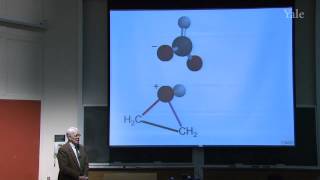
Addition to Form Three-Membered Rings - Carbenoids and Epoxidation
Explore three-membered ring formation through carbenoids and epoxidation. Learn mechanisms, stereochemistry, and practical applications in organic chemistry.
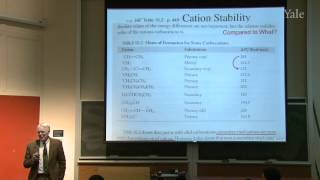
Carbocations and the Mechanism of Electrophilic Addition to Alkenes and Alkynes - Lecture 11
Explore carbocation stability, electrophilic addition mechanisms, and alkene/alkyne reactivity. Gain insights into organic reaction principles and their applications in chemistry.
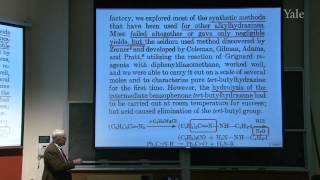
Cation Intermediates and Alkene Reactions - Formation, Addition, and Stability
Explore cation intermediates, alkene reactions, and isomer stability. Learn about SN1 and E1 mechanisms, electrophilic addition, and using the NIST Webbook for thermochemical data analysis.
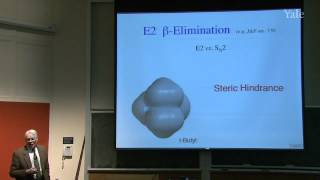
Pentavalent Carbon and Competing Reaction Mechanisms - E2, SN1, E1
Explore organic chemistry mechanisms: E2, SN1, E1 reactions. Analyze stereochemistry, kinetic isotope effects, and carbocation intermediates. Learn strategies for substitution in organic synthesis.
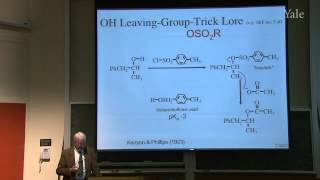
Organic Chemistry II - Nucleophiles, Leaving Groups, and SN2 Reactions - Lecture 8
Explore nucleophiles, leaving groups, and SN2 reactions in organic chemistry. Learn about bridgehead substitution, converting poor leaving groups, and applications in PET scanning and medical imaging.
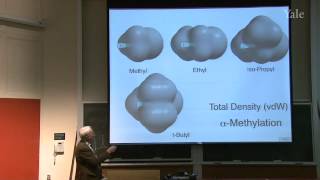
Nucleophilic Substitution Mechanisms: Stereochemistry, Kinetics, and Structural Influences
Explore nucleophilic substitution mechanisms through stereochemistry, kinetics, and structural influences. Gain insights into experimental tools for determining reaction pathways in organic chemistry.
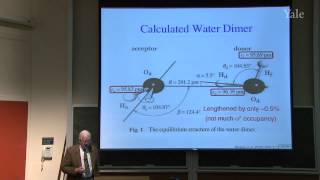
Solvation, Hydrogen-Bonding, and Ionophores in Organic Chemistry - Lecture 5
Explore solvation, hydrogen bonding, and ionophores in organic chemistry. Learn about non-bonded interactions, electrostatics, and their impact on chemical properties and reactions in solution.
Chemistry - Rate Processes
Explore reaction rates, complex reactions, and theories in chemistry. Learn about specific reactions, enzyme inhibition, oscillatory reactions, and advanced topics like ultrafast processes and reaction dynamics.

Organic Chemistry by CrashCourse
Comprehensive introduction to organic chemistry covering nomenclature, structure, reactions, and spectroscopy. Develop skills in mechanism sketching, synthesis planning, and connecting chemical properties to real-world applications.
Mechanisms in Organic Chemistry
Explore fundamental principles and advanced concepts in organic chemistry mechanisms through comprehensive lectures, enhancing understanding of molecular interactions and reactions.
Chemistry - Heterocyclic Chemistry
Explore heterocyclic chemistry through nomenclature, structure determination, reactions, and synthesis methods. Learn about various heterocycles and their properties.
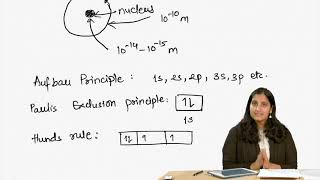
Introductory Organic Chemistry I
Explore atomic structure, molecular orbital theory, alkanes, cycloalkanes, and their properties in this comprehensive introduction to organic chemistry fundamentals.
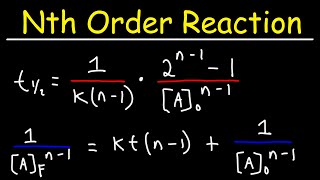
Integrated Rate Laws and Half Life Formula - Nth Order Reaction - Chemical Kinetics
Explore integrated rate laws and half-life formulas for nth order reactions in chemical kinetics, enhancing your understanding of reaction rates and mechanisms.
Organic Chemistry Practice Problems
Comprehensive practice problems covering various organic chemistry topics, from nomenclature to complex synthesis challenges, with step-by-step solutions for self-paced learning and exam preparation.
Coordination Chemistry
Explore coordination chemistry, quantum mechanics, and organic compounds. Learn about molecular structures, theories, and applications in biological systems and chemical reactions.