
Organic Chemistry Lab Workshop
In this course, you will learn Workshop on Techniques in Organic Chemistry, Introduction to claesen- Condensation, How to separate different components from a mixture using column chromatography, Chemiluminescence Phenomenon etc.
Coordination Chemistry
Explore coordination chemistry concepts, from ligand classification to reaction mechanisms, with emphasis on bonding, isomerism, spectra, magnetism, and biological applications.
Nucleophilic Acyl Substitution Reaction Mechanism - Carboxylic Acid Derivatives, Organic Chemistry
Comprehensive exploration of nucleophilic acyl substitution mechanisms in organic chemistry, covering various reactions, intermediates, and practical applications with examples.
Principles of Organic Synthesis
Comprehensive exploration of organic synthesis principles, covering key reactions, mechanisms, and reagents for creating complex molecules and forming various chemical bonds.
Mechanism and Equilibrium of Carbonyl Reactions - Lecture 28
Explore carbonyl reactions, mechanisms, and equilibrium in organic chemistry. Learn about esterification, hydration, protecting groups, and imine formation. Gain insights into substituent effects and reaction pathways.
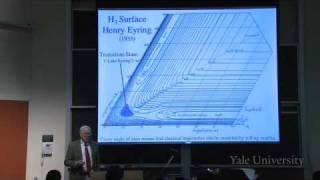
Potential Energy Surfaces, Transition State Theory and Reaction Mechanism - Lecture 37
Explore reaction rates, potential energy surfaces, and transition state theory in organic chemistry. Learn to predict equilibria and rates using bond energies and statistical mechanics principles.
Oxidation States and Mechanisms in Organic Chemistry - Lecture 30
Explore oxidation states, spectroscopy, and reaction mechanisms in organic chemistry. Learn about carbon oxidation states and alcohol oxidation processes through practical examples and exam questions.

Epoxide Opening, Dipolar Cycloaddition, and Ozonolysis in Organic Chemistry
Explore advanced organic chemistry concepts including epoxide opening, ozonolysis, and cycloaddition reactions. Gain insights into reaction mechanisms, regiospecificity, and orbital interactions in complex organic transformations.
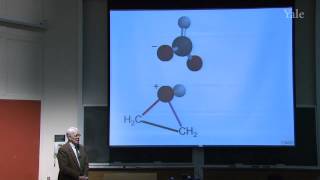
Addition to Form Three-Membered Rings - Carbenoids and Epoxidation
Explore three-membered ring formation through carbenoids and epoxidation. Learn mechanisms, stereochemistry, and practical applications in organic chemistry.
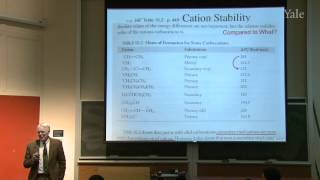
Carbocations and the Mechanism of Electrophilic Addition to Alkenes and Alkynes - Lecture 11
Explore carbocation stability, electrophilic addition mechanisms, and alkene/alkyne reactivity. Gain insights into organic reaction principles and their applications in chemistry.
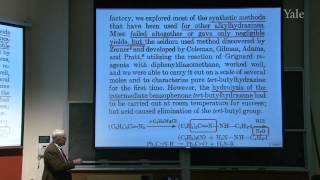
Cation Intermediates and Alkene Reactions - Formation, Addition, and Stability
Explore cation intermediates, alkene reactions, and isomer stability. Learn about SN1 and E1 mechanisms, electrophilic addition, and using the NIST Webbook for thermochemical data analysis.
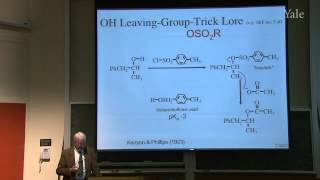
Organic Chemistry II - Nucleophiles, Leaving Groups, and SN2 Reactions - Lecture 8
Explore nucleophiles, leaving groups, and SN2 reactions in organic chemistry. Learn about bridgehead substitution, converting poor leaving groups, and applications in PET scanning and medical imaging.
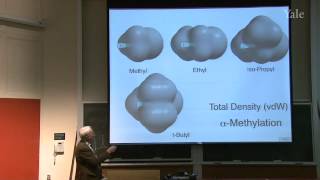
Nucleophilic Substitution Mechanisms: Stereochemistry, Kinetics, and Structural Influences
Explore nucleophilic substitution mechanisms through stereochemistry, kinetics, and structural influences. Gain insights into experimental tools for determining reaction pathways in organic chemistry.
Chemistry - Rate Processes
Explore reaction rates, complex reactions, and theories in chemistry. Learn about specific reactions, enzyme inhibition, oscillatory reactions, and advanced topics like ultrafast processes and reaction dynamics.

Organic Chemistry by CrashCourse
Comprehensive introduction to organic chemistry covering nomenclature, structure, reactions, and spectroscopy. Develop skills in mechanism sketching, synthesis planning, and connecting chemical properties to real-world applications.
Mechanisms in Organic Chemistry
Explore fundamental principles and advanced concepts in organic chemistry mechanisms through comprehensive lectures, enhancing understanding of molecular interactions and reactions.
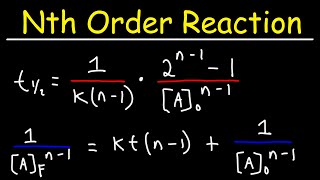
Integrated Rate Laws and Half Life Formula - Nth Order Reaction - Chemical Kinetics
Explore integrated rate laws and half-life formulas for nth order reactions in chemical kinetics, enhancing your understanding of reaction rates and mechanisms.
Organic Chemistry Practice Problems
Comprehensive practice problems covering various organic chemistry topics, from nomenclature to complex synthesis challenges, with step-by-step solutions for self-paced learning and exam preparation.
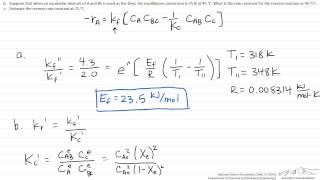
Kinetics - Reactor Design Review
Comprehensive review of kinetics and reactor design concepts through exam problem screencasts, covering topics from activation energy to reactor types and selectivity.
Haloalkanes Haloarenes Class 12
Comprehensive study of haloalkanes and haloarenes for Class 12 CBSE Chemistry, covering nomenclature, reactions, properties, and numericals with detailed explanations and problem-solving.

SN2 SN1 E1 E2 Reaction Mechanisms Made Easy
Comprehensive guide to SN2, SN1, E1, and E2 reaction mechanisms in organic chemistry, featuring examples, practice problems, and a chart for predicting major products.