
Introduction to Freshman Organic Chemistry - How Do You Know?
Explore the foundations of scientific inquiry through experimentation and logic, using historical examples to illustrate key principles in organic chemistry and scientific thinking.
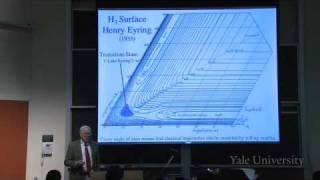
Potential Energy Surfaces, Transition State Theory and Reaction Mechanism - Lecture 37
Explore reaction rates, potential energy surfaces, and transition state theory in organic chemistry. Learn to predict equilibria and rates using bond energies and statistical mechanics principles.
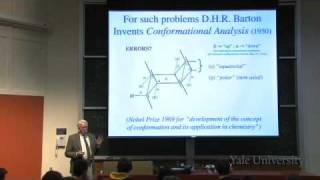
Conformational Energy and Molecular Mechanics - Lecture 33
Explore conformational energy and molecular mechanics in organic chemistry, focusing on cyclohexane structures, conformational relationships, and energy estimation techniques.
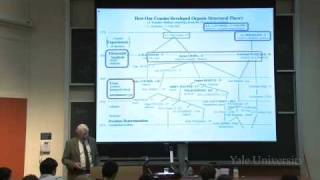
Berzelius, Gay-Lussac, and Davy - Advances in Chemistry from 1805-1832 - Lecture 21
Explore key developments in early 19th-century chemistry, including electrolysis, dualism, and the radical theory, through the work of Berzelius, Gay-Lussac, Davy, Wöhler, and Liebig.
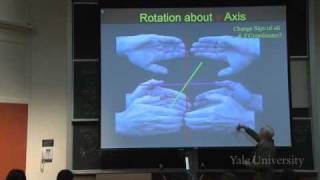
Van't Hoff's Tetrahedral Carbon and Chirality - Lecture 26
Explore tetrahedral carbon models, optical isomers, and chirality in organic chemistry. Discover van't Hoff's groundbreaking work on stereochemistry and its implications for molecular structure and symmetry.

Esomeprazole - Drug Testing, Usage, and Clinical Trials
Explore the clinical trials, FDA approval, and marketing of esomeprazole, with insights on drug testing, efficacy evaluation, and pharmaceutical industry practices from chemical and clinical perspectives.
Preparing Single Enantiomers and the Mechanism of Optical Rotation
Explore optical rotation in chiral molecules, from enantiomer synthesis to the mechanism of polarized light interaction, with insights on its relevance in biological systems and drug development.
Oxygen and the Chemical Revolution - From Alchemy to Lavoisier (1789)
Explore the origins of modern chemistry, from alchemy to Lavoisier's revolutionary ideas on oxidation, elements, and scientific language in this historical journey through early chemical discoveries.

Preparing Single Enantiomers and Conformational Energy - Freshman Organic Chemistry
Explore chirality, single enantiomer production, and conformational isomerism in organic chemistry. Learn about legal implications, isolation methods, and energy considerations in molecular structures.
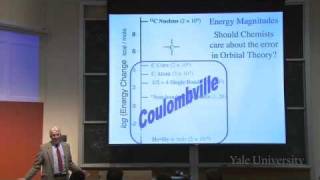
Orbital Correction and Plum-Pudding Molecules in Organic Chemistry - Lecture 11
Explore advanced orbital theory, electron repulsion corrections, and molecular structure using the Plum-Pudding model. Gain insights into atomic orbitals and their relation to molecules like methane and ammonia.
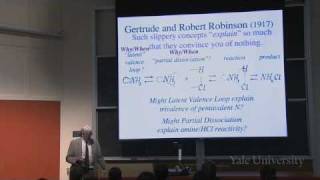
Force Laws, Lewis Structures and Resonance in Organic Chemistry
Explore chemical bonding through force laws, Lewis structures, and resonance. Understand valence electrons' role in molecular structure and reactivity. Gain insights into fundamental organic chemistry concepts.

One-Dimensional Wave Functions in Quantum Chemistry - Lecture 8
Explore wave functions, their relationship to kinetic energy and probability density, and how they apply to various potentials. Learn about the isotope effect on bond properties in organic chemistry.
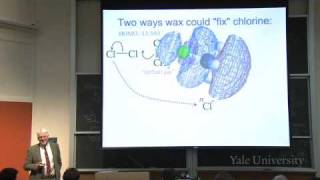
Radical and Type Theories in Organic Chemistry (1832-1850) - Lecture 22
Explores radical and type theories in organic chemistry, covering historical developments, key figures, and fundamental concepts like HOMO-LUMO mechanism and free-radical chain reactions.
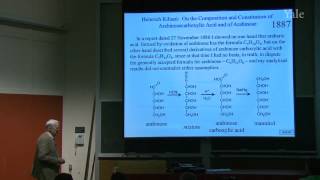
Proving the Configuration of Glucose and Synthesizing Cyclobutadiene - Lecture 37
Explore glucose structure, configuration proof, and synthesis of unnatural products. Delve into historical developments and modern spectroscopic techniques in organic chemistry.
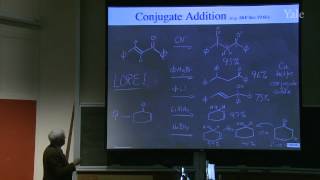
Alpha-Reactivity and Condensation Reactions in Organic Chemistry - Lecture 36
Explore key organic chemistry reactions: alkylation, aldol condensation, Robinson annulation, and Claisen condensation. Learn about their mechanisms, applications in synthesis, and relevance to biochemistry.
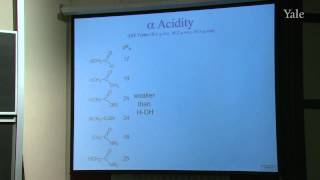
Acyl Insertions and Alpha-Reactivity in Organic Chemistry - Lecture 35
Explore acyl insertions, α-carbon reactivity, and rearrangements in organic chemistry. Learn about nucleophilic attacks, enolates, and mechanisms behind H/D exchange, racemization, halogenation, and alkylation.
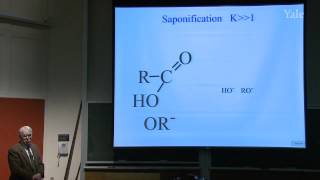
Acids and Acid Derivatives - Reactions and Spectroscopy
Explore reactions of carboxylic acids, IR spectroscopy of acid derivatives, interconversion mechanisms, selective reductions, and specialized reactions like decarboxylation and Baeyer-Villiger oxidation.
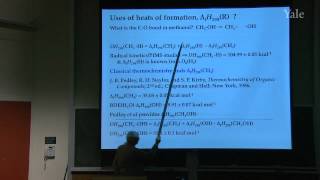
Measuring Bond Energies in Organic Chemistry
Prof. Ellison explores advanced techniques for measuring bond energies in polyatomic molecules, combining spectroscopy, mass spectrometry, and thermochemistry to provide insights into chemical bonding and resonance.
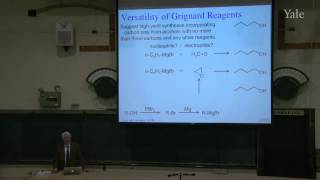
Periodate Cleavage, Retrosynthesis, and Green Chemistry in Organic Chemistry
Explore organic chemistry concepts including periodate cleavage, retrosynthesis, and green chemistry. Learn about alcohol synthesis, Grignard reagents, and Wittig olefination in this comprehensive lecture.
Oxidation States and Mechanisms in Organic Chemistry - Lecture 30
Explore oxidation states, spectroscopy, and reaction mechanisms in organic chemistry. Learn about carbon oxidation states and alcohol oxidation processes through practical examples and exam questions.
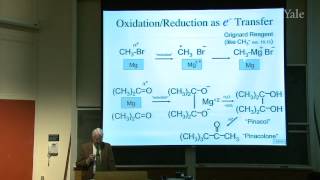
Imines, Enamines, Oxidation and Reduction in Organic Chemistry - Lecture 29
Explore imines in chemistry and biology, their role in amino acid synthesis, enamine reactions, and the concepts of oxidation and reduction in organic chemistry.