
Jupyter Notebook Assignment - Runge-Kutta Method Development - Vlog 3
Explore the Runge-Kutta Method in computational physics, comparing it with Euler-Cromer. Develop skills in numerical analysis and scientific computing using Jupyter Notebooks.
Square Roots with an Abacus
Explore the fascinating process of calculating the square root of 2 using an abacus, blending ancient techniques with modern mathematical concepts.

Numerical Modeling of the 2014 Oso, Washington, Landslide
Explore numerical simulations of the 2014 Oso landslide, examining factors behind its devastating runout. Learn how initial sediment conditions can dramatically influence landslide behavior and consequences.
Speeding up Langevin Dynamics by Mixing
Explore a method to accelerate Langevin dynamics using mixing drift, improving convergence to stationary distribution in polynomial time for systems with multiple local minima.
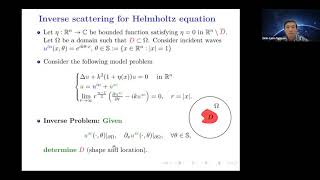
Orthogonality Sampling Methods for Electromagnetic Inverse Scattering Problems
Exploring orthogonality sampling methods for electromagnetic inverse scattering problems, focusing on implementation simplicity, noise robustness, and applications in 2D and 3D experimental data.
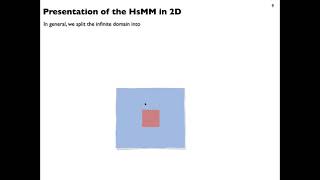
The Half-space Matching Method for Solving Scattering in Complex Media
Explore innovative wave scattering solutions in complex media using the Half-space Matching Method, offering efficient alternatives to traditional computational techniques.
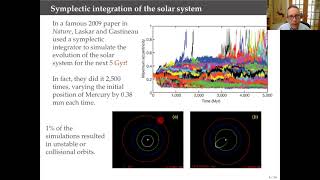
Structure Preservation in the Discretization of Partial Differential Equations
Explore structure preservation techniques in discretizing partial differential equations, enhancing numerical accuracy and stability in computational mathematics.
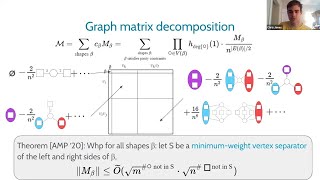
Matrix Methods in Computer Science - Session 6B
Explore advanced matrix methods and their applications in computer science, focusing on cutting-edge research and algorithmic developments.
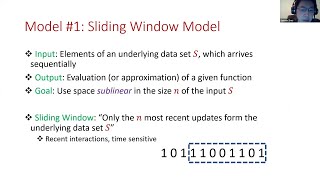
Matrix Methods in Computer Science - Session 4B
Explore advanced matrix methods and their applications in computer science, focusing on cutting-edge research and algorithmic developments.

An Introduction to Newton’s Method on Semirings
Explore Newton's method generalization for solving polynomial fixpoint equations on omega-continuous semirings, its applications, and characterization of Newton approximants to the fixpoint.
More Bases of Polynomial Spaces - Lecture 21
Explore advanced polynomial bases: Lagrange, Chebyshev, Bernstein, and Spread. Learn their properties, applications in approximation, and relationships, enhancing understanding of polynomial spaces in linear algebra.
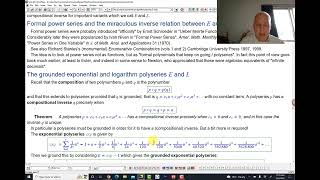
Formal Power Series and the Miraculous Relation Between E (exp) and L (log)
Explore formal power series as a powerful alternative to traditional analysis, focusing on the miraculous inverse relationship between exp and log polyseries variants E and L.
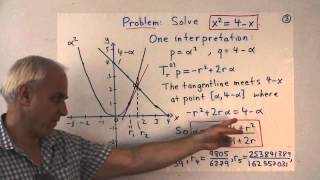
Solving Quadratics and Cubics Approximately - Real Numbers and Limits - Math Foundations 85
Explore approximate solutions for quadratic and cubic equations using standard formulas and Newton's method. Learn historical context and connect algebraic techniques with numerical methods.
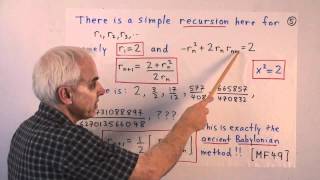
Newton's Method for Finding Zeros - Real Numbers and Limits
Explore Newton's method for finding zeros, focusing on quadratic functions and approximating square roots. Learn about tangent lines, recursion, and practical applications in mathematics.

Real Numbers and Cauchy Sequences of Rationals - Math Foundations 112
Explores the concept of real numbers, challenging their existence and examining how quantities like length, area, and function values are inherently approximate rather than exact 'real' values.

Fundamental Theorem of Algebra Reexamined - Math Foundations 217
Reexamines the Fundamental Theorem of Algebra, proposing new formulations based on rational complex arithmetic and quadrance, avoiding assumptions about continuity and real/complex numbers.
Interpretations of Numerical Results for MBL by Piotr Sierant
Explore numerical results and interpretations for Many-Body Localization (MBL) in quantum systems, focusing on stability and dynamics in non-equilibrium physics.
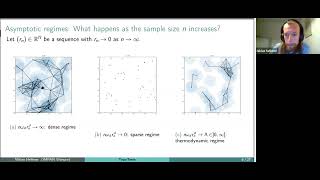
Topology-Driven Goodness-of-Fit Tests in Arbitrary Dimensions
Explore topology-driven goodness-of-fit tests using Euler characteristic curves for multi-dimensional samples, offering comparable power to state-of-the-art tests with controlled error rates.
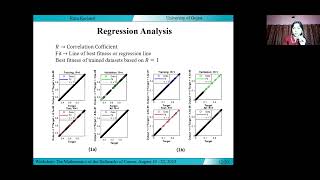
Numerical Analysis for Cervical Cancer Using Stochastic Levenberg-Marquardt Backpropagated Technique
Explore advanced neural network techniques for cervical cancer analysis, focusing on the Stochastic Levenberg-Marquardt Backpropagated method and its applications in oncology research.
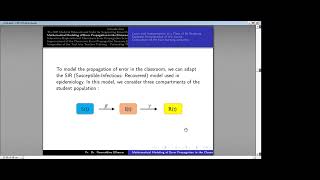
Mathematical Modelling of Error Propagation in the Classroom - Inauguration of a New Path
Explore innovative mathematical modeling techniques for analyzing error propagation in educational settings, opening new avenues for improving teaching and learning outcomes.
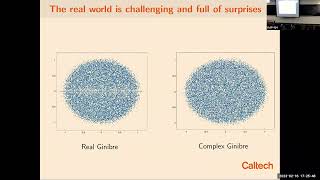
Spectral Stability Under Real Random Absolutely Continuous Perturbations
Explore spectral stability in random matrix perturbations, focusing on eigenvector condition numbers and minimum eigenvalue gaps. Gain insights into numerical linear algebra algorithms.