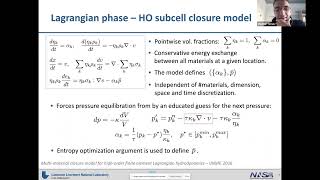
Finite Element Algorithms and Research Topics in ALE Hydrodynamics
Explore high-order finite element methods for shock hydrodynamics simulations, covering Lagrangian mechanics, mesh optimization, and remap phases in ALE formulation.
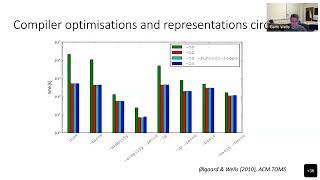
FEniCSx: Design of the Next Generation FEniCS Libraries for Finite Element Methods
Explore FEniCSx, the next-gen finite element library. Learn design improvements, high-performance kernels, and flexible solver creation in C++ or Python for partial differential equations.
Logistic Regression and Generalized Linear Models
Explore exponential family models, logistic regression, and Newton's method for classification tasks, with applications in app recommendation and sparse data analysis.
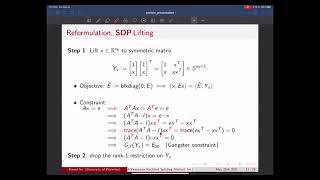
A Peaceman-Rachford Splitting Method for the Protein Side-Chain Positioning Problem
Explore protein side-chain positioning through doubly nonnegative relaxation and Peaceman-Rachford splitting method, with insights on facial reduction and numerical experiments for optimal solutions.
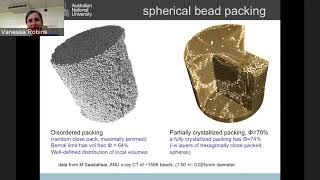
Vanessa Robins - Persistence Diagrams of Bead Packings
Exploring grain-scale mechanisms in granular crystallization using X-ray tomography and persistent homology, revealing key formation processes of tetrahedral and octahedral pores in spherical bead packings.
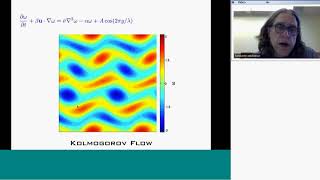
Nonlinear Dynamics, High Dimensional Data, and Persistent Homology
Explore nonlinear dynamics, high-dimensional data analysis, and persistent homology with Konstantin Mischaikow. Learn about algebraic topology applications, persistence diagrams, and recent advancements in data science.
Particle Methods for Optimization Over Measures - Lecture 2
Explore particle methods for measure optimization in this advanced lecture, covering theoretical foundations and practical applications in data science and machine learning.
Particle Methods for Optimization over Measures - Lecture 1
Explore particle methods for measure optimization, focusing on theoretical foundations and practical applications in data science and machine learning.
Adaptive Regularization and Linearization for Nonsmooth and Degenerate Problems
Explore advanced mathematical techniques for solving nonsmooth and degenerate problems in flow and transport, focusing on adaptive regularization methods and Newton-based linearization approaches.
Approximation of Vertex Transitive Graphs by Nilpotent Groups and Applications to Probability
Delve into advanced mathematical concepts exploring vertex-transitive graphs, their approximation through nilpotent groups, and probabilistic applications in topological dynamics.
Sequential Design Based on Mutual Information for Computer Experiments - Joakim Beck, KAUST
Explore uncertainty quantification using Gaussian Process emulators for complex systems. Learn about sequential design methods, mutual information criteria, and applications in climate, tsunami, and earthquake modeling.
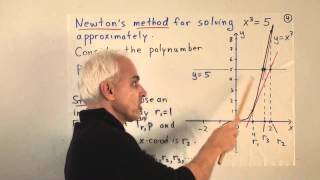
Newton's Method for Approximating Cube Roots - Real Numbers and Limits Math Foundations
Newton's method for approximating cube roots: explore cubes, cube roots, and techniques to find approximate solutions. Learn about Taylor expansion, tangent lines, and advanced methods like the weighted Babylonian and quadratic Newton approaches.
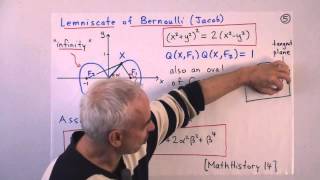
Newton's Method and Algebraic Curves - Real Numbers and Limits Math Foundations
Explore Newton's method for algebraic curves, examining Fermat curves and Bernoulli's Lemniscate. Learn about Taylor expansions, tangent planes, and iterative techniques for approximating curve intersections.
Chaos in ODEs - Lorenz and the Double Pendulum
Explore chaos in ordinary differential equations through Lorenz systems and double pendulum examples, examining numerical integration challenges and chaotic dynamics in engineering mathematics.
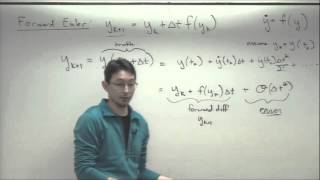
Runge-Kutta Integration of ODEs and the Lorenz Equation
Explore Runge-Kutta integration methods for ODEs and delve into the fascinating Lorenz equation, uncovering its chaotic behavior and applications in engineering mathematics.
Solving High Dimensional HJ Equations Using Generalized Hopf-Lax Formulas vs Using Machine Learning
Explore advanced techniques for solving high-dimensional Hamilton-Jacobi equations, comparing generalized Hopf-Lax formulas with machine learning approaches in control and differential games.
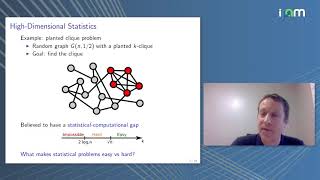
The Kikuchi Hierarchy and Tensor PCA
Explores advanced algorithms for tensor PCA, introducing a new hierarchy inspired by Kikuchi free energy to improve belief propagation performance and match sum-of-squares methods.
Conics in a Second by Bernd Sturmfels
Explore conics through historical and modern perspectives, from pentagon construction to applied algebraic geometry, with insights on Newton's method and enumerative geometry.
Error Analysis of a Variational Multiscale Stabilization for Convection-Dominated Diffusion Equations in 2D
Análisis de error de estabilización multiescala variacional para ecuaciones de difusión dominadas por convección en 2D. Enfoque en métodos Petrov-Galerkin y correcciones de escala fina para problemas de perturbación singular.

Panorama of Mathematics - Alfio Quarteroni
Explore reduced order models for solving partial differential equations, focusing on complexity reduction and efficient simulations in multiphysics problems.
Standard and Less Standard Asymptotic Methods - Lecture 9
Explore advanced asymptotic methods for evaluating infinite sums and recognizing sequence patterns. Learn techniques from standard to unconventional, with practical examples and applications in mathematics.