Calculating Expectation Values - A Journey through Modern Physics
Explore computational modeling of early 20th-century physics discoveries, focusing on wave functions and expectation values in quantum mechanics through practical examples and numerical integration.
Dark Energy by Varun Sahni
Explore the mysteries of dark energy and its implications for cosmology in this lecture by Varun Sahni, part of a comprehensive program on cutting-edge topics in modern astrophysics and cosmological research.
Dark Energy by Varun Sahni
Explore the mysteries of dark energy and its role in cosmic expansion. Delve into current theories, observational evidence, and implications for the Universe's future.
Galaxy Formation by Kandaswamy Subramanian
Explore galaxy formation processes, including dark matter's role, structure growth, and observational insights. Gain a comprehensive understanding of cosmic evolution and structure formation.
21cm Physics and Cosmology by Somnath Bharadwaj
Explore 21cm physics and its applications in cosmology, focusing on the study of dark matter, dark energy, and the Universe's reionization history through advanced observational techniques.
Gravitational Lensing by Alan Heavens
Explore gravitational lensing in cosmology with Prof. Alan Heavens. Learn about this powerful tool for studying dark matter, dark energy, and the structure of the universe.
Cosmological Structure Formation by Aseem Paranjape
Explore cosmological structure formation, covering perturbation theory, large-scale structure growth, and the cosmic web. Gain insights into the evolution of the universe and its components.
Cosmological Perturbation Theory - CMB by D Pogosyan
Explore cosmological perturbation theory and CMB anisotropies in this advanced lecture, delving into the intricacies of cosmic structure formation and early universe physics.
21cm Physics and Cosmology by Somnath Bharadwaj
Explore 21cm physics and cosmology in this lecture, covering key concepts, observational techniques, and implications for understanding the early universe and cosmic structure formation.
Cosmological Perturbation Theory - CMB by D Pogosyan
Explore cosmological perturbation theory and CMB anisotropies in this lecture, part of a comprehensive program on the future of cosmology and unresolved mysteries of the Universe.
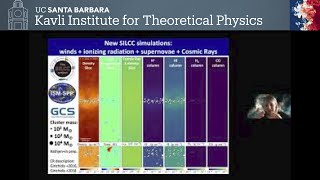
Multi-Phase Gas in and Around Young, Star-Forming Molecular Clouds - Stefanie Walch-Gassner
Explore multi-phase gas dynamics in star-forming regions, covering ISM structure, feedback processes, and outflows. Gain insights into astrophysical fluid dynamics across various scales.
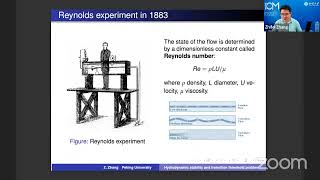
Hydrodynamic Stability at High Reynolds Number and Transition Threshold Problem
Explores hydrodynamic stability theory, focusing on laminar flow instability and turbulence transition at high Reynolds numbers. Discusses key physical effects and recent progress in linear inviscid damping and enhanced dissipation for shear flows.
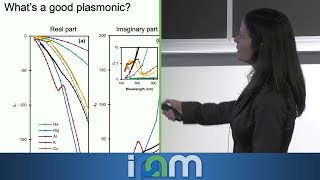
Electron and Optical Microscopy of Magnesium Nanoparticles - IPAM at UCLA
Explore advanced microscopy techniques for analyzing magnesium nanoparticles, including tomography, electron diffraction, and hyperspectral optical spectroscopy, with insights on plasmon resonances and photothermal effects.
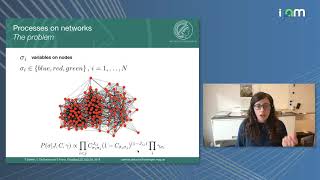
Matrix Product States for Modeling Dynamical Processes on Networks
Explore matrix product states and dynamic message-passing algorithms for modeling network dynamics, reducing computational complexity from exponential to polynomial in system size and duration.
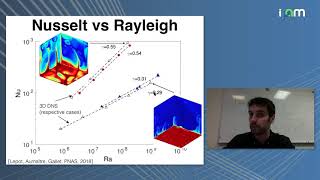
Heat Transport Efficiency Beyond the So-Called 'Ultimate' Regime
Explores innovative approaches to thermal convection, challenging traditional Rayleigh-Bénard models with radiative heating techniques to achieve more efficient heat transport in turbulent flows.
Nuclear Matter EOS Constraints from Gravitational Waves by Wolfgang Kastaun
Explore gravitational wave observations as a tool for understanding nuclear matter equation of state, focusing on measurable aspects, model-agnostic studies, and implications for neutron star properties.
Exotic Patterns in Faraday Waves
Explore exotic patterns in Faraday waves through advanced numerical simulations and theoretical analysis. Discover fascinating phenomena like quasipatterns, superlattices, and dynamic pattern evolution in vibrated fluid layers.
Magnetic Reconnection - Plasmoid Instability in an Experimentally Accessible Regime by Pallavi Bhat
Explore magnetic reconnection and plasmoid instability in the semi-collisional regime, with theoretical and numerical investigations validating its existence at lower, experimentally accessible Lundquist numbers.
The Computational Theory of Riemann-Hilbert Problems - Lecture 4
Explores computational approaches to Riemann-Hilbert problems, covering Cauchy integrals, Sobolev spaces, and applications to nonlinear equations like Schrödinger and KdV, with code demonstrations and numerical solution techniques.
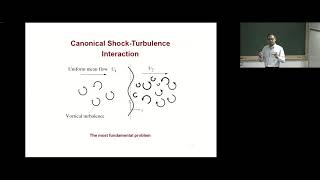
Shock Waves and Turbulence - Physical Modeling, Numerical Challenges
Explore shock waves and turbulence in high-speed flows, covering physical modeling, numerical simulations, and applications in aerospace and astrophysics. Learn about shock-turbulence interactions and heat transfer.
Forced Integrable Systems - The Case of Sine-Gordon Equation by Vasudeva Murthy
Explore forced integrable systems, focusing on the sine-Gordon equation. Examine its applications in tectonic stress transfer and crack dynamics, with insights on boundary conditions and numerical methods.