
Bridging the Divide: From Matrix to Tensor Algebra for Optimal Approximation and Compression
Explore tensor algebra and its advantages over matrix-based approaches for data compression and analysis. Learn about novel tensor-tensor products and their applications in various fields.

From Quantum Entanglement to Future Data-Driven Engineering - Rothschild Lecture
Explore high-dimensional Bayesian statistics in engineering, focusing on efficient data-physical model integration and uncertainty quantification. Learn about multilevel MCMC and measure-transport approaches.

Uncertainty Quantification for Bayesian Inverse Problems - Efficient Methods in the Small Noise Regime
Explore efficient methods for uncertainty quantification in Bayesian inverse problems, focusing on small noise regimes and data-driven engineering applications.
Numerical Simulation of Timoshenko-Beam Models for Fiber-Based Materials
Numerical simulation techniques for modeling fiber-based materials using Timoshenko beam models, focusing on efficient preconditioners and applications in paperboard mechanics.
Multiscale Finite Element Methods for Advection and Reaction-Diffusion Problems
Explore advanced finite element techniques for solving complex PDEs with oscillatory coefficients, focusing on multiscale methods for advection-diffusion and reaction-diffusion problems.

LU-Decomposition of a Matrix - Linear Algebra Explained
Explore LU-Decomposition in linear algebra: definition, applications for solving systems, step-by-step process, and examples. Master this powerful technique for efficient matrix analysis.
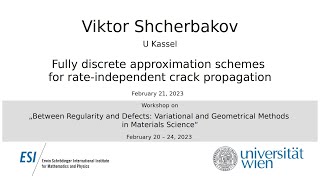
Fully Discrete Approximation Schemes for Rate-Independent Crack Propagation
Explore convergence analysis of space-time discrete approximation schemes for rate-independent crack propagation in brittle elastic bodies, focusing on Griffith fracture criterion and local energy minimizers.
Polynomially Convex Embeddings of Real Manifolds in C^n
Explore geometric embeddings of real manifolds in complex spaces, focusing on polynomial convexity and its connections to approximation theory and diverse mathematical areas.
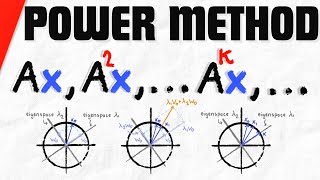
Power Method for Dominant Eigenvalues and Eigenvectors in Linear Algebra
Learn to approximate dominant eigenvalues and eigenvectors using the power method with maximum entry and Euclidean scaling. Explore power sequences, Rayleigh quotient, and geometric intuition in linear algebra.
NumPy: Introduction, Installation, Attributes, and Arithmetic Operations
Master NumPy fundamentals: installation, attributes, and arithmetic operations for efficient numerical computing in Python.
Overview of Numerical Methods: Finite Difference Method
Explore finite difference methods in CFD, covering discretization, mesh types, and equation solving techniques for numerical solutions.

Numerical Integration: Simple Numerical Integration
Learn simple numerical integration techniques for approximating definite integrals, enhancing computational skills in mathematical analysis.
Method of Lines for Hyperbolic PDEs
Explore the Method of Lines technique for solving hyperbolic partial differential equations, enhancing your understanding of numerical methods in applied mathematics.
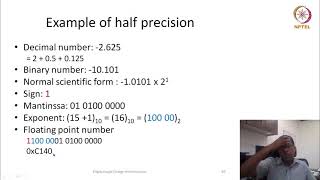
Floating Point Numbers: Double, Extended, and Half Precision - Lecture 4
Explore double, extended, and half precision floating point numbers, understanding their limitations and applications in numerical computations.
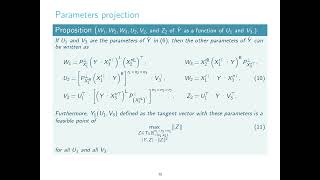
An Approximate Projection onto the Tangent Cone to the Variety of Third Order Tensors of Bounded Rank
Explore approximate projection techniques for third-order tensors with bounded rank, focusing on tangent cone analysis and applications in tensor decomposition.
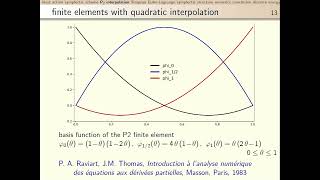
A Variational Symplectic Scheme Based on Simpson's Quadrature
Explore a variational symplectic scheme utilizing Simpson's quadrature, delving into its mathematical foundations and practical applications in numerical analysis.
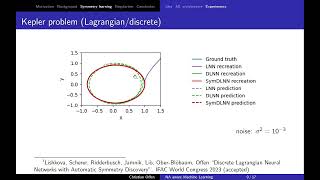
Learning Discrete Lagrangians for Variational PDEs from Data and Detection of Travelling Waves
Explore discrete Lagrangians for variational PDEs, focusing on data-driven approaches and techniques for identifying travelling wave solutions.
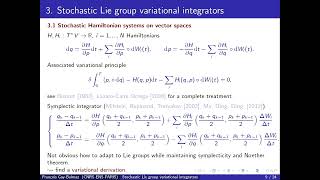
Variational Integrators for Stochastic Hamiltonian Systems on Lie Groups
Explore variational integrators for stochastic Hamiltonian systems on Lie groups, gaining insights into advanced mathematical concepts and their applications.
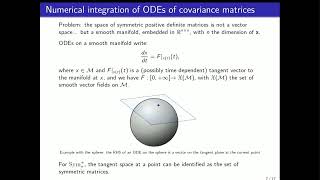
Geometry Preserving Lie Group Integrators for Differential Equations on the Manifold of Symmetric Matrices
Explore Lie group integrators for differential equations on symmetric manifolds, preserving geometric properties in numerical solutions.
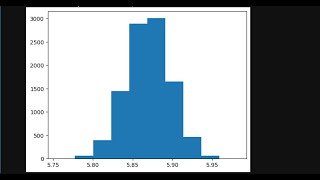
Integration by Monte Carlo Method Using Python in Jupyter Notebook
Explore Monte Carlo integration using Python in Jupyter Notebook. Learn to apply this powerful numerical technique for solving complex integrals.
Integration Algorithms
Master integration algorithms for solving complex mathematical problems and enhancing computational skills.