
Neurology - Facial Nerve: Cranial Nerve VII
Comprehensive exploration of facial nerve anatomy, including branches, fiber types, and target organs. Covers associated pathologies and clinical correlations for a deep understanding of Cranial Nerve VII.

Cardiovascular - Electrophysiology - Extrinsic Cardiac Conduction System
Explore the extrinsic cardiac conduction system, focusing on blood pressure regulation, sympathetic nervous system, and heart rate control mechanisms in this comprehensive electrophysiology lecture.

Anatomy of the Brain - Dissectible Model
Explore brain anatomy using a dissectible model, guided by Professor Zach Murphy. Gain insights into smaller structures and enhance your understanding of neuroanatomy through this detailed visual demonstration.

Neurology - Pons Anatomy & Function
Comprehensive exploration of pons anatomy and function, covering nuclei, fiber tracts, and neural pathways. Detailed cross-sectional analysis and discussion of key structures in this crucial brainstem region.

Neurology - Resting Membrane, Graded, Action Potentials
Comprehensive exploration of neuronal electrical activity, covering resting membrane potential, graded potentials, and action potentials. Delves into ion channels, summation, and refractory periods.

Circulatory System - Circle of Willis Circulation
Comprehensive exploration of the brain's arterial supply, focusing on the Circle of Willis. Covers internal carotid, vertebrobasilar system, and key arteries, providing a detailed understanding of cerebral circulation.

Endless Forms Most Beautiful by Shannon Olsson
Explore the evolution of species through the story of a fly, from Darwin's time to modern virtual reality experiments, revealing how small brain changes lead to new species formation.
Computational Principles of Sensorimotor Control - Lecture 1
Explore computational principles of sensorimotor control, including optimal feedback control, state estimation, motor learning, and Bayesian decision theory in human movement and robotics.

An Introduction to Drosophila Neuroscience - Lecture 1
Explore Drosophila neuroscience, from genome to behavior. Learn about olfactory processing, motion vision, and neural circuits underlying sensory perception and motor control in fruit flies.
How Flies Navigate - Lecture 1
Explore the intricate mechanisms of fly navigation, from neural circuits to behavioral outputs. Discover how flies determine their heading and direction through advanced neuroscience techniques and connectome analysis.
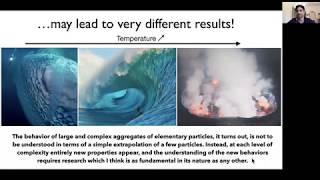
Phase Transitions - From Physics to Computer Science
Explore phase transitions across physics and computer science, from water states to combinatorial optimization and information theory, revealing their universal nature in complex systems.

The Anatomy of Pain
Explore the intricate anatomy of pain, from its purpose and perception to its processing in the brain. Learn about pain thresholds, neural pathways, and the body's natural pain management systems.
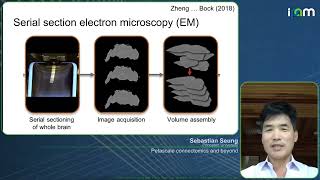
Petascale Connectomics and Beyond - IPAM at UCLA
Explore petascale connectomics, its advancements in brain mapping, and future exascale projects. Learn about automated image analysis techniques and their impact on understanding neural structures and brain function.
Inferring Coupled Oscillatory Dynamics From Data - IPAM at UCLA
Explore phase dynamics in oscillatory systems, focusing on phase demodulation techniques and network reconstruction. Learn about protophase-to-phase transformation and applications in cardiorespiratory interactions.
Connectome-Based Modeling of Real World Clinical Outcomes in Addictions
Exploring connectome-based modeling to predict addiction outcomes, focusing on cocaine and opioid abstinence, network stability, and brain states. Discusses potential clinical applications and theoretical models.
Computational Contributions to Understanding Impaired Motivation and Effort in Psychosis
Exploring computational approaches to understand impaired motivation and effort in psychosis, focusing on reinforcement learning and decision-making to aid treatment development.

The Visions of Shamans and Saints - Dynamic Instabilities in Neuroscience by Bard Ermentrout
Explore neural patterns, from motor activity to brain imaging, and their connections to paleolithic art and hallucinations. Discover mechanisms behind spatial and temporal patterns in neuroscience.
More Perfect Than We Imagined: A Physicist's View of Life - Lecture 1
Explore how biological systems operate near physical limits, from atomic-scale hearing to bacterial decision-making, revealing life's surprising simplicity and perfection through a physicist's perspective.
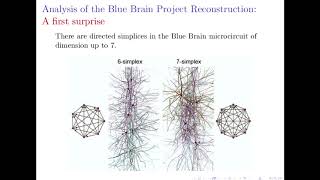
Ran Levi - Bedlewo: Topological Analysis of Neural Networks
Explore topological analysis of neural networks using algebraic topology techniques on biologically accurate digital reconstructions, revealing structural and functional insights into brain connectivity.
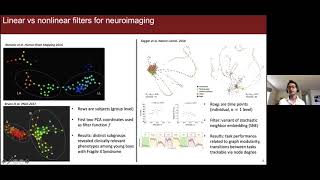
Exploring Brain Dynamics During Ongoing Cognition Using Mapper
Exploring brain dynamics using Mapper: analyzing fMRI data with geometric techniques to reveal whole-brain activity patterns and predict task performance in multitask paradigms.
How Do Brains Count?
Explore how brains process numbers with neuroscientist Brian Butterworth, from animal counting to human mathematical cognition and its practical implications.