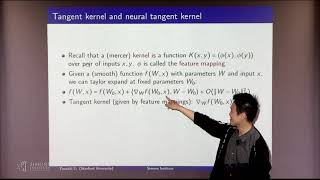
Learning and Generalization in Over-parametrized Neural Networks - Going Beyond Kernels
Explore neural network learning and generalization beyond kernel methods, examining tangent kernels, learning algorithms, and complexity in over-parametrized networks.
How Hard Is It to Train Variational Quantum Circuits?
Explores challenges in training variational quantum circuits, comparing them to classical neural networks and examining quantum generative models, with a focus on robust training methods and circuit compression.
Studying Generalization in Deep Learning via PAC-Bayes
Explore PAC-Bayes theory's application to deep learning generalization, focusing on risk bounds, optimal priors, and SGD prediction for neural networks.
Computation in Very Wide Neural Networks
Explore infinite-width neural networks, their correspondence to Gaussian processes, and implications for deep learning performance and dynamics in parameter space.
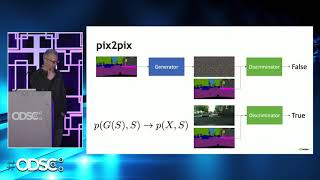
Generative Adversarial Networks for Image Synthesis and Translation - Dr. Jan Kautz
Explore recent GAN advancements for image synthesis and translation, including conditional GANs, supervised vs unsupervised methods, and multimodal approaches. Learn to design, modify, and understand GAN architectures.
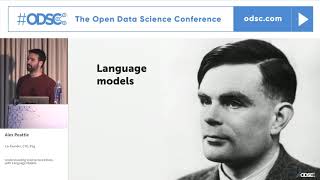
Understanding Unstructured Data with Language Models - Alex Peattie
Explore language models for unstructured data analysis, covering classification, predictive modeling, and information retrieval. Learn key concepts and practical applications in various fields.
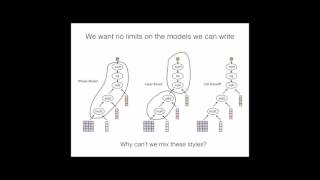
ODSC East 2016 - Building Neural Networks at Twitter with Autograd
Explore building flexible neural networks using autograd, a tool that simplifies gradient computation and enables easy experimentation with new model architectures at Twitter.
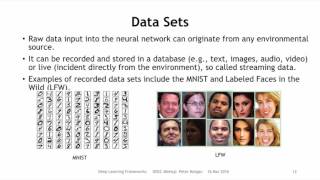
ODSC London Meet-up - Deep Learning Frameworks
Explore deep learning frameworks, algorithms, and state-of-the-art developments with industry expert Peter Morgan in this comprehensive overview of neural network technologies.
Using Free Text for Predictive Modeling
Explore efficient text representation for predictive analytics, covering techniques to transform varied-length text into fixed-length vectors for machine learning applications like sentiment analysis and news classification.
Machine Learning: From ABCs to DEFs
Explore machine learning fundamentals, from basic concepts to practical applications, focusing on people, data, and code. Learn to build simple AI models and understand key ML principles.
Artificial Intelligence: Success, Limits, Myths and Threats - Lecture 1
Explore AI's successes, limitations, and societal impact. Delve into machine learning, neural networks, and the future of AI. Gain insights on scientific intelligence and ethical considerations.
Fermionic Neural-Network Quantum States - IPAM at UCLA
Explore fermionic neural-network quantum states, their efficient representations, and applications in quantum mechanics with Giuseppe Carleo's insightful presentation at IPAM's workshop.
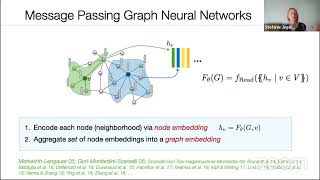
Theory of Graph Neural Networks: Representation and Learning
Explore the theory behind Graph Neural Networks, covering approximation, learning properties, and connections to graph isomorphism, equivariant functions, and dynamic programming.
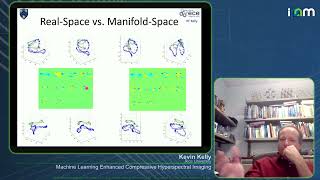
Machine Learning Enhanced Compressive Hyperspectral Imaging - IPAM at UCLA
Explore machine learning-enhanced compressive hyperspectral imaging techniques, combining optical systems and neural networks for efficient data acquisition and processing in various applications.
The Role of Data and Models for Deep-Learning Based Image Reconstruction
Explores deep learning in image reconstruction, focusing on model scaling, data requirements, and robustness. Discusses performance under distribution shifts and strategies for improvement.
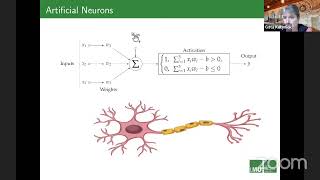
The Mathematics of Artificial Intelligence
Explore the mathematical foundations of AI, its impact on problem-solving in mathematics, and the challenges in developing reliable AI systems. Gain insights into generalization, explainability, and AI applications in inverse problems and PDEs.

Understanding, Interpreting and Designing Neural Network Models Through Tensor Representations
Explore tensor representations for neural networks, enhancing interpretability, expressive power, generalization, and robustness in deep learning models through spectral methods and innovative architecture design.
Machine Learning for Quantum Simulation - IPAM at UCLA
Explore machine learning applications in quantum simulation, focusing on neural networks for phase recognition and insights into complex quantum systems.
Collective Intelligence for Deep Learning - A Survey of Recent Developments
Survey of recent developments in collective intelligence for deep learning, exploring self-organization, emergent behavior, and cellular systems to address robustness and adaptability issues in neural networks.
On Bayesian Models with Networks for Reconstruction and Detection
Explore Bayesian models with neural networks for MRI reconstruction and outlier detection in medical imaging, focusing on network-based priors and generative modeling approaches.
Machine Learning and Neural Networks: Activation Functions - Day 11
Explore activation functions in neural networks, their role in machine learning, and how they impact model performance and decision-making processes.