Neural Network Programming - Deep Learning with PyTorch
Learn to build and train neural networks using PyTorch, covering tensor operations, CNN architecture, data preparation, training loops, and performance optimization techniques for deep learning projects.

Stanford Seminar 2022 - DeepMind's Perceiver and Perceiver IO: New Data Family Architecture
Exploring DeepMind's Perceiver architecture for flexible AI processing across diverse data types, offering domain-general solutions comparable to specialized models in various tasks.
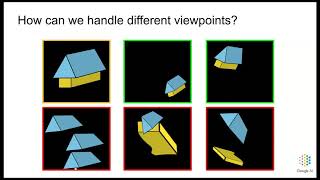
Capsule Networks for Computer Vision – CVPR 2019 Tutorial
Explore capsule networks for computer vision, covering architecture, challenges, applications, and advancements in this cutting-edge deep learning approach.
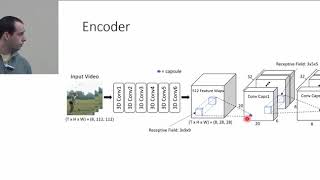
VideoCapsuleNet - A Simplified Network for Action Detection
Explore VideoCapsuleNet, a simplified network for action detection in videos. Learn about capsule networks, convolutional layers, and innovative techniques for improved video analysis.
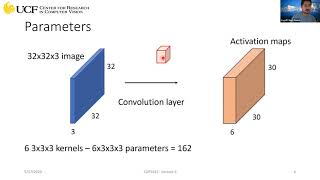
CAP5415 - Introduction to Convolutional Neural Networks Part 2 - Lecture 6
Explore convolutional neural networks' architecture, layers, and features. Learn about AlexNet, pooling, normalization, and the progression from low-level to complex features in deep learning.
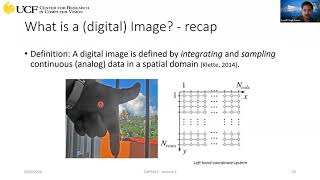
Introduction to Convolutional Neural Networks - Part 1 - Lecture 6
Comprehensive introduction to Convolutional Neural Networks, covering history, architecture, key concepts, and applications in image processing and beyond.
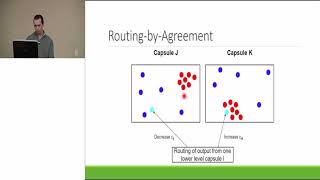
Dynamic Routing Between Capsules
Explore capsule networks, routing-by-agreement, and their applications in computer vision, with a focus on MNIST and multiMNIST datasets.
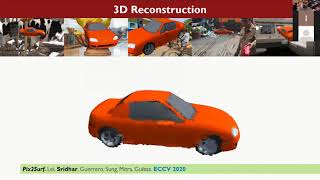
3D Deep Learning for Gaming with Srinath Sridhar and Stanford Artificial Intelligence
Explore 3D deep learning for gaming, covering human pose estimation, object reconstruction, and computer vision applications with Stanford AI expert Srinath Sridhar.
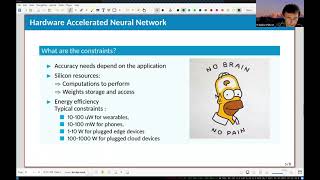
TinyML Talks France - State of the TinyML Today
Exploration des applications, avancées et défis du TinyML, mettant en lumière son potentiel dans les systèmes à très faible consommation et son impact sur l'IA embarquée et l'IoT.
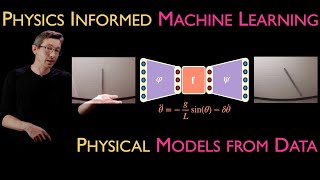
Physics Informed Machine Learning: High-Level Overview of AI and ML in Science and Engineering
Explore how to integrate physics into machine learning, enhancing model accuracy and efficiency in engineering applications. Learn to leverage prior physical knowledge across all stages of the ML process.
Nonlinear Approximation by Deep ReLU Networks - Ron DeVore, Texas A&M
Explores deep ReLU networks for nonlinear approximation, covering architecture, error analysis, and manifold approximation. Bridges mathematics, statistics, and computer science in data science applications.
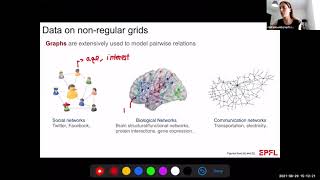
Simplicial Neural Networks
Explore simplicial neural networks, a generalization of graph neural networks for multi-dimensional data, and their applications in imputing missing data on coauthorship complexes.
Pawel Dlotko - A Few Simple Stories on Topology in Action
Explore practical applications of computational topology in material science, dynamical systems, and brain research. Learn how theory and algorithms work together to solve real-world problems.
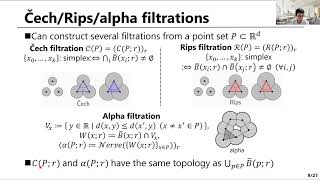
RipsNet- Fast and Robust Estimation of Persistent Homology for Point Clouds
Estimating persistence diagrams of point clouds using neural networks for faster, more robust topological analysis. Overcomes computational complexity and sensitivity to outliers in practical applications.
Uncertainty Quantification with Physics-Informed Machine Learning
Exploring uncertainty quantification in physics-informed machine learning, focusing on architecture and learning approaches for scientific applications and complex real-world phenomena.
Python Neural Networks - Tensorflow 2.0 Tutorial - What Is a Neural Network?
Explore neural networks using TensorFlow 2.0, covering key concepts, architecture, and practical implementation in Python for beginners and intermediate learners.
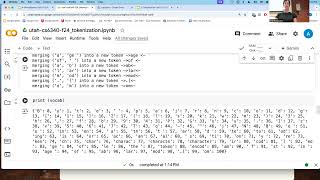
Neural Networks Foundations - Feedforward Neural Networks
Master the fundamentals of feedforward neural networks, exploring their architecture, functionality, and implementation principles for building effective machine learning models.
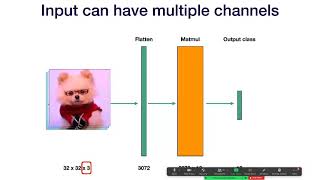
Convolutional Neural Networks - Full Stack Deep Learning - Spring 2021
Explore convolutional neural networks, from basic operations to advanced concepts like dilated convolutions and pooling. Learn about the classic LeNet architecture and gain insights into ConvNet implementation.
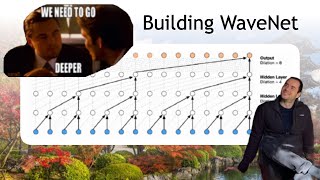
Building Makemore - Building a WaveNet
Dive deep into building a WaveNet-like convolutional neural network, exploring torch.nn, and understanding the typical deep learning development process through hands-on implementation.
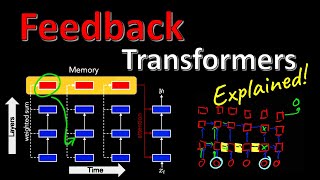
Feedback Transformers - Addressing Some Limitations of Transformers with Feedback Memory
Explores Feedback Transformers, an architecture that improves on standard Transformers by allowing higher-level representations to inform lower-level processing, enhancing performance on complex reasoning and long-range dependency tasks.
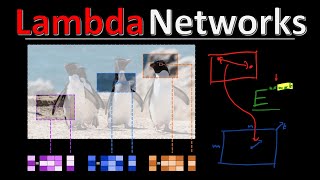
LambdaNetworks- Modeling Long-Range Interactions Without Attention
Explore LambdaNetworks, a novel approach to modeling long-range interactions in AI without traditional attention mechanisms, offering improved efficiency and performance in computer vision tasks.