Instabilities in Neural Autoregressive Models of Geophysical Flows
Explores instabilities in neural autoregressive models for geophysical flows, discussing challenges and advancements in predicting complex atmospheric and oceanic dynamics using machine learning techniques.
System of Interacting Neurons with Short-Term Synaptic Facilitation
Explore interacting neurons and short-term synaptic facilitation in this comprehensive lecture by experts from renowned French universities.
Topological Insights in Neuroscience
Explore topological approaches in neuroscience, uncovering insights into brain structure and function through mathematical analysis.
Inferring Monosynaptic Connections from Cross-Correlograms of Neuronal Spike Trains
Explore techniques for inferring monosynaptic connections from neuronal spike train cross-correlograms, enhancing understanding of neural network structures.
A Multiple Time Renewal Equation for Neural Assemblies with Elapsed Time Model
Explore neural assemblies through a multiple time renewal equation, focusing on the elapsed time model and its implications for understanding brain dynamics.
The Non-Linear Dynamics of Retinal Waves
Explore the complex dynamics of retinal waves, uncovering their non-linear behavior and implications for visual system development.
Projection Methods for Neurobiological Networks
Explore projection techniques for analyzing complex neurobiological networks, focusing on applications in neuroscience research and computational modeling.
Understanding Synaptic Mechanisms: Why a Multi-disciplinary Approach is Important
Explore multi-disciplinary approaches to understanding synaptic mechanisms, emphasizing their importance in neuroscience research and potential applications.
Time Averages of a Metastable System of Spiking Neurons
Explore metastable systems of spiking neurons and their time averages in this concise neuroscience lecture by Morgan André.
Recent Results on Mean Field Analysis of Spiking Neuron Networks
Explore recent findings on mean field theory applied to spiking neuron networks, presented by Romain Veltz from Inria Sophia Antipolis.
Spontaneous Oscillations in Pure Excitatory Mean Field Networks of Neurons
Explore spontaneous oscillations in excitatory neural networks through mean field analysis, uncovering insights into complex neuronal dynamics.
Cognition Emerges from Neural Dynamics
Explore neural dynamics and their role in cognitive emergence with MIT's Prof. Earl Miller. Gain insights into cutting-edge neuroscience research and its implications.
Imaging the Brain for Neuroscience and Artificial Intelligence
Explore cutting-edge brain imaging techniques for advancing neuroscience and AI research with Prof. Zhongming Liu from the University of Michigan.
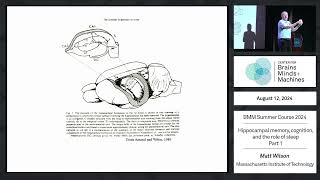
Hippocampal Memory, Cognition, and the Role of Sleep - Part 1
Explore hippocampal memory, cognition, and sleep's influence in this comprehensive lecture by MIT's Matt Wilson, delving into neuroscience fundamentals.
Computation with Sequences of Neuronal Assemblies
Explore neuronal assembly sequences in computation, bridging AI, psychology, and neuroscience for insights into higher-level intelligence.
Space is a Latent Sequence - A Theory of Hippocampus and PFC
Explore a theory linking hippocampus and prefrontal cortex, examining spatial cognition as a latent sequence for insights into higher-level intelligence.
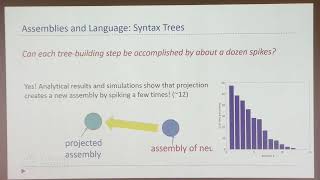
Coin-Flipping in the Brain - Probabilistic Computation and Learning in the Assembly Model
Explores how brain noise enables probabilistic computation and statistical learning, using the Assembly Model to demonstrate biologically plausible mechanisms for handling uncertainty and making predictions.

What Neural Machinery is Needed for Language Acquisition
Explore the neural mechanisms underlying language acquisition, integrating insights from AI, psychology, and neuroscience to understand higher-level intelligence.
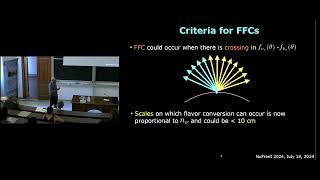
AI for Collective Neutrino Oscillations: From Detection of FFCs to Prediction of the Asymptotic
Explore AI applications in neutrino physics, focusing on collective oscillations, fast flavor conversions detection, and asymptotic prediction techniques.
Emergent Computation and Learning with Assemblies of Neurons
Explore neural assemblies' role in emergent computation and learning, uncovering insights into brain function and artificial intelligence advancements.
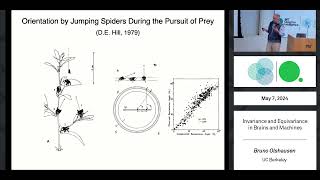
Invariance and Equivariance in Brains and Machines
Exploring neural mechanisms for visual perception, this talk proposes innovative approaches to building invariant and equivariant representations, bridging neuroscience and AI for improved machine vision and neurobiological understanding.