How Do Neural Networks Grow Smarter? - With Robin Hiesinger
Exploring neural networks' growth into brains, this talk delves into the interplay between neurobiology and AI, questioning if biological brains are just messy hardware and if nature or artificial intelligence holds the key to smarter systems.
Computation in Networks of Neurons in the Brain I
Explore neural network computation in the brain, focusing on advanced concepts and recent research findings in computational neuroscience.
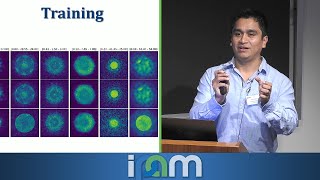
Application of Machine Learning to Electron Microscopy Data - IPAM at UCLA
Explore machine learning applications in electron microscopy, focusing on data modeling and neural networks for distortion compensation in experimental datasets.
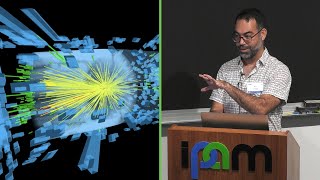
Simulation-Based Inference for Gravitational Wave Astronomy - IPAM at UCLA
Explore simulation-based inference techniques for gravitational wave astronomy, covering frequentist vs. Bayesian approaches, summary statistics, and the role of neural networks and inductive bias.
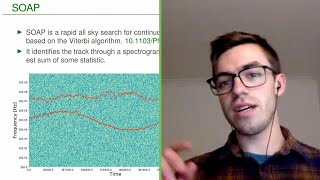
Rapidly Searching for Continuous Gravitational Waves
Explore challenges and solutions in detecting continuous gravitational waves from neutron stars, focusing on SOAP's rapid search method using neural networks for signal identification and parameter estimation.
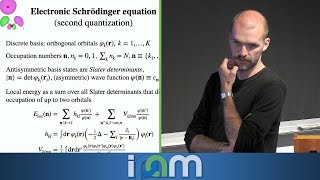
Neural-Network Wave Functions for Quantum Chemistry - IPAM at UCLA
Explore neural-network wave functions in quantum chemistry, covering variational quantum Monte Carlo, antisymmetric ansatzes, and applications to electronic and exciton-phonon Hamiltonians for improved accuracy in molecular modeling.
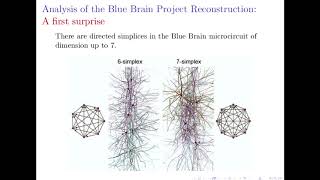
Ran Levi - Bedlewo: Topological Analysis of Neural Networks
Explore topological analysis of neural networks using algebraic topology techniques on biologically accurate digital reconstructions, revealing structural and functional insights into brain connectivity.
Spin Alignments and Large-Scale Structure Reconstructions Using Neural Nets by Punyakoti Veena
Explore neural networks for spin alignments and large-scale structure reconstructions in cosmology, advancing our understanding of the Universe's structure and evolution.
Glassy Dynamics and Plasticity - Building ML-Based Theories - Lecture 3
Explore ML-based theories for glassy dynamics and plasticity, focusing on bottom-up learning approaches in soft matter physics and their applications in designing functional materials.
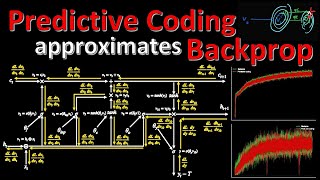
Predictive Coding Approximates Backprop Along Arbitrary Computation Graphs - Paper Explained
Explores how predictive coding can approximate backpropagation in neural networks, bridging neuroscience and machine learning. Discusses implications for biologically plausible deep learning algorithms.
Using Dynamics to Constrain Connectivity of Neuronal Population in Respiratory Brainstem
Explores models of neuronal connectivity in respiratory brainstem, focusing on synchronized bursting activity and network architecture insights using multi-state bootstrap percolation.
Interpretable Machine Learning Approaches for Multi-Year Climate Variability
Explore interpretable machine learning techniques for identifying and understanding predictable multi-year climate variability, focusing on neural networks and explainable AI in climate science research.
What Do We Want to Know and How Will a Connectome Help Us Know It?
Explore the potential of connectome analysis in neuroscience with Gwyneth Card, discussing its applications, limitations, and future directions in understanding brain function and behavior.
How to Simulate a Connectome - Predicting Neural Activity from Connectivity
Exploring how connectivity measurements of neural networks can predict neural activity and inform understanding of neural computation, with experimentally testable predictions across multiple studies.
From Connectome to Dynamic Representations
Explore dynamic representations in connectome analysis, bridging neuroscience and mathematics to uncover brain network functionality and information processing mechanisms.
Enhancing Brain Health and Mental Acuity
Explore brain mechanisms behind cognition and memory with Dr. D'Esposito. Learn about neural networks, memory types, dopamine's role, and brain disorders. Discover practical tools to enhance cognitive function and memory.

How Does the Brain Beget the Mind? - Bridging Neuroscience and Cognition
Exploring the neural basis of cognition and intelligence through the Assembly Calculus, a computational system bridging the gap between brain activity and higher-level cognitive functions.
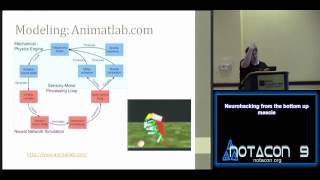
Neurohacking from the Bottom Up
Explore neurohacking fundamentals, from cell biology to neural networks. Learn about action potentials, EEG monitoring, and non-invasive techniques to understand and potentially modify brain function.
Fluid Mechanics-Informed Machine Learning - Successes and Failures
Explore machine learning approaches for fluid mechanics simulations, including physics-based features and CNNs, with insights on successes and challenges in speeding up predictions.
Singularities in Fluid
Explore innovative techniques for investigating fluid singularities, including self-similar analysis, computer-assisted proofs, and neural networks.
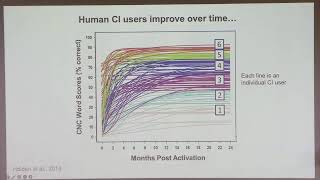
New Models of Human Hearing via Machine Learning
Exploring machine learning models to understand human auditory abilities and brain function, with implications for auditory prosthetics and behavioral insights.