
Does Your LLM Truly Unlearn? - A Simple Approach to Recover Unlearned Knowledge
Explore the effectiveness of LLM unlearning methods and discover how supposedly "forgotten" knowledge can be recovered through simple approaches in AI model training.
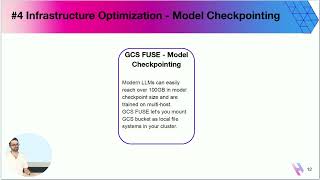
Compute Strategies for Generative AI - Resource Optimization and ML Platform Development
Discover strategic approaches to distribute computing resources for large-scale AI models, focusing on optimization techniques and efficient resource management in production environments.
End-to-End Secure Machine Learning Development - Building a Secure AI Supply Chain
Discover essential security practices for AI development, from dataset handling to production deployment, focusing on supply chain security, model provenance, and risk mitigation in machine learning applications.
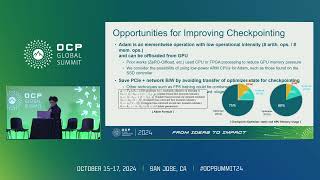
Checkpoint Offloading SSD - Enhancing Performance and Scalability in LLM Training
Discover how checkpoint offloading SSD technology optimizes LLM training by reducing GPU memory usage and improving data movement efficiency between storage components.
Characterizing Communication in Distributed Parameter-Efficient Fine-Tuning for LLMs
Explore communication patterns and optimization techniques in distributed parameter-efficient fine-tuning for Large Language Models, focusing on network performance and scalability challenges.
gRPC and AI: Adapting to Changing Development and Workload Paradigms
Explore AI's impact on development, workloads, and hardware, focusing on gRPC's role in AI and its adaptation to intense model training demands.
Leveraging GANs for Building Synthetic Data
Explore GANs for synthetic data generation to overcome data scarcity, preserve privacy, and enhance machine learning model training across various domains.
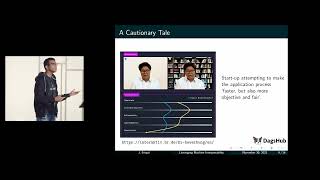
Interpretability Tools as Feedback Loops in Machine Learning Training
Explore machine learning interpretability techniques to optimize training sequences and develop more effective models without increasing compute or training time.
Mastering LLMs with Skill-it! and Zero-Shot Robustification
Explore innovative techniques for optimizing language models: Skill-it! for efficient training and zero-shot robustification for improved performance. Learn data-driven approaches to enhance AI capabilities.

The Making of RedPajama and the Future of Open-Source AI
Explore the creation of RedPajama, an open-source AI project, and its impact on the future of AI. Learn about data collection and training processes for building leading open-source models.

Securing GenAI End-to-End: From Development to Deployment
Explore comprehensive strategies for securing AI-powered applications throughout the software supply chain, from data ingestion to model deployment and output protection.
Introduction to Vertex AI - Build Series Episode 9
Explore Vertex AI on Google Cloud: Learn about machine learning options, AutoML, custom models, and see demos on dataset creation, model building, and classification.
Training a Neural Network: Underfitting and Overfitting
Learn techniques for training neural networks, including strategies to prevent underfitting and overfitting, enhancing model performance and generalization.

Top Ten Tips for Fine-tuning Large Language Models
Discover ten essential tips for effective fine-tuning of language models, from starting small to advanced techniques like LoRA and preference tuning. Gain practical insights for optimal results.
nnScaler: Constraint-Guided Parallelization Plan Generation for Deep Learning Training
Innovative framework for efficient deep learning training parallelization, using primitives and constraints to generate optimized execution plans, outperforming existing solutions for popular DNN models.
Active Learning in Computer Vision
Discover techniques for creating active learning pipelines to leverage production data in training advanced computer vision models.

Creating Your Own Flux AI Model with LoRA Fine-Tuning
Learn to create and fine-tune a custom Flux AI model using LoRA, including dataset preparation, cost-effective training on Replicate, and generating AI images with your personalized model.
Driving Better Decisions: The Case for Precision Data to Power AI
Explore the symbiosis of data and AI, focusing on high-quality data streams. Learn about AI fundamentals, data's role in model training, and overcoming data management challenges for enhanced decision-making and innovation.

Fine-Tuning and Deploying LLaMA 3.1 on Hugging Face and Ollama
Step-by-step guide to fine-tune LLaMA 3.1 with custom data, save on Hugging Face and Ollama, and deploy for enhanced AI performance tailored to specific business needs.

What Is Quantum Machine Learning?
Friendly introduction to quantum computing and machine learning, covering qubits, quantum gates, entanglement, and their applications in generative modeling and optimization.

Multi-Class Language Classification With BERT in TensorFlow
Learn to build a multi-class language classification model using BERT and TensorFlow. Covers data preprocessing, model architecture, training, and prediction with transformers for NLP tasks.