Linear Algebra for the Standard C++ Library
Exploring a proposal to add linear algebra components to the C++ standard library, covering design, rationale, and implementation details for matrices, vectors, and related operations.
A Generic Binary Tree - Why Grow Your Own?
Explore the design and implementation of a generic binary tree for Boost.Graph, discussing trade-offs, storage options, and performance comparisons while drawing insights from classic computer science texts.
The Truth of a Procedure in Programming
Explore the mathematical logic behind programming procedures, treating them as statements about event arrangements and bridging programming with formal languages and truth concepts.
Identifying Monoids - Exploiting Compositional Structure in Code
Explore monoids as a powerful compositional pattern in code architecture. Learn to identify, exploit, and apply monoids to improve API design, incremental computation, and work distribution.
STL Algorithms as Expressions
Explore advanced C++ techniques using Expression Templates for flexible algorithm customization, enhancing STL range algorithms and generic programming beyond traditional approaches.
Taking Static Type-safety to the Next Level - Physical Units for Matrices
Explore advanced C++ techniques for implementing physical unit types in matrix operations, enhancing type safety and error prevention in robotics, graphics, and automated driving applications.
Durable Integer Arithmetic
Exploring integer arithmetic in C++: hardware vs. language rules, challenges for numerical libraries, and potential improvements for more durable and efficient implementations.
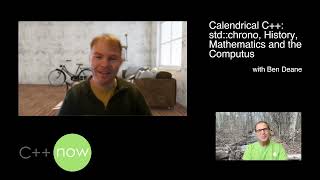
Calendrical C++ - std::chrono, History, Mathematics and the Computus
Explore std::chrono, calendrical mathematics, and historical computations in C++. Gain insights into time-related programming challenges and their solutions through an engaging interview with expert Ben Deane.

C++ Compile-Time Sparse Matrices for Linear Algebra and Tracking Applications
Explore compile-time sparse matrices in C++ for efficient linear algebra and tracking applications, optimizing memory usage and performance through advanced type system techniques.
Calendrical C++ - std::chrono, History, Mathematics and the Computus
Explore std::chrono, calendar history, and Easter calculation algorithms in C++. Gain insights into real-world time complexities and learn to create appropriate abstractions for calendrical challenges.
Pyambic Pentameter - Generating Rhyming and Metered Poems
Explore generating rhyming and metered poems using Python, combining Markov chains and NLTK for creative text generation with style and structure.
The Joy of Creating Art with Code
Explore the fusion of art and code through generative algorithms, creating autonomous aesthetic forms using Processing and PyCairo. Learn about randomness, shapes, and advanced techniques like fractals and genetic algorithms.
A Careful Walk Through Probability Distributions, Using Python
Explore probability distributions using Python, demystifying key concepts like sampling, joint, conditional, and marginal distributions for a solid foundation in Bayesian statistics.
A Hands-On Introduction to Multi-Objective Optimization
Hands-on Python tutorial exploring multi-objective optimization using Pareto Fronts. Learn to balance conflicting objectives like quality and cost, with practical applications in various fields including supply chain and therapeutics development.
Python + VPS Jupyter HUB - Notebook
Experiencia educativa innovadora que combina Python, Jupyter y VPS para enseñar programación y otras disciplinas de forma remota, accesible y práctica en el norte argentino.
Vectorize Using Linear Algebra and NumPy to Make Your Python Code Fast
Learn to optimize Python code using linear algebra and NumPy vectorization techniques. Discover how to replace inefficient loops with fast NumPy operations, significantly improving performance while maintaining readability.
It Might Look Normal but This Distribution Will Ruin Your Stats
Explore a deceptive non-normal distribution that mimics normality, its prevalence in nature, and its impact on hypothesis testing. Learn about robust statistics and their applications in data analysis.
Three Musketeers - Sherlock Holmes, Mathematics and Python
Explore how mathematics and Python can be used to solve crime mysteries, inspired by Sherlock Holmes. Learn to apply statistical concepts and Python libraries to tackle forensic puzzles and hypothetical cases.
Improving Efficiency in Transportation Networks Using Python
Explore Python's role in optimizing transportation networks through real-world examples, including driver-load matching, network optimization, and decision-making using graph analytics and data science concepts.
Exploring Eco Topics with Python
Learn to apply Python skills to pressing environmental issues, using tools like numpy, pandas, and matplotlib to analyze deforestation, wildlife trade, and carbon pollution data.
PostgreSQL - The Database-Sister of Python
Explore PostgreSQL's powerful features and its synergy with Python for robust database management and efficient data handling in web applications.