Maths - The Fun Parts
Explore fun mathematical concepts through programming, including Sets, Groups, and Graphs. Discover the joy of abstract math ideas by writing code to understand their inner workings.
The Wheels on D-Bus
Explore D-Bus in Emacs: learn its model, interfaces, and native support. Discover Debase for object management and see demos of remote evaluation and Org capture.
Fonts and Math
Explore the intersection of font design and mathematics, covering topics like nib pens, Donald Knuth, railroad tracks, and differential equations. No advanced math knowledge required.
On the Importance of Visibility
Explore the importance of visibility in orchestrated services, learn from real-world incidents, and discover strategies to prevent hidden issues in internal tools and products.

The seL4 Foundation - Growing Through Upheaval
Exploring seL4 microkernel's journey: from groundbreaking proofs to community-driven growth, overcoming challenges and fostering broader engagement in secure computing systems.
AI and Web Development - Hype or Reality
Explore AI's impact on web development, separating hype from reality. Discover potential uses, integration challenges, and future implications for developers and frameworks.
Mistakes I Made Building React Async
Explore common pitfalls and lessons learned in developing React Async, a popular library for handling asynchronous operations in React applications.
What Does It Mean to Live a Better Life Within the Limits of One Planet
Explore sustainable living and IKEA's approach to inspiring eco-friendly lifestyles while meeting consumer values and addressing urgent environmental challenges.
Driving Revenue in the API Economy
Explore how APIs are shaping the modern economy, enabling innovative services and revenue streams across industries. Learn to leverage integration for business growth in the digital age.
Quantum Computing
Explore quantum computing basics, debunk misconceptions, and learn about its potential applications and challenges in this engaging talk on cutting-edge technology.
Why Algebraic Data Types Are Important
Explore type theory, category theory, and logic in functional programming, focusing on algebraic data types and their role in enhancing code reliability and expressiveness.
Embedded Systems 101
Comprehensive introduction to embedded systems, covering their importance, challenges, and development techniques. Ideal for computer science graduates seeking organized knowledge in this field.
Linear Programming Made Easy with Boost Proto
Linear programming optimization using Boost Proto. Learn to model and solve complex decision problems efficiently with CVX++, a declarative domain-specific language embedded in C++.
Metaprogramming Applied to Numerical Problems
Explore advanced Template Metaprogramming techniques for implementing efficient Runge-Kutta schemes to solve ordinary differential equations in various scientific fields.
A Discussion of Selected Vienna-Libraries for Computational Science
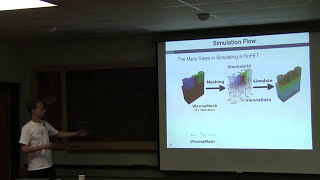
Explore Vienna-Libraries for computational science: ViennaCL, ViennaGrid, ViennaData, ViennaMath, and ViennaFEM. Learn how C++ can better meet scientific computing needs.
Building Finite-Element Matrix Expressions with Boost Proto and the Eigen Library
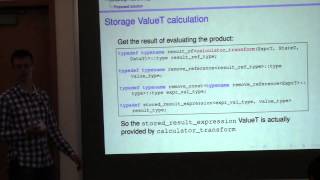
Learn to integrate Eigen with Boost Proto for finite-element matrix expressions, including user-defined functions and external libraries in domain-specific languages.
Functional Programming in C++
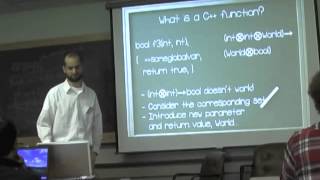
Explore functional programming techniques in C++, including recursive algebraic data types, curried functions, purity, generic programming, and category theory for more general, concise, and composable code.
C++ in Space Plasma Model Development
Explore space plasma modeling using C++11, covering numerical methods, advanced algorithms, and concurrency for efficient simulations in astrophysics and space weather.
Functional Geometry - Producing Pure Spaces
Explore geometric synthesis using category theory and functional programming. Learn to model complex spatial configurations with C++14, combining Geometric Algebra and FP paradigms for dimensional fluency.

Monoids, Monads, and Applicative Functors - Repeated Software Patterns
Explore abstract mathematical structures in software development, focusing on monoids, monads, and applicative functors. Learn to recognize these patterns and apply them to improve code design and problem-solving skills.
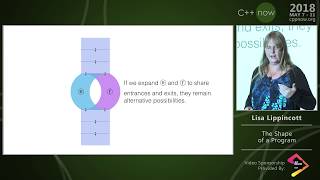
The Shape of a Program
Explore how programs can be viewed as mathematical shapes using topology, examining connections between actions, capabilities, time, and possibility in software architecture.