Pricing Products Using Python Graphs and Sets
Explore product pricing strategies using Python's graphing and set capabilities, focusing on ice cream as a model system to uncover patterns and meet business requirements.
Pricing Products Using Python Graphs and Sets
Learn to price products efficiently using Python's graph and set capabilities, exploring practical techniques for product lifecycle management and rule interpretation.
Google Apps Loves Python
Explore Python's integration with Google Apps, enhancing productivity and automation in cloud-based workflows.

Non Sequitur - An Exploration of Python's Random Module
Explore Python's random module, covering pseudorandom number generation, Mersenne Twister algorithm, and various probability distributions. Gain insights into randomness applications and practical usage in programming.
VPython Goes to School
Explore VPython's potential in high school education, linking programming concepts with math, physics, and chemistry through interactive 3D visualizations and simulations.
Statistics 101 for System Administrators
Python for sysadmins: Analyze system data using statistics, scipy, and matplotlib. Learn to parse logs, calculate distributions, find correlations, and create informative plots to quickly identify performance issues.
Probabilistic Programming in Python
Learn probabilistic programming in Python using PyMC3 for flexible statistical modeling, automated parameter estimation, and uncertainty quantification in data science and scientific research.
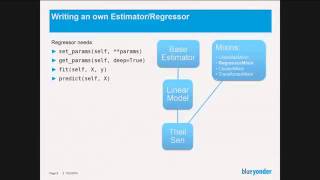
Extending Scikit-Learn with Your Own Regressor
Learn to extend Scikit-Learn by implementing a robust Theil-Sen estimator, exploring its advantages over ordinary least squares and understanding Scikit-Learn's design and contribution process.
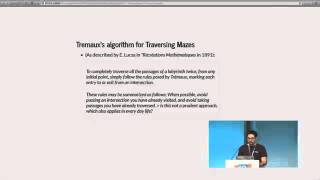
Traversing Mazes the Pythonic Way and Other Algorithmic Adventures
Explore graph algorithms through a Pythonic lens, focusing on maze traversal, efficient representations, and problem-solving techniques like backtracking and dynamic programming.
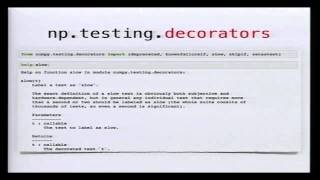
Machine Learning Under Test
Explore testing strategies for machine learning algorithms, focusing on code quality, domain-specific challenges, and practical implementation techniques for more robust and reliable ML models.
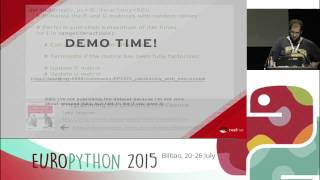
Yak Shaving a Good Place to Eat Using Non Negative Matrix Factorization
Explore data handling techniques to analyze restaurant reviews, group users with similar tastes, and find personalized dining recommendations using non-negative matrix factorization.
Just Because You Can, Doesn't Mean You Should
Explores antipatterns in Python library design, discussing type checking, API design, resource management, and networking. Emphasizes balancing convenience with flexibility, readability, and predictability.
Query Embeddings - Web Scale Search Powered by Deep Learning and Python
Explore query embeddings in web-scale search using deep learning and Python. Learn about unsupervised techniques, vector representations, and efficient retrieval systems for improved search engine performance.
Unveiling the Universe with Python
Explore how Python and Monte Carlo simulations unveil the mysteries of the Universe, from analyzing cosmic microwave background data to revealing the surprising dominance of dark matter and energy.
Planning for the Worst
Explore strategies for handling production issues, from common errors to obscure failures. Learn practical tips, best practices, and code solutions to enhance system reliability and resilience.
NetworkX Visualization Powered by Bokeh
Interactive network visualization using NetworkX and Bokeh in Jupyter Notebooks. Learn to create, manipulate, and update network structures with Python, enhancing data exploration and analysis of social networks.
Neat Analytics with Pandas Indexes
Explore advanced Pandas indexing techniques for efficient data analysis, covering index types, time-series resampling, and multi-indexing to enhance your productivity in Python analytics.
Automatic Conference Scheduling with PuLP
Explore linear programming and its practical application in conference scheduling using PuLP, a Python-based solver. Learn how to optimize complex event planning with this powerful tool.
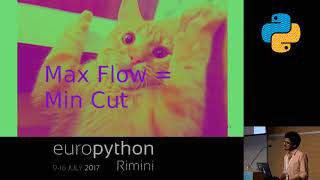
Optimization Using Flow Networks in NetworkX
Explore NetworkX for optimization using flow networks, covering library basics, network flow concepts, and solving the project selection problem with practical examples.
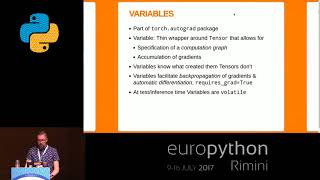
An Introduction to PyTorch & Autograd
Explore PyTorch's dynamic computation graphs and Autograd package for efficient deep learning, with practical examples and insights into GPU processing and algorithmic differentiation.
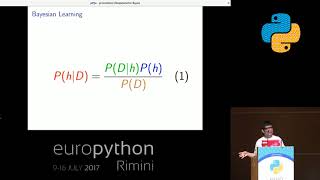
Introduction to Nonparametric Bayesian Models
Explore flexible machine learning with Nonparametric Bayesian Models. Learn about Dirichlet Process, compare parametric vs nonparametric approaches, and discover relevant Python libraries for advanced data analysis.