
Opening Remarks and Number-theoretic Cryptography
Opening remarks and exploration of number-theoretic cryptography, covering fundamental concepts and advanced applications in secure communication and data protection.
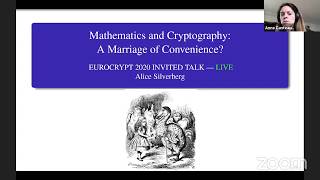
Mathematics and Cryptography - A Marriage of Convenience?
Explore the interplay between mathematics and cryptography, discussing cultural differences, challenges, and opportunities in academic research and collaboration.

Lattices and Related Problems
Explore lattice theory and its applications in cryptography, focusing on computational problems and their significance in modern security systems.

ECC and Isogenies
Explore elliptic curve cryptography and isogenies, delving into advanced mathematical concepts for secure cryptographic systems and post-quantum algorithms.
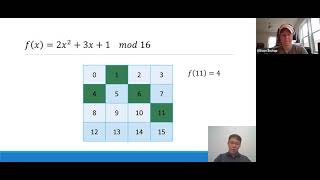
Iterated Inhomogeneous Polynomials
Explore iterated inhomogeneous polynomials and their applications in cryptography, including VDFs, group actions, and Diffie-Hellman protocols.

Take Control of Your Headless CMS with Contenta
Explore Contenta's open-source headless CMS features, comparing it to commercial platforms and showcasing 17+ years of community-driven development for superior content management.

Design Like a Supervillain - An Ode to Chaos and Creativity
Embrace chaos and failure in creative processes to foster innovation in digital products and branding. Learn from supervillains to challenge norms and push boundaries in design.
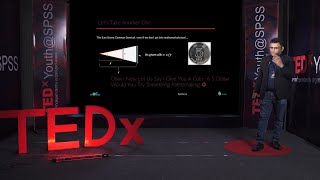
The Mathematical Way of Life
Discover how mathematics and problem-solving skills can lead to a better world and future. Explore the power of technology and human ingenuity in democratizing solutions to global challenges.
Free Energy Minimisation for Perception as Inference
Explores predictive processing theory and free energy principle in perception, comparing Helmholtz machine and message passing approaches to neural inference and consciousness.
A Categorical Formulation of Predictive Processing and Active Inference
Categorical formulation of Predictive Processing and Active Inference using string diagrams, clarifying key concepts and enabling comparison with Integrated Information Theory.
Mathematical Phenomenology, from Subjectivity to Objectivity Through Mathematical Invariants
Explore mathematical phenomenology's role in consciousness studies, examining how objectivity emerges from subjectivity using category theory and mathematical invariants.
Gnomonic Projection from Objective Flat 3-Space to Subjective Hemi-3-Sphere
Explores a novel model of visual perception using gnomonic projection to map objective 3D space onto a curved subjective space, explaining phenomena like foreshortening and straight line perception.
Geometry of World Model Influences Behaviors - Exact Results for Curiosity-Based Exploration
Explores how the geometry of internal world models affects behavior, focusing on the Projective Consciousness Model and its implications for understanding consciousness and designing social robots.
Consciousness - Coherence of Modalities
Explores a coherence-based theory of consciousness, proposing structured nets and dynamic mappings as key elements. Discusses data structures, neural codes, and links to mathematical concepts.
How to Model Consciousness Processes in Categorical Process Theory
Explore modeling consciousness using ZXW calculus, a graphical language for quantum computing, to understand interactions between perceiving and perceived divisions in cognitive processes.
Mathematizing Phenomenology Within a Process Framework
Exploring mathematical approaches to phenomenology within a process framework, bridging subjective experiences and objective analysis for a comprehensive understanding of consciousness.
The Emergence of Geometric Worldviews in Qualia Space
Explores how cognitive capabilities, subjective experience, and macroscopic perception lead to geometric worldviews in organisms, using qualia-based measurement spaces and topological concepts.
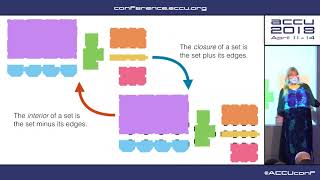
The Shape of a Program
Explore topology's application to programming, viewing code as a shape in time, space, causality, and possibility. Gain insights into program structure and design.
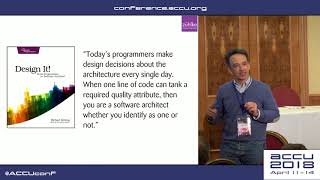
Creating an Incremental Architecture for Your System
Learn to create flexible software architecture incrementally, balancing upfront design with adaptability. Discover techniques for evolving system design as requirements change, focusing on key qualities and delaying non-critical decisions.

STL Algorithms in Less Than an Hour
Comprehensive overview of STL algorithms, their groupings, and applications in C++, enhancing code expressiveness and robustness through practical examples and patterns.
C++ and Linear Algebra
Explore the proposal for adding linear algebra support to C++'s standard library, discussing its importance, requirements, and potential applications in geometry and color manipulation.