Hidden Symmetries of Computational Problems
Explore hidden symmetries in computational problems, uncovering geometric methods for optimization and sampling with insights from experts in mathematics and quantum computing.

Approximation Power
Explore deep learning's approximation capabilities, focusing on theoretical foundations and practical implications for neural network design and performance optimization.
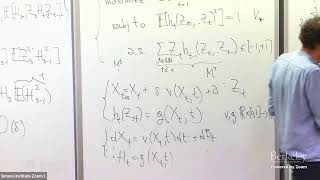
Optimal Iterative Algorithms for Problems With Random Data
Explore advanced iterative algorithms for solving problems with random data, focusing on computational complexity in statistical inference.
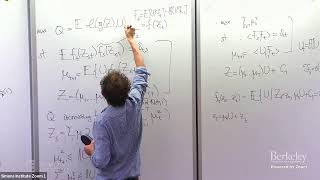
Optimal Iterative Algorithms for Problems With Random Data
Explore optimal iterative algorithms for statistical problems with random data, focusing on computational complexity and efficient solutions in statistical inference.
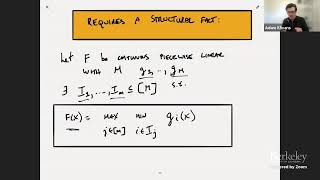
In Search of New Algorithms Part I - Neural Networks
Explore neural networks and their role in developing new algorithms, focusing on computational complexity and statistical inference challenges.

Pseudorandomness
Explorations in pseudorandomness: SoS lower bounds, block rigidity, unbounded-width permutation branching programs, computational entropies, and random projections in circuit complexity.

Berkeley in the 80s - Richard Karp and the Theory of Computing
In-depth interview with Turing Laureate Richard Karp, exploring his groundbreaking research on computational theory at Berkeley in the 1980s and its lasting impact on computer science.
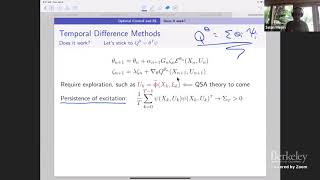
Every Optimization Problem Is a Quadratic Program
Explore how diverse optimization problems can be reframed as quadratic programs, offering insights into reinforcement learning theory and practical applications.
The Power and Limitations of Kernel Learning
Explore kernel learning's potential and limitations in modern machine learning, including practical implementations, comparisons with state-of-the-art methods, and insights into overfitting and acceleration.
Learning One-Hidden-Layer Neural Networks with Landscape Design
Explore optimization techniques for one-hidden-layer neural networks, focusing on landscape design and new objective functions to overcome traditional training challenges.
A Nearly-Linear Time Algorithm for Submodular Maximization with a Knapsack Constraint
Explore efficient algorithms for submodular maximization with knapsack constraints, focusing on nearly-linear time solutions and their applications in discrete optimization.

Asymptotic and Null Controllability of an Advection-Diffusion Equation
Explore asymptotic analysis and null controllability of advection-diffusion equations, focusing on boundary and internal layer interactions as diffusion parameter approaches zero.

Beating the Integrality Ratio for S-T-Tours in Graphs
Explores a novel algorithm for the s-t-path graph TSP, achieving a 1.497 approximation ratio and surpassing the known integrality ratio of 3/2 through innovative techniques.

A 1.5-Approximation for Path TSP
Explores a 1.5-approximation algorithm for the Metric Path Traveling Salesman Problem, introducing novel techniques to handle larger s-t cuts and achieve a simplified approach matching Christofides' TSP algorithm.
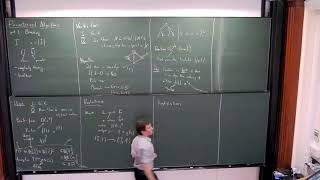
Introduction to Parameterized Algorithms, Lecture I
Gentle introduction to parameterized complexity, focusing on basic techniques like branching, color coding, and kernelization. Explores connections to linear programming and discrete optimization.
A Fibrational Framework for Modal Simple Type Theories
Explore modal extensions of homotopy type theory, focusing on fibrational frameworks for modal simple type theories and their applications in topology, geometry, and spectra.
Discrete and Codiscrete Modalities in Cohesive HoTT
Explore discrete and codiscrete modalities in Cohesive Homotopy Type Theory, examining their applications in topology, differential geometry, and synthetic formalizations of mathematical concepts.
Kathlén Kohn - The Geometry of Linear Convolutional Networks
Explore the geometry of linear convolutional networks, their function spaces, and optimization challenges. Gain insights into critical points, polynomial representations, and architectural impacts.
The Approximation Ratio of the k-Opt Heuristic for Euclidean TSP
Explore the k-Opt heuristic's approximation ratio for Euclidean TSP, improving upper bounds and providing new lower bounds for k ≥ 3, applicable to various p-norms.
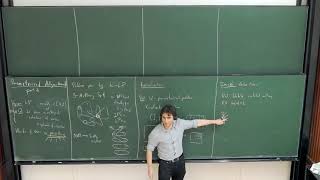
Michal Pilipczuk: Introduction to Parameterized Algorithms, Lecture II
Explore parameterized complexity, focusing on LP-related methods. Learn branching, color coding, kernelization, and dynamic programming techniques for algorithm design and optimization.
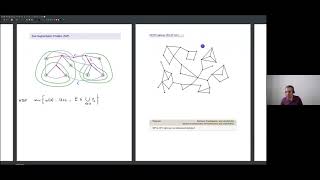
Approximation Algorithms for Hard Augmentation Problems
Explore advanced network design techniques for increasing graph connectivity, focusing on augmentation problems and recent developments in combinatorial optimization.