It Is Entropy That Counts by Jaikumar Radhakrishnan
Explore Shannon entropy's applications in combinatorics and computer science, including randomized two-party communication complexity and quantum communication complexity of Set Disjointness problem.
Computational Complexity in Theory and in Practice by Richard M. Karp
Explore the contrast between theoretical and practical approaches to algorithm efficiency, covering complexity classes, NP-completeness, approximation algorithms, and real-world applications.
Deep Learning Approaches in Inverse Problems by Deep Ray
Explore deep learning techniques for solving inverse problems in various fields, focusing on applications, challenges, and recent advancements in this cutting-edge area of research.

Advances in Applied Probability II
Explore cutting-edge research in applied probability, covering statistical learning, high-dimensional computation, Monte Carlo methods, discrete probability, percolation, and empirical methods. Gain insights from leading experts.
Standard and Less Standard Asymptotic Methods - Lecture 4
Explore advanced techniques for evaluating infinite sums and recognizing asymptotic patterns in numerical sequences, with practical examples and applications in various mathematical fields.
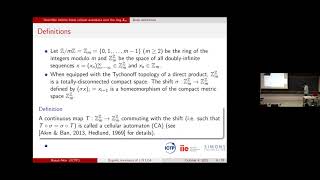
Reversible D-Dimensional CA Over the Ring ZM and Some Applications in Ergodic Theory
Explore cellular automata on $\mathbf{Z}_p$ and $\mathbf{Z}_m$, covering invertibility, ergodic properties, and entropy concepts. Delve into measure-theoretic and topological entropy for 1D linear CA and $\mathbb{Z}^2$-actions.
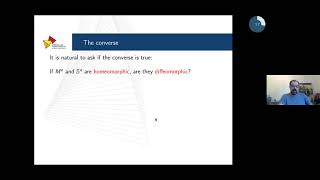
Exotic Spheres and Singularities - Math Associates Seminar
Explore the fascinating journey from exotic spheres to Milnor's Fibration Theorem, a cornerstone in singularity theory, and its impact on complex hypersurface geometry and topology.
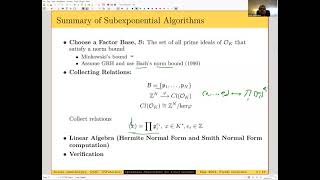
A Survey on Quantum Algorithms for Computing Class Groups
Explore quantum algorithms for class group computation, covering classical methods, quantum computing basics, hidden subgroup problems, and a polynomial-time quantum algorithm for ideal class groups.
Lattices in Low-Dimensional Topology
Explore advanced concepts in low-dimensional topology, focusing on lattice structures and their applications in geometric and topological analysis.
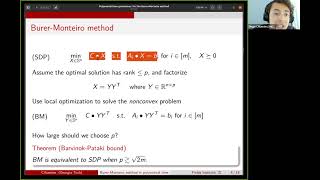
Polynomial Time Guarantees for the Burer-Monteiro Method
Explore polynomial time guarantees for the Burer-Monteiro method in solving large-scale semidefinite programs, focusing on smoothed analysis and its implications for optimization algorithms.
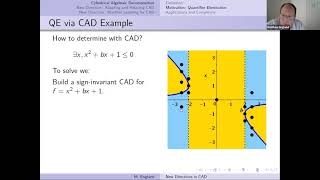
New Directions in Cylindrical Algebraic Decomposition
Explores recent advancements in Cylindrical Algebraic Decomposition, focusing on search-based algorithms and machine learning heuristics to improve efficiency in solving polynomial constraints.

Latency SLOs Done Right - Calculating and Setting Accurate Service Level Objectives
Explore accurate latency SLO calculation methods, including histogram-based approaches, to set mathematically correct quantiles and improve service level objectives for better monitoring and performance management.
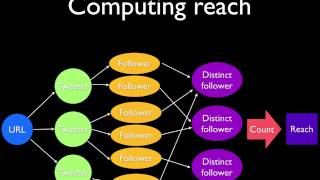
Storm: Realtime Distributed Computing with Nathan Marz - ETE 2012
Explore Storm for real-time data processing, covering concepts, development, deployment, fault-tolerance, and practical applications in distributed computing environments.

Deep Learning for Survival Analysis
Explore deep learning models for survival analysis, applying them to predict time-to-event outcomes in various fields like credit, machinery, and healthcare with Louise Ferbach.
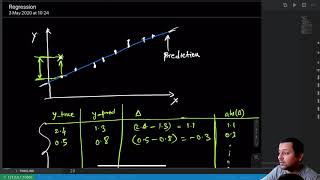
Simple and Basic Evaluation Metrics for Regression
Learn essential evaluation metrics for regression problems, including MAE, MSE, RMSE, RMSLE, and R2 score, with practical implementation in Python.

Model Explanation and Prediction Exploration Using Spark ML
Explore techniques for explaining non-linear models, showing feature contributions, and performing what-if analysis using Spark ML. Implement these methods to enhance model interpretability and enable interactive prediction exploration.
Interpolation and Learning With Scale Dependent Kernels
Explore scale-dependent kernels in machine learning, covering overfitting, statistical theory, and practical applications in regression and interpolation.
Learning What We Know and Knowing What We Learn - Gaussian Process Priors for Neural Data Analysis
Explore Gaussian process priors for neural data analysis, covering latent variable models, Bayesian inference, covariance kernels, and factor analysis. Gain insights into advanced techniques for understanding complex neural datasets.
DeepOnet - Learning Nonlinear Operators Based on the Universal Approximation Theorem of Operators
Learn to approximate nonlinear operators using DeepONet, a neural network architecture based on the universal approximation theorem. Explore applications in differential equations, fluid mechanics, and multiphysics problems.
Detecting Cancer with RBF Networks Trained by Genetic Algorithms
Explore machine learning techniques for cancer detection using RBF networks and genetic algorithms, with practical insights on implementation and advanced concepts.
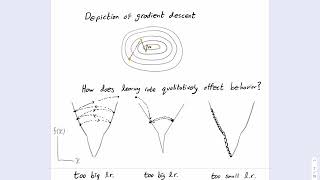
Gradient Descent and Stochastic Gradient Descent
Explore gradient descent and stochastic gradient descent in deep neural networks, covering convergence rates, learning rate effects, and challenges in optimization algorithms.