
Gibbs Sampling for Convex Bodies and an L_0 Isoperimetric Inequality
Explore Gibbs sampling for high-dimensional distributions, focusing on convergence guarantees and conductance bounds for sampling from convex bodies. Gain insights into this widely-used algorithm's efficiency and limitations.

Prediction + Optimisation - Without and With Decision-Focused Learning
Explore AI-enhanced combinatorial optimization, including preference learning, decision-focused learning, and explanation generation. Discover CPMpy, a modern constraint programming language integrating multiple solving paradigms with machine learning.

AlphaTensor - Discover Faster Matrix Multiplication Algorithms with RL - IPAM at UCLA
Discover how DeepMind's AlphaTensor uses reinforcement learning to find efficient matrix multiplication algorithms, outperforming human-designed methods and improving on Strassen's algorithm after 50 years.
Machine Learning for MIP Solving - IPAM at UCLA
Explore machine learning techniques for solving Mixed Integer Programming problems, enhancing optimization algorithms in discrete mathematics and artificial intelligence applications.
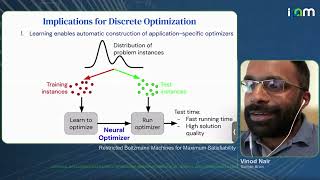
Restricted Boltzmann Machines for Maximum Satisfiability - IPAM at UCLA
Explore how Restricted Boltzmann Machines can be applied to Maximum Satisfiability problems, leveraging neural network accelerators for efficient stochastic search in combinatorial optimization.
New Approaches in Simulation of Transition Paths - IPAM at UCLA
Explores tensor methods for simulating chemical transition processes, focusing on compressing high-dimensional PDE functions and introducing a novel tensor-network generative modeling approach without optimization.
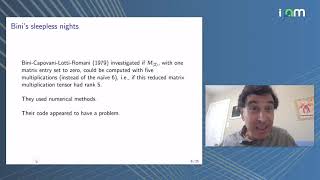
Introduction to the Geometry of Tensors
Explore tensor geometry and its applications in physical and data sciences through a gentle introduction, emphasizing how geometric perspectives advance practical implementations.

Stabilizer Formalism & Quantum Error Correction Through the Lens of Tensors - Part 1
Explore stabilizer formalism and quantum error correction using tensor methods. Learn about many-body systems, error correction challenges, and connections to finite symplectic geometries.
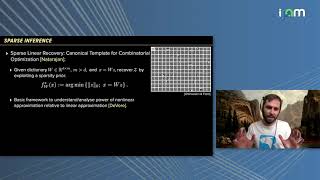
On Sparse Linear Programming and Simple Neural Networks
Explores connections between sparse linear programming and neural networks, focusing on overparametrized learning and sparse inference from computational perspectives.
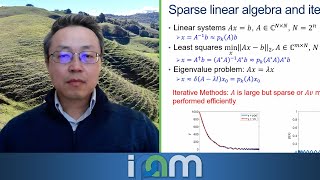
Practical Quantum Circuits for Block Encodings of Sparse Matrices
Explore efficient quantum circuits for block encodings of sparse matrices, focusing on strategies for well-structured matrices and quantum walks on graphs. Gain insights into quantum linear algebra algorithms.
Simple and Fast Rounding Algorithms for Directed and Node Weighted Multiway Cut
Explore efficient algorithms for directed and node-weighted multiway cut problems, focusing on simple rounding techniques and integrality gap analysis in graph theory and combinatorial optimization.
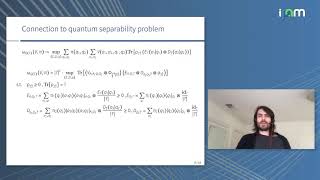
Characterising Quantum Correlations of Fixed Dimension
Explores semidefinite programming for quantum correlations, improving approximation algorithms for two-player free games with quantum assistance using entropy inequalities and de Finetti theorems.
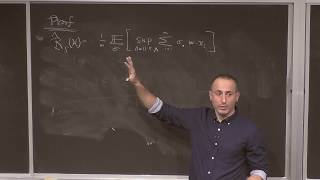
Gradient Descent, Stochastic Gradient Descent, and Acceleration - Part 2
Explore advanced gradient-based optimization methods for large-scale machine learning, including stochastic gradient descent and accelerated versions, with convergence analysis and ODE connections.
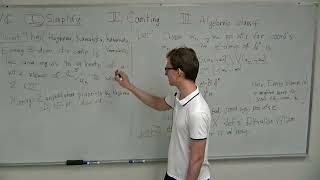
Counting Divisorial Contractions with Centre a $cA_n$-Singularity
Explore 3D divisorial contractions with $cA_n$-singularity centers, simplifying existing classifications and examining high-discrepancy contractions to fixed varieties.

Logarithmic Resolution of Singularities
Explore a novel approach to resolving singularities in algebraic geometry using logarithmic techniques, offering faster and more functorial results with applications to log schemes and morphisms.
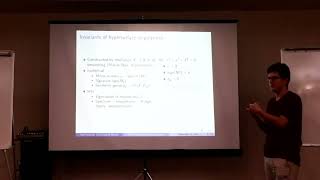
GPPV Invariants and the Spectrum of Singularities
Explore complex surface singularities, their 3-manifold links, and GPPV invariants. Discover new connections between modular forms and singularity spectra for Brieskorn homology spheres and ADE singularity links.
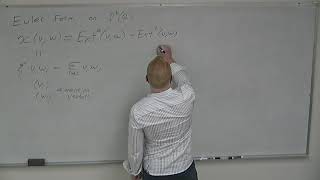
Steenbrink Spectra in Singularity Categories
Explore Steenbrink spectra's role in singularity categories, examining how spectral numbers manifest in triangulated singularity categories associated with singularities.

Embedding as a Tool for Algorithm Design
Explore embedding algorithms for structured data prediction, combinatorial optimization, and dynamic network processes. Learn innovative approaches to algorithm design using latent variable models and mean field techniques.

Geometry, Optimization and Generalization in Multilayer Networks
Explore the interplay of geometry, optimization, and generalization in multilayer networks, focusing on representation learning and its applications in deep learning architectures.
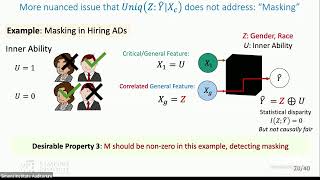
Algorithmic Fairness From The Lens Of Causality And Information Theory
Explore algorithmic fairness through causality and information theory, focusing on identifying and explaining sources of disparity in ML models and quantifying accuracy-fairness trade-offs.
Wasserstein GANs Work Because They Fail - to Approximate the Wasserstein Distance
Explore the counterintuitive success of Wasserstein GANs despite their failure to accurately approximate the Wasserstein distance, offering insights into their effectiveness in generative modeling.