Weighted Min-Cut - Sequential, Cut-Query and Streaming Algorithms
Explore advanced algorithms for solving the weighted min-cut problem across sequential, cut-query, and streaming models, with a focus on a unified schematic approach and open challenges.
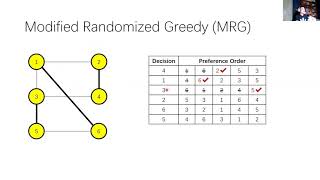
Towards a Better Understanding of Randomized Greedy Matching
Explores randomized greedy matching algorithms, introducing Modified Randomized Greedy (MRG) and analyzing its performance in various graph scenarios, including weighted and oblivious matching.
Quadratic Speedup for Finding Marked Vertices by Quantum Walks
Explore quantum walks for efficient vertex search, offering quadratic speedup over classical methods. Learn about structured search, constraints, and applications in quantum computing.
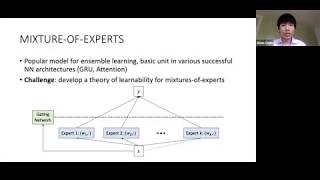
Learning Mixtures of Linear Regressions in Subexponential Time via Fourier Moments
Explore efficient algorithms for learning mixtures of linear regressions using Fourier moments, overcoming previous barriers and achieving subexponential time complexity.
Machine Learning for Beginners - Data Scientists and Analysts
Comprehensive introduction to machine learning for data professionals, covering key concepts, techniques, and practical applications in business contexts, with hands-on coding examples.
Introduction to Causal Graphical Models - Graphs, D-Separation, Do-Calculus
Explore causal graphical models, d-separation, and do-calculus. Learn about graphs, Bayesian networks, and instrumental variables for understanding causality in complex systems.
Optimal Gradient-Based Algorithms for Non-Concave Bandit Optimization
Explore optimal gradient-based algorithms for non-concave bandit optimization, covering stochastic problems, low-rank linear rewards, and high-order polynomials with applications to reinforcement learning.

Optimization Crash Course
Explore geometric methods in optimization and sampling, covering key topics like convexity, optimality, and gradient descent with expert insights from MIT's Ashia Wilson.

Dreamcoder- Bootstrapping Inductive Program Synthesis With Wake-Sleep Library Learning
Explore program induction and library learning in AI, focusing on DreamCoder's approach to synthesizing models and systems through neural-guided Bayesian inference and abstraction refinement.

Hybrid Classical-Quantum Algorithms
Explore hybrid algorithms combining quantum and classical computing for optimization and inference, leveraging strengths of both platforms to solve complex problems efficiently.

What Are the Statistical Limits of Offline Reinforcement Learning With Function Approximation?
Explore statistical limitations in offline reinforcement learning with function approximation, covering realizability, coverage, policy evaluation, and practical considerations.
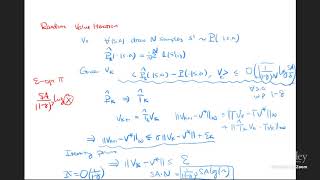
Planning and Markov Decision Processes - Part 2
Explore advanced concepts in reinforcement learning, including generative models, sample complexity, value equations, and linear programming, with experts from leading institutions.
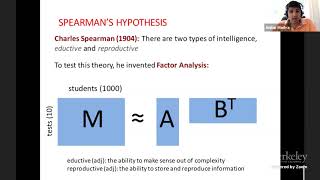
Recent Progress in High-Dimensional Learning
Explore recent advancements in high-dimensional learning, covering factor analysis, phylogenetic reconstruction, and hidden Markov models, with applications in genetics and machine learning.
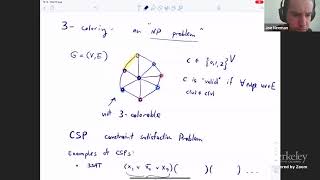
Crash Course on Probabilistically Checkable Proofs - Introduction
Explore probabilistically checkable proofs, including recoloring, constraint satisfaction, and the PCP theorem. Learn about verifier parameters and hardness of approximation in this comprehensive introduction.
Optimal Transport and PDE - Gradient Flows in the Wasserstein Metric
Explore gradient flows in Wasserstein metric, continuity equations, and aggregation dynamics. Learn about two-layer neural networks and chi-squared divergence in optimization and sampling.
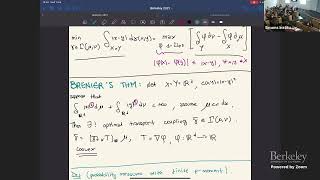
Crash Course on Optimal Transport
Explore optimal transport theory, its applications, and key concepts like cost formulation, optimal coupling, and transport maps in this comprehensive lecture.
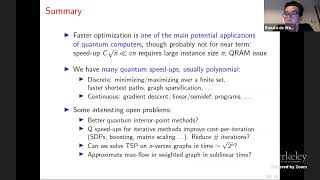
Quantum Algorithms for Optimization - Quantum Colloquium
Explore quantum algorithms for optimization, including discrete and continuous problems, with insights on potential speedups and limitations in quantum computing applications.
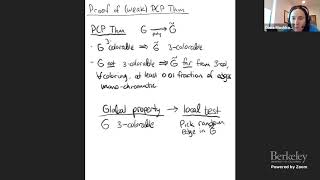
Crash Course on Probabilistically Checkable Proofs - PCP
Explore probabilistically checkable proofs, their formulation, global vs local tests, and computational implications in this comprehensive lecture on advanced theoretical computer science concepts.
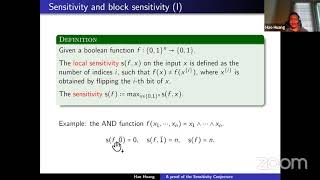
Sensitivity Conjecture and Its Applications
Explore sensitivity in Boolean functions, its relation to other complexity measures, and the recent proof of the long-standing Sensitivity Conjecture, with implications for theoretical computer science.

Berkeley in the 80s - Manuel Blum's Contributions to Computing Theory
Explore Manuel Blum's groundbreaking research, advising philosophy, and insights on complexity theory, number theory, and consciousness in this engaging interview with the Turing Laureate.

Practical Applications of Homomorphic Encryption
Explore practical applications of homomorphic encryption, including ORAM optimization and MNIST inference, with insights on performance and implementation using Microsoft SEAL.